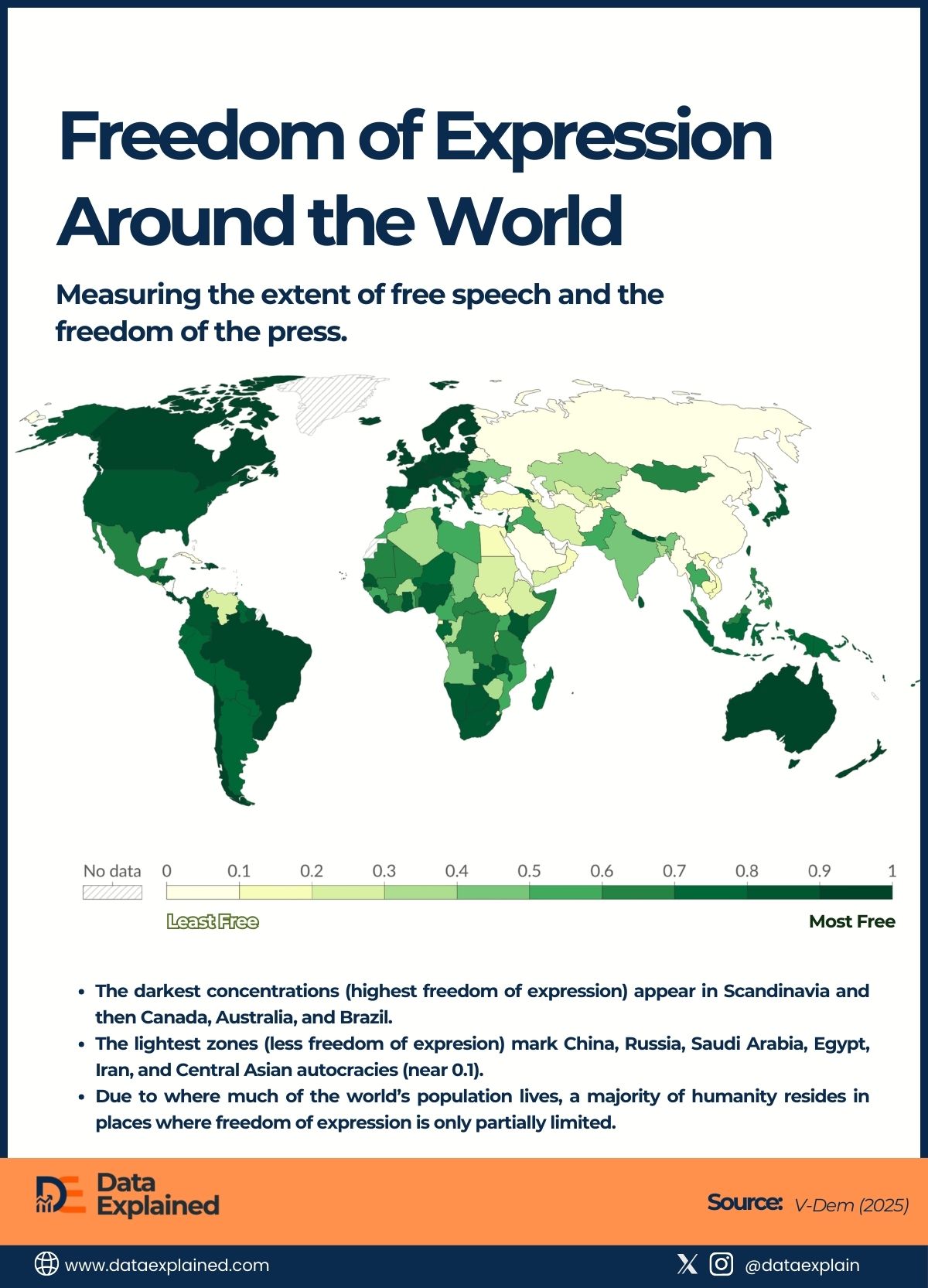
Estimatably 4 to 5 billion people (the majority of humanity) live in countries scoring below 0.4 on the Freedom of Expression Index.
It’s a continuous belt of media repression stretching from Russia through Central Asia and China to the Middle East, where governments severely restrict speech and press.
The visualization above shows the extent of free speech and the freedom of the press across countries of the world.
The index ranges from 0 to 1 (most free).
It comes from Varieties of Democracy (V-Dem), accessed via Our World in Data.
TL;DR
- The darkest concentrations (highest freedom of expression) appear in Scandinavia, then in Canada, Australia, and Brazil.
- The lightest zones (less freedom of expression) mark China, Russia, Saudi Arabia, Egypt, Iran, and Central Asian autocracies (near 0.1).
- Due to where much of the world’s population lives, a majority of humanity resides in places where freedom of expression is only partially limited.
CONTEXT MATTER HERE:
The data ranks based on combined information on:
- Freedom of discussion
- Freedom of academic and cultural expression
- Media censorship
- Media self-censorship
- Media bias
- Harassment of journalists
- Existence of critical and different perspectives in print and broadcast media.
| wdt_ID | wdt_created_by | wdt_created_at | wdt_last_edited_by | wdt_last_edited_at | Country | Freedom of Expression index | Continent |
|---|---|---|---|---|---|---|---|
| 1 | emmanuel-ashemiriogwa | 09/03/2026 02:26 PM | emmanuel-ashemiriogwa | 09/03/2026 02:26 PM | Afghanistan | 0.09 | Asia |
| 2 | emmanuel-ashemiriogwa | 09/03/2026 02:26 PM | emmanuel-ashemiriogwa | 09/03/2026 02:26 PM | Albania | 0.70 | Europe |
| 3 | emmanuel-ashemiriogwa | 09/03/2026 02:26 PM | emmanuel-ashemiriogwa | 09/03/2026 02:26 PM | Algeria | 0.34 | Africa |
| 4 | emmanuel-ashemiriogwa | 09/03/2026 02:26 PM | emmanuel-ashemiriogwa | 09/03/2026 02:26 PM | Angola | 0.49 | Africa |
| 5 | emmanuel-ashemiriogwa | 09/03/2026 02:26 PM | emmanuel-ashemiriogwa | 09/03/2026 02:26 PM | Argentina | 0.76 | South America |
| 6 | emmanuel-ashemiriogwa | 09/03/2026 02:26 PM | emmanuel-ashemiriogwa | 09/03/2026 02:26 PM | Armenia | 0.73 | Asia |
| 7 | emmanuel-ashemiriogwa | 09/03/2026 02:26 PM | emmanuel-ashemiriogwa | 09/03/2026 02:26 PM | Australia | 0.94 | Oceania |
| 8 | emmanuel-ashemiriogwa | 09/03/2026 02:26 PM | emmanuel-ashemiriogwa | 09/03/2026 02:26 PM | Austria | 0.92 | Europe |
| 9 | emmanuel-ashemiriogwa | 09/03/2026 02:26 PM | emmanuel-ashemiriogwa | 09/03/2026 02:26 PM | Azerbaijan | 0.13 | Asia |
| 10 | emmanuel-ashemiriogwa | 09/03/2026 02:26 PM | emmanuel-ashemiriogwa | 09/03/2026 02:26 PM | Bahrain | 0.13 | Asia |
The Three Worlds of Press Freedom
The Freedom of Expression Index shows three zones.
The democratic core is first, including North America, Western Europe, and Oceania, where countries score between 0.7 and 1.0 on the index.
Denmark and Canada sit close to the top, indicating strong protections for open media systems and legal safeguards for speech.
At the other end lies an authoritarian belt going across Russia, China, and parts of the Middle East, where scores often fall between 0.1 and 0.3.
In these countries, media outlets are restricted, and criticism of the government can face legal or political consequences.
Between these extremes is a contested middle, including India, many African states, and parts of Southeast Asia, where scores range from 0.3 to 0.7.
These countries often have elections and some independent media but still face pressure on journalists or uneven enforcement of free speech protections.
Because much of the world’s population lives in the middle, a majority of humanity resides in places where freedom of expression is only partially limited.
Africa Defies Stereotypes
The data shows that Africa is far from uniformly restrictive when it comes to freedom of expression.
Several countries stand out as relatively strong performers, including South Africa,and Senegal, which score between 0.6 and 0.7 on the Freedom of Expression Index.
These countries maintain open media environments, stronger constitutional protections, and more active civil societies than many might expect.
This diversity creates more variation across Africa than in regions like the Middle East, where freedom of expression scores is at much lower levels.
The pattern challenges the long-standing “hopeless continent” narrative, showing clear pockets of democratic progress and media openness visible in the data.
Latin America’s Success Story
The map highlights Latin America as a relative success story for freedom of expression among developing regions.
Countries like Costa Rica and Chile score above 0.8 on the Freedom of Expression Index, placing them in the same high-freedom range as many nations in Western Europe who maintain strong protections for journalism.
The map appears greener than large parts of Asia or Africa, showing stronger speech protections.
This reflects the long-term impact of democratic transitions that began in the late 20th century, when many countries moved from military rule to civilian governments.
The Authoritarian Belt
The map shows a broad “authoritarian belt” stretching from Eastern Europe through Central Asia into East Asia and the Middle East, where freedom of expression scores often fall between 0.1 and 0.3.
Countries like Russia, China, the UAE, and Qatar fall into this low-freedom category, indicating strict government control over media and political discussion.
This zone also overlaps with many resource-rich states, where political systems tend to be more centralized and media independence is limited.
More people live in regions with heavy restrictions on free expression, creating a visible geographic pattern of limited speech freedoms across this belt.
ELI5
Global data shows the world can roughly be divided into three groups when it comes to freedom of expression: a democratic core where free speech is strongly protected, an authoritarian belt where governments control media and political discussion, and a contested middle where speech exists but still faces pressure.
Interestingly, Latin America stands out as a positive exception among developing regions, with several countries maintaining strong press freedoms despite economic challenges.
Countries in the low-freedom category tend to have heavy government control over news, online speech, and political criticism.
Source: