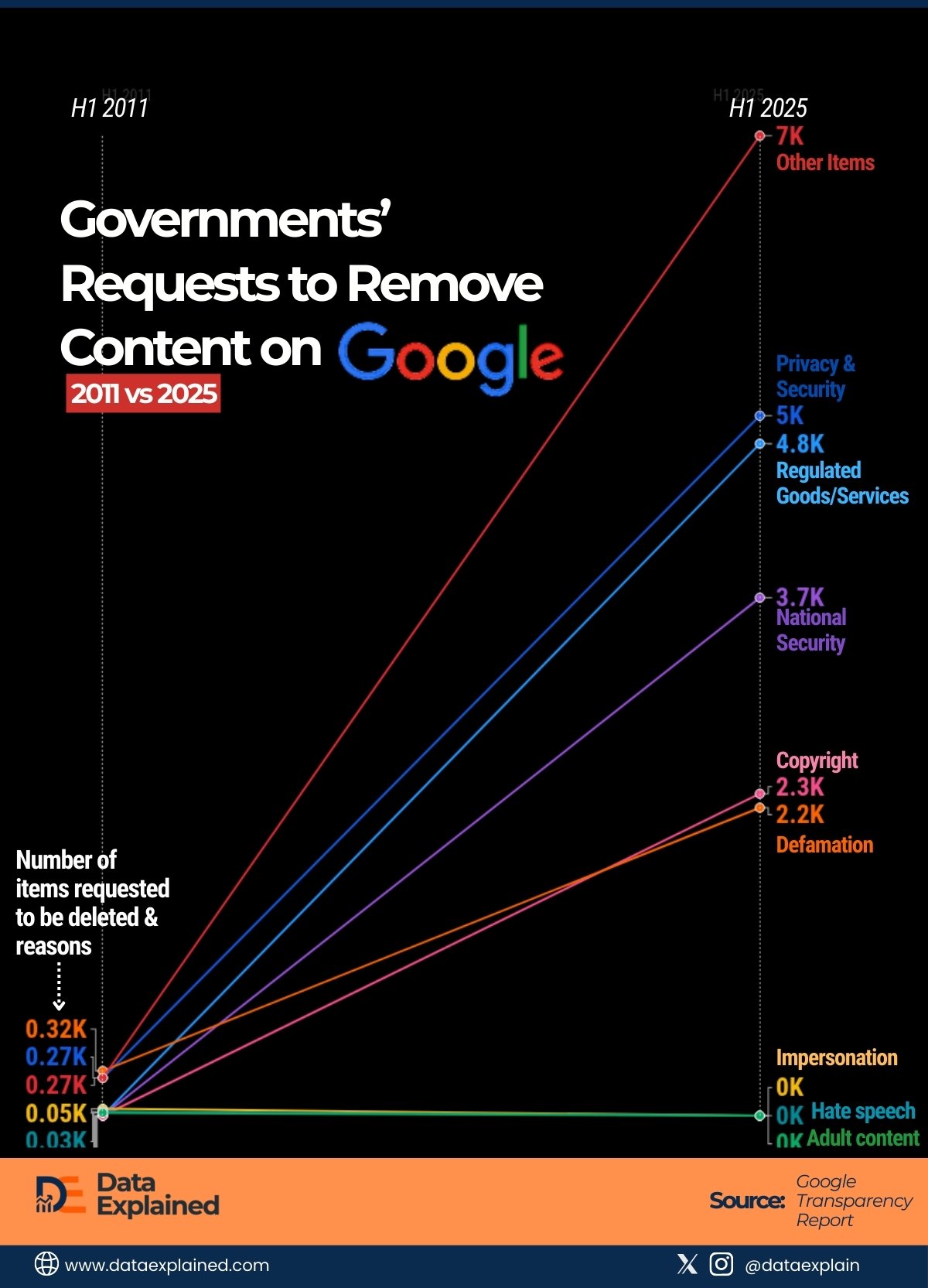
Governments demanded that Google remove approximately 25,000 items from the internet in the first half (H1) of 2025.
This was a 25-fold increase from roughly 1,000 requests in the first half of 2011.
“Privacy and security” was the dominant reason for censorship, accounting for 4,958 last year.
The data was harvested from Google’s Transparency Report.
Based on projections, governments are likely to demand approximately 50,000 content removals from Google in 2026.
TL;DR
- Government removal requests to Google increased from around 1,000 (H1 2011) to 25,000 (H1 2025), a 2,400% rise in 14 years.
- Censorship priorities shifted from defamation (33% in 2011) to national security (26% in 2025)
According to Google, the total removal requests received since 2011 are 551,487, while the total items named for removal within the period are approximately 7 million.
Government Removal Requests by Category (H1 2011 vs H1 2025)
| wdt_ID | wdt_created_by | wdt_created_at | wdt_last_edited_by | wdt_last_edited_at | Reason | Items Delete Request (H1 2011) | Items Delete Request (H1 2025) |
|---|---|---|---|---|---|---|---|
| 1 | emmanuel-ashemiriogwa | 02/03/2026 03:20 PM | emmanuel-ashemiriogwa | 02/03/2026 03:20 PM | Privacy and security | 270 | 5,000 |
| 2 | emmanuel-ashemiriogwa | 02/03/2026 03:20 PM | emmanuel-ashemiriogwa | 02/03/2026 03:20 PM | Regulated goods and services | 0 | 4,800 |
| 3 | emmanuel-ashemiriogwa | 02/03/2026 03:20 PM | emmanuel-ashemiriogwa | 02/03/2026 03:20 PM | National security | 0 | 3,700 |
| 4 | emmanuel-ashemiriogwa | 02/03/2026 03:20 PM | emmanuel-ashemiriogwa | 02/03/2026 03:20 PM | Copyright | 0 | 2,300 |
| 5 | emmanuel-ashemiriogwa | 02/03/2026 03:20 PM | emmanuel-ashemiriogwa | 02/03/2026 03:20 PM | Defamation | 320 | 2,200 |
| 6 | emmanuel-ashemiriogwa | 02/03/2026 03:20 PM | emmanuel-ashemiriogwa | 02/03/2026 03:20 PM | Impersonation | 50 | 0 |
| 7 | emmanuel-ashemiriogwa | 02/03/2026 03:20 PM | emmanuel-ashemiriogwa | 02/03/2026 03:20 PM | Hate speech | 30 | 0 |
| 8 | emmanuel-ashemiriogwa | 02/03/2026 03:20 PM | emmanuel-ashemiriogwa | 02/03/2026 03:20 PM | Adult content | 20 | 0 |
| 9 | emmanuel-ashemiriogwa | 02/03/2026 03:20 PM | emmanuel-ashemiriogwa | 02/03/2026 03:20 PM | All others | 270 | 7,000 |
The 25-Fold Explosion
While documentation of requests began in late 2010, the first full baseline year was 2011.
Since then, what began as a modest level of intervention has evolved into a sustained, systemic pattern of digital control.
2011: The Baseline
In the first half of 2011, governments made roughly 1,000 removal requests to Google.
These requests targeted content across products like Search, YouTube, and Blogger (meaning web pages, videos, blog posts, and indexed materials).
Defamation dominated the period, accounting for roughly one-third of requests, while categories like hate speech, impersonation, and adult content remained relatively small.
The internet, though contested, was still largely reactive. Governments intervened primarily when reputational or clearly unlawful concerns were raised.
2025: Institutionalized Control
By contrast, the first half of 2025 recorded approximately 25,000 removal demands.
Entirely new categories, such as national security and regulated goods, now account for thousands of requests.
Privacy claims surged, copyright enforcement expanded, and defamation (once dominant) now represents a smaller share of a vastly larger system.
Political content and government criticism increasingly fall under broad legal justifications, including copyright and regulatory laws.
“National Security” Emerged From Nothing
In 2011, national security was not even a reporting category in government removal requests to Google.
The framework at the time focused on defamation, privacy, impersonation, and other personal or legal harms. Security, as a formal justification for content removal, simply did not appear in the data.
By 2025, that changed.
Approximately 2,500 removal requests, roughly 10% of the total, were attributed to national security concerns. In just over a decade, a category that did not exist became a central pillar of government censorship activity.
The shift reflects a broader geopolitical transformation.
In the post-Snowden, post-Trump era, digital platforms became battlegrounds for political influence, misinformation, and state stability.
What Disappeared: Hate Speech, Adult Content
As national security rose from nothing to a formal justification for removal, other once-visible categories quietly faded.
In 2011, hate speech and adult content each accounted for roughly 15 requests in the first half of the year.
They were small, but explicitly tracked, reflecting moral and social concerns that shaped early digital regulation.
By 2025, neither category appears to be a major standalone driver of removal demand.
This absence is striking, particularly given the intense public debate over hate speech on social platforms over the past decade.
One might expect moral content regulation to expand, not recede.
Instead, the center of gravity has shifted.
Geographic/Government Breakdown Missing
The aggregate totals show rapid growth in removal requests, but they do not clearly identify which governments are driving that increase.
In the report provided by Google, you’d have to individually go through countries to know the requests made by their government. But there’s no aggregating data in a single presentation.
Without a visible breakdown by country in the headline figures, it is more technical to assess whether the surge is concentrated in a small number of powerful states or broadly distributed across regions.
Distribution fundamentally shapes interpretation.
- If a handful of governments account for most requests, the trend reflects concentrated regulatory pressure.
- If growth is widespread across democratic and authoritarian systems alike, it signals a structural global shift in digital governance.
Some governments are likely extreme outliers, significantly inflating totals.
ELI5
Fourteen years ago, governments only asked Google to remove about 1,000 pieces of content in six months. Now, they ask for about 25,000 in the same period.
The number didn’t just get bigger; the reasons for them changed. Previously, most requests were about people saying harmful things about someone else.
Now, governments are using broader justifications, such as national security, regulations, and copyright, to control what stays online.
Sources