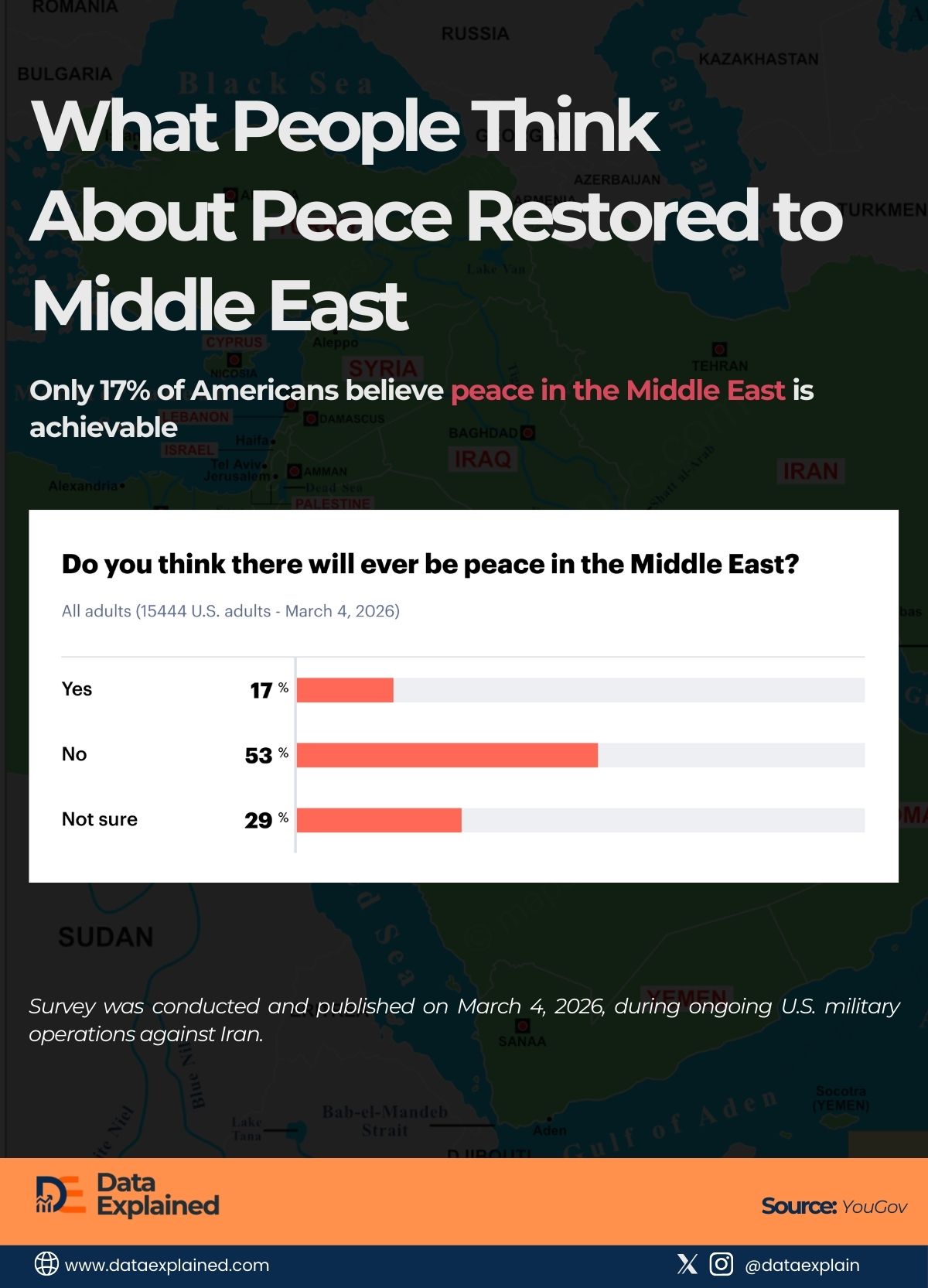
A majority of Americans believe there will never be peace in the Middle East, while just 17% think regional peace is achievable.
This data comes from a YouGov survey of 15,444 adults conducted on March 4, 2026. It coincides with the ongoing military operations against Iran.
The poll reveals profound pessimism about the region where American forces have fought for decades.
TL;DR
- 29% of Americans say they are “not sure” whether peace is possible in the Middle East.
- Democrats are pessimistic about prospects for peace in the Middle East.
| wdt_ID | wdt_created_by | wdt_created_at | wdt_last_edited_by | wdt_last_edited_at | Response Option | All (%) | Democratics | Independents | Republicans |
|---|---|---|---|---|---|---|---|---|---|
| 1 | emmanuel-ashemiriogwa | 08/03/2026 11:32 PM | emmanuel-ashemiriogwa | 23/03/2026 12:53 PM | Yes | 17% | 11% | 14% | 27% |
| 2 | emmanuel-ashemiriogwa | 08/03/2026 11:32 PM | emmanuel-ashemiriogwa | 08/03/2026 11:32 PM | No | 53% | 61% | 53% | 46% |
| 3 | emmanuel-ashemiriogwa | 08/03/2026 11:32 PM | emmanuel-ashemiriogwa | 08/03/2026 11:32 PM | Not Sure | 29% | 28% | 34% | 26% |
Only 17% Believe Peace Possible
A recent survey by YouGov shows that only 17% of Americans believe peace in the Middle East is achievable, a tiny minority compared to the overwhelming share of respondents who express doubt about the region’s future stability.
In contrast, 53% believe peace will never be achieved, while 29% remain uncertain.
Together, 82% of Americans either reject the possibility of peace or are unsure, reflecting widespread pessimism about the region’s long-term prospects.
This skepticism is largely shaped by decades of unsuccessful peace efforts and recurring conflicts.
From the long-running Israeli–Palestinian Conflict to wars in Iraq and Afghanistan, repeated attempts at stabilizing the region have produced limited or temporary results.
For example, the ongoing Yemeni Civil War, which began in 2015 and has drawn international involvement, remains unresolved despite years of diplomatic and military efforts.
Prolonged crises like this reinforce the belief among many Americans that lasting peace in the Middle East may be unattainable.
Trends of wars in the Middle East (1948–Present)
| wdt_ID | wdt_created_by | wdt_created_at | wdt_last_edited_by | wdt_last_edited_at | Year / Period | Major Conflict or Event |
|---|---|---|---|---|---|---|
| 1 | emmanuel-ashemiriogwa | 08/03/2026 11:40 PM | emmanuel-ashemiriogwa | 08/03/2026 11:40 PM | 1948 – Present | Israeli–Palestinian Conflict |
| 2 | emmanuel-ashemiriogwa | 08/03/2026 11:40 PM | emmanuel-ashemiriogwa | 08/03/2026 11:40 PM | 1979 | Iran Revolution and Hostage Crisis |
| 3 | emmanuel-ashemiriogwa | 08/03/2026 11:40 PM | emmanuel-ashemiriogwa | 08/03/2026 11:40 PM | 1980–1988 | Iran–Iraq War |
| 4 | emmanuel-ashemiriogwa | 08/03/2026 11:40 PM | emmanuel-ashemiriogwa | 08/03/2026 11:40 PM | 1990–1991 | Gulf War |
| 5 | emmanuel-ashemiriogwa | 08/03/2026 11:40 PM | emmanuel-ashemiriogwa | 08/03/2026 11:40 PM | 2001 | Afghanistan invasion |
| 6 | emmanuel-ashemiriogwa | 08/03/2026 11:40 PM | emmanuel-ashemiriogwa | 08/03/2026 11:40 PM | 2003 | Iraq War |
| 7 | emmanuel-ashemiriogwa | 08/03/2026 11:40 PM | emmanuel-ashemiriogwa | 08/03/2026 11:40 PM | 2011 | Arab Spring → Libya and Syria chaos |
| 8 | emmanuel-ashemiriogwa | 08/03/2026 11:40 PM | emmanuel-ashemiriogwa | 08/03/2026 11:40 PM | 2014 | ISIS |
| 9 | emmanuel-ashemiriogwa | 08/03/2026 11:40 PM | emmanuel-ashemiriogwa | 08/03/2026 11:40 PM | 2015 – Present | Yemen war |
| 10 | emmanuel-ashemiriogwa | 08/03/2026 11:40 PM | emmanuel-ashemiriogwa | 08/03/2026 11:40 PM | 2023 – Present | Gaza war |
The majority say “Never” While Bombs Fall
Despite the deep pessimism revealed by the YouGov survey, U.S. military involvement in the Middle East continues to intensify.
While only 17% of Americans believe peace is achievable, the United States remains actively engaged in military operations across the region.
This contradiction becomes sharper when considering current events. The United States is presently conducting airstrikes against Iran, deploying bombers, missiles, and advanced drones as part of an expanding military campaign.
These operations involve extensive airpower and advanced weapon systems, reflecting a major escalation in regional conflict.
The financial cost of this campaign is also enormous.
Estimates suggest that the first day of the offensive alone cost roughly $779 million, while analysts estimate daily expenses could approach $900 million per day as the war continues.
This creates a striking paradox. The United States is spending hundreds of millions of dollars daily and conducting military operations in pursuit of regional stability, even as a majority of Americans believe that lasting peace in the Middle East may ultimately be unattainable.
Why Republicans Are “Optimistic”
Republican optimism in the survey is less about genuine belief in diplomacy and more about a different interpretation of how peace can be achieved.
Only 27% of Republicans think peace in the Middle East is possible, yet much of this optimism reflects confidence in military success rather than expectations of negotiated settlements.
For decades, Republican foreign policy has emphasized the doctrine of “peace through strength,” which argues that maintaining overwhelming military power deters adversaries and ultimately promotes stability.
Strong military action is seen as a tool to force compliance or prevent future conflict rather than a contradiction to peace.
Within this framework, ongoing U.S. military campaigns, including actions against Iran, are interpreted not as failures but as necessary steps toward eventual stability.
Supporters of policies associated with Donald Trump often assert that decisive military action demonstrates strength and discourages future threats.
Why Democrats Are Most Pessimistic
On the other hand, 61% of Democrats believe peace will never be achieved, the largest share among the partisan groups, and the most pessimistic.
This skepticism is often linked to perceptions that repeated military interventions have failed to produce long-term stability.
Conflicts such as the Iraq War, the War in Afghanistan, and the aftermath of the Libyan Civil War are frequently cited as examples where intervention did not lead to lasting peace.
ELI5
Americans are watching a very long fight that has been going on for many years. 53% think it will never stop, 17% think it might stop someday and 29% do not know what the outcome will be. In the survey by YouGov. After seeing many wars like the Gulf War, the Iraq War, and the conflicts that followed the Arab Spring, some people feel the situation is too complicated to predict.
Sources:
Al Jazeera | Anadolu Ajansı | Political Dictionary | White House | TASS |