While inflation in other sectors has begun to cool, the world’s “Oils and Meals” market is heading in the opposite direction.
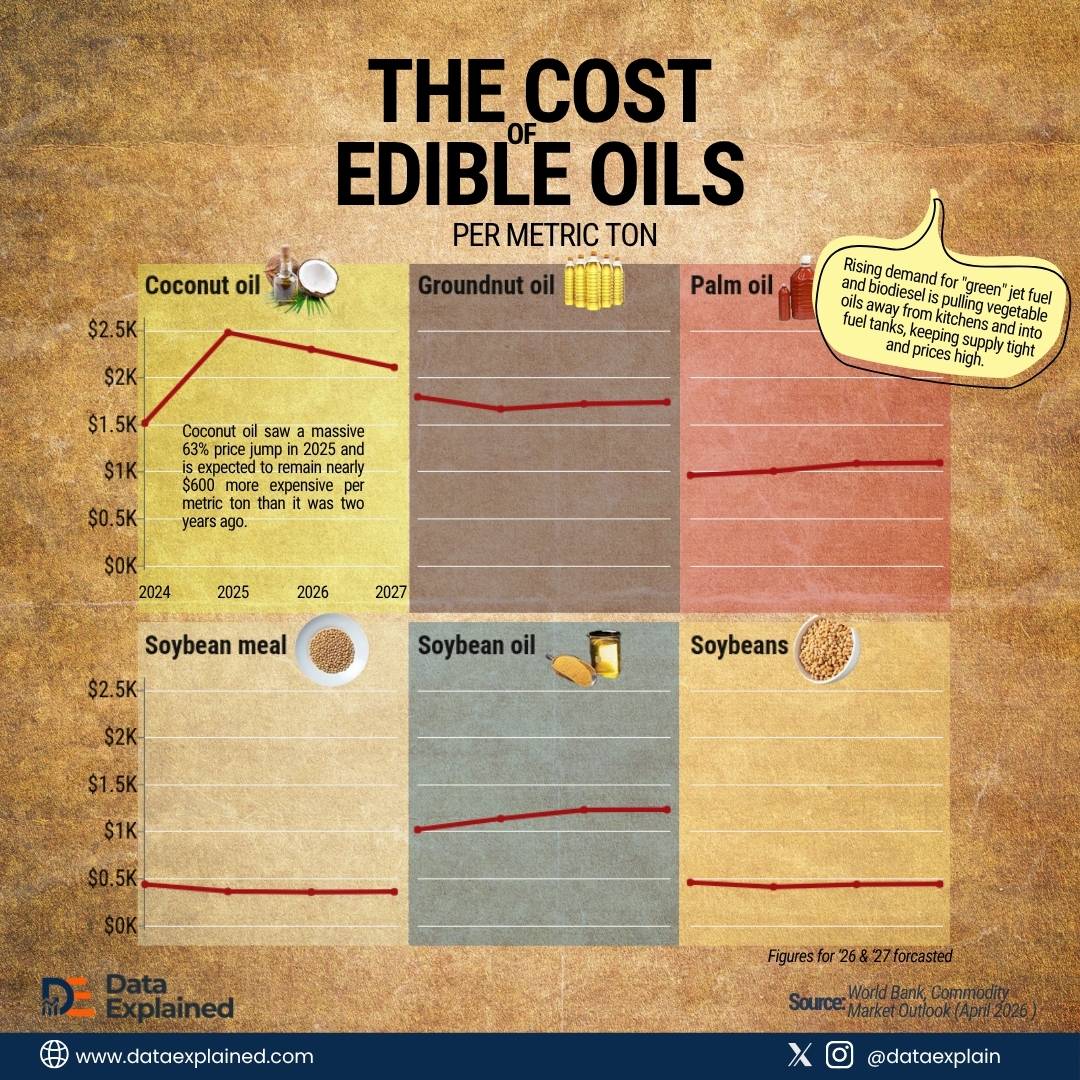
Using the latest data from the World Bank’s April 2026 Commodity Market Outlook, the visualization above shows the projected prices of essential edible oils.
According to newly released nominal price forecasts, the cost of the fats and oils used in everything from chocolate bars and potato chips to laundry detergent and jet fuel is expected to remain stubbornly high through 2027.
TL;DR
- Prices for essential oils like Palm and Soybean oil are forecast to rise steadily through 2027, meaning no relief for consumers at the checkout counter.
- Coconut oil saw a massive 63% price jump in 2025 and is expected to remain nearly $600 more expensive per ton than it was two years ago.
- A growing demand for “green” jet fuel and biodiesel is pulling vegetable oils away from kitchens and into fuel tanks, keeping supply tight and prices high.
| wdt_ID | wdt_created_by | wdt_created_at | wdt_last_edited_by | wdt_last_edited_at | Oils and Meals | 2024 ($/mt) | 2025 ($/mt) | 2026f ($/mt) | 2027f ($/mt) |
|---|---|---|---|---|---|---|---|---|---|
| 1 | emmanuel-ashemiriogwa | 05/05/2026 12:43 PM | emmanuel-ashemiriogwa | 05/05/2026 12:43 PM | Coconut oil | 1,519.0 | 2,480.0 | 2,301.0 | 2,111.0 |
| 2 | emmanuel-ashemiriogwa | 05/05/2026 12:43 PM | emmanuel-ashemiriogwa | 05/05/2026 12:43 PM | Groundnut oil | 1,796.0 | 1,666.0 | 1,722.0 | 1,740.0 |
| 3 | emmanuel-ashemiriogwa | 05/05/2026 12:43 PM | emmanuel-ashemiriogwa | 05/05/2026 12:43 PM | Palm oil | 963.0 | 1,007.0 | 1,089.0 | 1,096.0 |
| 4 | emmanuel-ashemiriogwa | 05/05/2026 12:43 PM | emmanuel-ashemiriogwa | 05/05/2026 12:43 PM | Soybean meal | 442.0 | 366.0 | 359.0 | 363.0 |
| 5 | emmanuel-ashemiriogwa | 05/05/2026 12:43 PM | emmanuel-ashemiriogwa | 05/05/2026 12:43 PM | Soybean oil | 1,022.0 | 1,140.0 | 1,233.0 | 1,236.0 |
| 6 | emmanuel-ashemiriogwa | 05/05/2026 12:43 PM | emmanuel-ashemiriogwa | 05/05/2026 12:43 PM | Soybeans | 462.0 | 414.0 | 441.0 | 446.0 |
A Great Coconut Spike
The most jarring figure in the World Bank’s dataset is the price of Coconut oil.
In 2024, a metric ton cost $1,519. By 2025, that price had risen by roughly 63% to $2,480.
While the forecast for 2026 and 2027 shows a slight cooling (dropping to $2,111 by 2027), the “new normal” for coconut oil is significantly higher than it was just 24 months ago.
Market analysts point to a “climate premium” as the culprit.
Extreme weather patterns in Southeast Asia (the world’s primary coconut-producing region) have hammered yields.
Because coconut trees take years to mature and recover from storms or droughts, the supply cannot simply be “turned back on,” leading to the long-term price elevation seen in the data.
“Soy Split” and the Green Fuel Factor
While the price of raw Soybeans and Soybean meal (primarily used for animal feed) is actually expected to drop by 2027, Soybean oil is on a tear.
In 2024, Soybean oil was priced at $1,022 per metric ton. The World Bank projects this will climb to $1,236 by 2027.
Why the difference?
The answer lies in the energy transition.
Around the world, governments are mandating a shift toward Sustainable Aviation Fuel (SAF) and renewable diesel.
Because soybean oil is a primary “feedstock” for these fuels, the energy sector is now competing directly with the food sector.
Essentially, we are increasingly choosing to fly planes and drive trucks with the same oils we use to fry food.
As long as “green fuel” mandates remain in place, the floor for soybean oil prices will likely remain high.
Palm Oil Breaks the Ceiling
Palm oil, the most widely consumed edible oil on the planet, is also showing a steady upward march.
After hovering below the $1,000 mark in 2024 ($963/mt), it broke through that psychological barrier in 2025 and is forecast to hit nearly $1,100 by 2027.
When palm oil prices rise and stay high, large food manufacturers typically pass those costs on to shoppers rather than shrinking their own profit margins.
For the next two years, the cost of keeping the world’s kitchens (and engines) running will only get more expensive.
ELI5
The World Bank says cooking oil prices are staying high for two main reasons. First, bad weather damaged coconut and palm trees, so there is less oil to go around. Second, we are now using those same oils to make “green” fuel for airplanes and trucks. Because demand is higher and supply is lower, the price you pay at the store stays high.
Sources:
World Bank Commodity Market Outlook