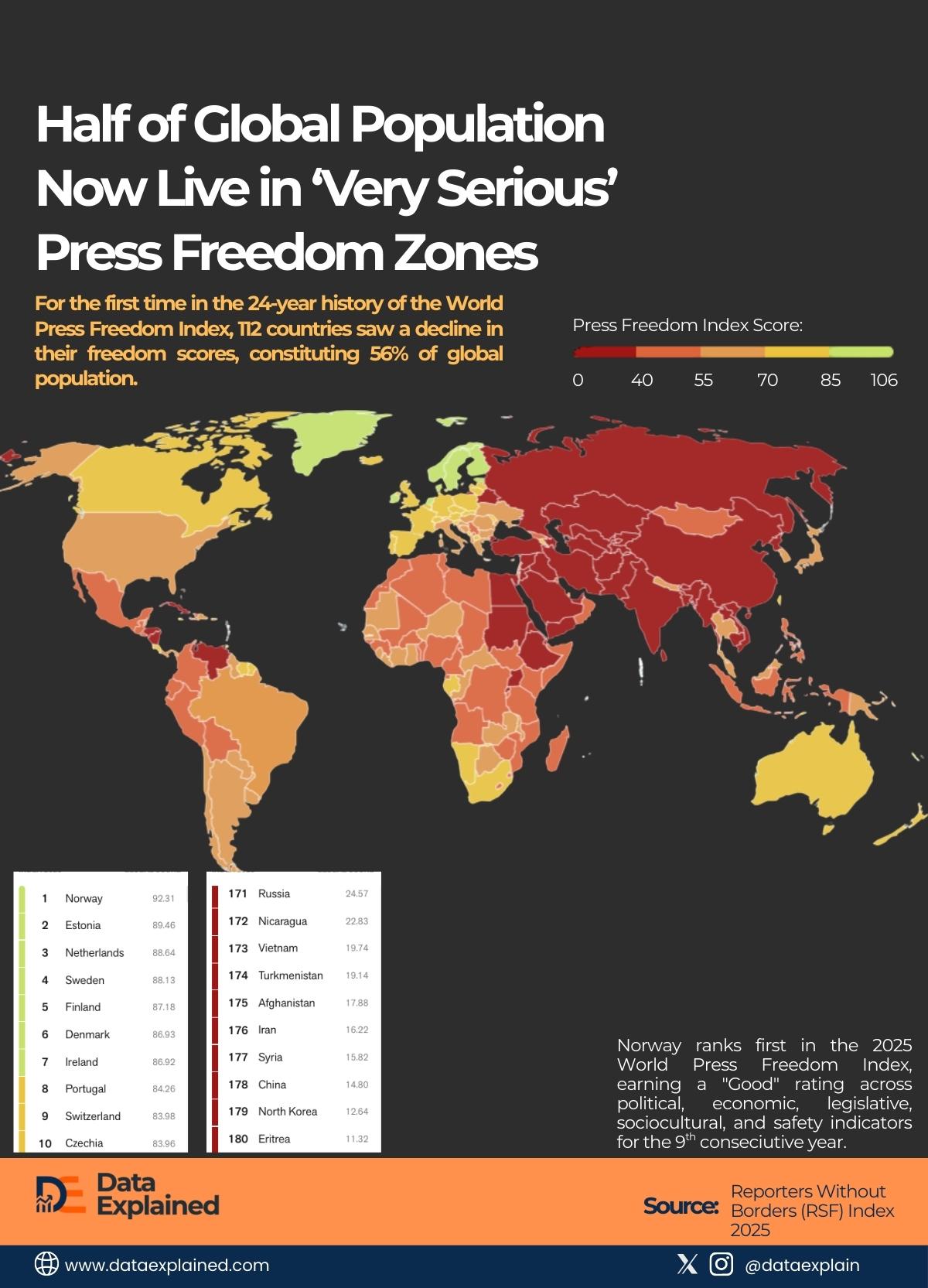
For the first time in the 24-year history of the World Press Freedom Index, global conditions for journalists have worsened.
It’s a shock that 56% of the world’s population now lives in countries where press freedom faces “very serious” threats.
The most recent data from Reporters Without Borders (RSF) shows that while physical assaults on journalists remain a serious concern, there is a growing problem of “economic strangulation.”
This systemic issue is undermining independent media in 180 countries, and this visualization highlights the countries most affected.
TL;DR
- Global press freedom has reached its lowest point in history, now rated as “difficult” overall, with about 56% of the world’s population living in countries where journalism is threatened by violence and economic pressure.
- Hong Kong exemplifies this global decline, ranking 140th with a score of 39.86/
| wdt_ID | wdt_created_by | wdt_created_at | wdt_last_edited_by | wdt_last_edited_at | Rank | Country | Press Freedom Score |
|---|---|---|---|---|---|---|---|
| 1 | emmanuel-ashemiriogwa | 14/02/2026 10:16 AM | emmanuel-ashemiriogwa | 14/02/2026 10:16 AM | 180 | Eritrea | 11.32 |
| 2 | emmanuel-ashemiriogwa | 14/02/2026 10:16 AM | emmanuel-ashemiriogwa | 14/02/2026 10:16 AM | 179 | North Korea | 12.64 |
| 3 | emmanuel-ashemiriogwa | 14/02/2026 10:16 AM | emmanuel-ashemiriogwa | 14/02/2026 10:16 AM | 178 | China | 14.80 |
| 4 | emmanuel-ashemiriogwa | 14/02/2026 10:16 AM | emmanuel-ashemiriogwa | 14/02/2026 10:16 AM | 177 | Syria | 15.82 |
| 5 | emmanuel-ashemiriogwa | 14/02/2026 10:16 AM | emmanuel-ashemiriogwa | 14/02/2026 10:16 AM | 176 | Iran | 16.22 |
| 6 | emmanuel-ashemiriogwa | 14/02/2026 10:16 AM | emmanuel-ashemiriogwa | 14/02/2026 10:16 AM | 175 | Afghanistan | 17.88 |
| 7 | emmanuel-ashemiriogwa | 14/02/2026 10:16 AM | emmanuel-ashemiriogwa | 14/02/2026 10:16 AM | 174 | Turkmenistan | 19.14 |
| 8 | emmanuel-ashemiriogwa | 14/02/2026 10:16 AM | emmanuel-ashemiriogwa | 14/02/2026 10:16 AM | 173 | Vietnam | 19.74 |
| 9 | emmanuel-ashemiriogwa | 14/02/2026 10:16 AM | emmanuel-ashemiriogwa | 14/02/2026 10:16 AM | 172 | Nicaragua | 22.83 |
| 10 | emmanuel-ashemiriogwa | 14/02/2026 10:16 AM | emmanuel-ashemiriogwa | 14/02/2026 10:16 AM | 171 | Russia | 24.57 |
Majority in the Dark
A total of 112 countries saw a decline in their freedom scores.
According to the 2025 World Press Freedom Index, more than 56% of the world’s population lives in countries where press freedom is rated “very serious.”
This indicates a notable deterioration in global media conditions.
This “very serious” situation affects approximately 4.5 billion people across 42 countries, including densely populated nations such as China, India, and Russia.
The red zone includes countries with scores below 40, reflecting systemic challenges to independent journalism.
While these regions face the harshest restrictions on journalistic activities, declining global averages underscore the range of threats and worsening trends in media freedom.
These threats faced by journalists have shifted from physical violence to economic suppression, increasing the crisis for media workers and outlets.
The Situation in Hong Kong
In the 2025 World Press Freedom Index, Hong Kong is ranked 140th out of 180 countries, with a score of 39.86.
This is a five-place decline from 2024.
The decline is largely attributable to tighter controls under China’s National Security Law.
These measures have curtailed independent journalism and led to arrests of media figures. Hong Kong’s political score of 27.40 indicates government interference, while its security score of 43.71 highlights the risks journalists face.
A notable example is the recent 20-year prison sentence for media owner Jimmy Lai, convicted of colluding with foreign forces.
Lai is the founder of the pro-democracy Apple Daily. He was prosecuted for meetings with U.S. officials during the 2019 protests.
His case has drawn international criticism as a symbol of the crackdown on free speech.
The BBC reports that Lai’s sentencing is the harshest under the National Security Law.
The Top 1%: Nordic Exception
Norway ranks first in the 2025 World Press Freedom Index, earning a “Good” rating across political, economic, legislative, sociocultural, and safety indicators.
And, it’s now for the ninth consecutive year.
This consistent performance underscores Norway’s stable media environment amid global declines in press freedom.
Well, according to the Australian Institute, its success is the direct opposite of weakening protections elsewhere, supported by subsidies and strong democratic principles.
Nordicom reports that Norway’s direct press subsidies amount to approximately 42 million euros annually.
It’s mainly in the form of production grants to support diverse outlets and independence.
Using revenue from the sovereign wealth fund, Norway funds nearly all news operations while preserving editorial independence.
- In Denmark, approximately EUR 52 million per year is allocated to subsidies that cover up to 35% of production costs for both paid and free media, thereby encouraging innovation.
- Sweden allocates EUR 102 million for press and media support, including operational assistance and funding for local journalism to help vulnerable outlets.
- Finland’s direct subsidies of EUR 500,000 focus on minority language news, complemented by public trust and VAT relief.
- Ireland is developing its support system with €5.7 million in grants for local reporting and court journalism, alongside license fee contributions to RTÉ, the national broadcaster.
ELI5: Press Freedom Index
Currently, global press freedom is at its worst ever, with about 56% of people living in countries where journalists face threats of violence and economic pressure.
On the other hand, Nordic countries such as Norway, Ireland, and Denmark score highly because they provide strong support for the free press, including annual press subsidy allocations.
Sources:
Reporters Without Borders, BBC, Australian Institute, Nordicom