The front line of financial crime has moved from inbox to your newsfeed.
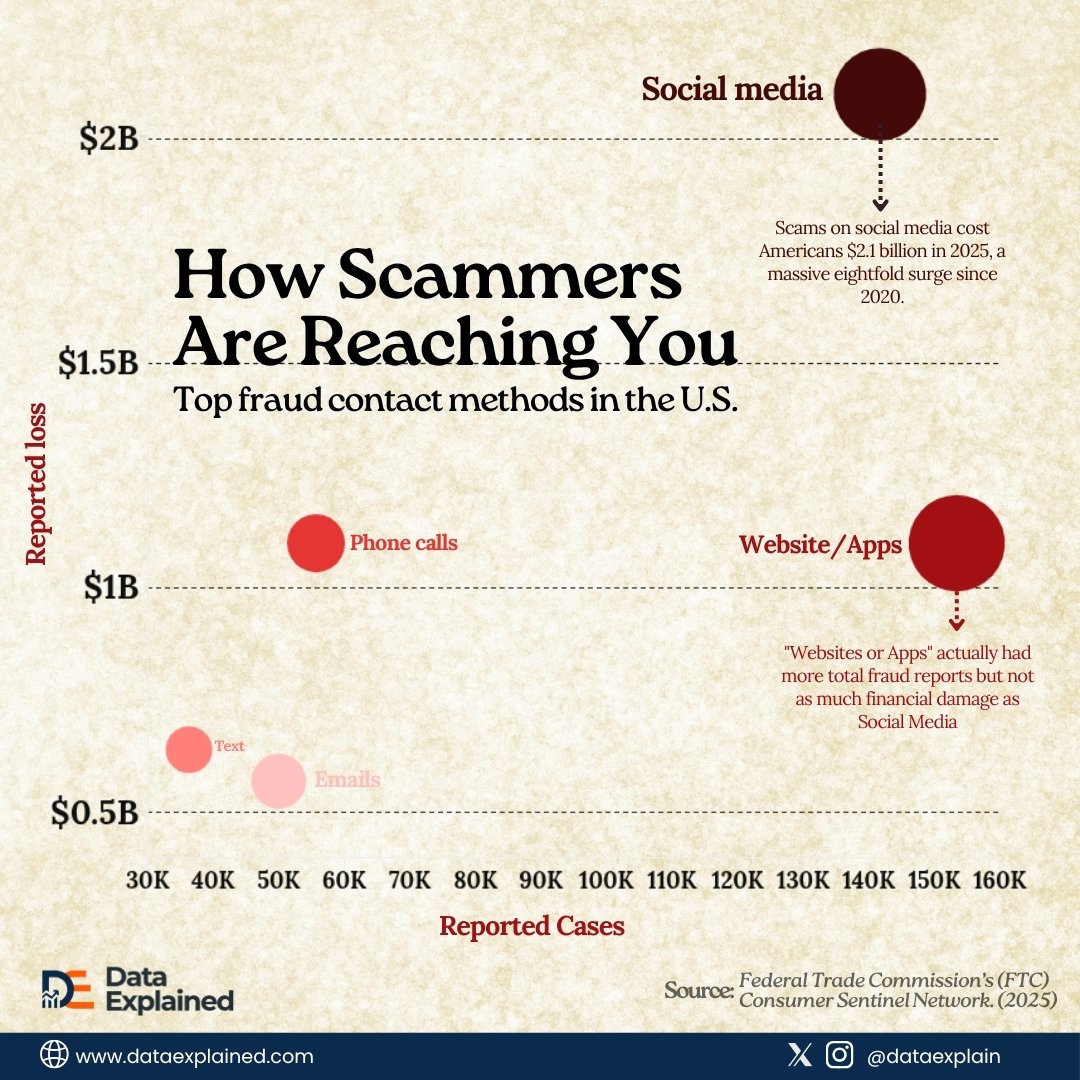
In 2025, social media scams in the U.S. reached a staggering $2.1 billion in reported losses, a figure that has grown eightfold since 2020.
The visualization above shows the top fraud contact methods ranked by the number of reported cases in America.
It is based on the latest data from the Federal Trade Commission’s (FTC) Consumer Sentinel Network.
TL;DR
- Scams on social media cost Americans $2.1 billion in 2025, a massive eightfold surge since 2020.
- Facebook is the single most dangerous platform for fraud, accounting for $794 million in losses and surpassing the financial damage from both email and text-based scams.
| wdt_ID | wdt_created_by | wdt_created_at | wdt_last_edited_by | wdt_last_edited_at | Platform | Money lost to Scams ($bn) | Reported Cases |
|---|---|---|---|---|---|---|---|
| 1 | emmanuel-ashemiriogwa | 06/05/2026 08:23 AM | emmanuel-ashemiriogwa | 06/05/2026 08:23 AM | Social Media | 2.10 | 141,706.0 |
| 2 | emmanuel-ashemiriogwa | 06/05/2026 08:23 AM | emmanuel-ashemiriogwa | 06/05/2026 08:23 AM | Website or Apps | 1.10 | 153,424.0 |
| 3 | emmanuel-ashemiriogwa | 06/05/2026 08:23 AM | emmanuel-ashemiriogwa | 06/05/2026 08:23 AM | Phone calls | 1.10 | 55,698.0 |
| 4 | emmanuel-ashemiriogwa | 06/05/2026 08:23 AM | emmanuel-ashemiriogwa | 06/05/2026 08:23 AM | Text | 0.64 | 36,318.0 |
| 5 | emmanuel-ashemiriogwa | 06/05/2026 08:23 AM | emmanuel-ashemiriogwa | 06/05/2026 08:23 AM | Emails | 0.57 | 50,012.0 |
The Meta Dominance
The most jarring takeaway from the FTC’s 2025 report is the dominance of Meta-owned platforms.
Together, Facebook, WhatsApp, and Instagram accounted for over $1.45 billion in fraud losses.
Facebook leads this grim pack with $794 million in stolen funds.
To put that in perspective, the total amount lost to Facebook scams alone is now higher than all reported losses from email fraud ($569 million) and text-based “smishing” ($639 million).
WhatsApp also emerged as a major player in the fraud economy, with $425 million in losses.
Experts suggest that while the initial “hook” of a scam often happens on a public Facebook or Instagram post, criminals quickly move victims to the encrypted environment of WhatsApp to “close the deal,” away from the prying eyes of platform moderators.
A More “Efficient” Criminal Enterprise
One of the oddest insights in the dataset involves the relationship between the number of reports and the total money lost.
According to the FTC figures, “Websites or Apps” actually had more total fraud reports (153,424) than social media (141,706).
However, social media scams resulted in nearly double the financial damage ($2.1 billion compared to $1.1 billion for websites).
This suggests that social media fraud is significantly more “efficient.”
Because scammers can view your personal profile, interests, and friend lists, they can craft highly personalized “social engineering” attacks.
Modern Scam Toolkit
Why the sudden surge?
Criminals are increasingly using AI-generated deepfakes to impersonate celebrities or trusted figures in Facebook ads.
Furthermore, the rise of “pig butchering” scams (long-term investment frauds that build trust over weeks) has found a home in social media DMs and WhatsApp groups.
Traditional contact methods, like phone calls still result in high losses ($1.1 billion), but they lack the visual trust and viral reach of social media.
ELI5
Bad guys have moved from sending junk emails to hanging out on Facebook and WhatsApp. Because they can see your profile, they make fake stories that look real to you. The data shows people now lose way more money on social media (over $2 billion) than they do to old-school emails or phone calls.
Source: