
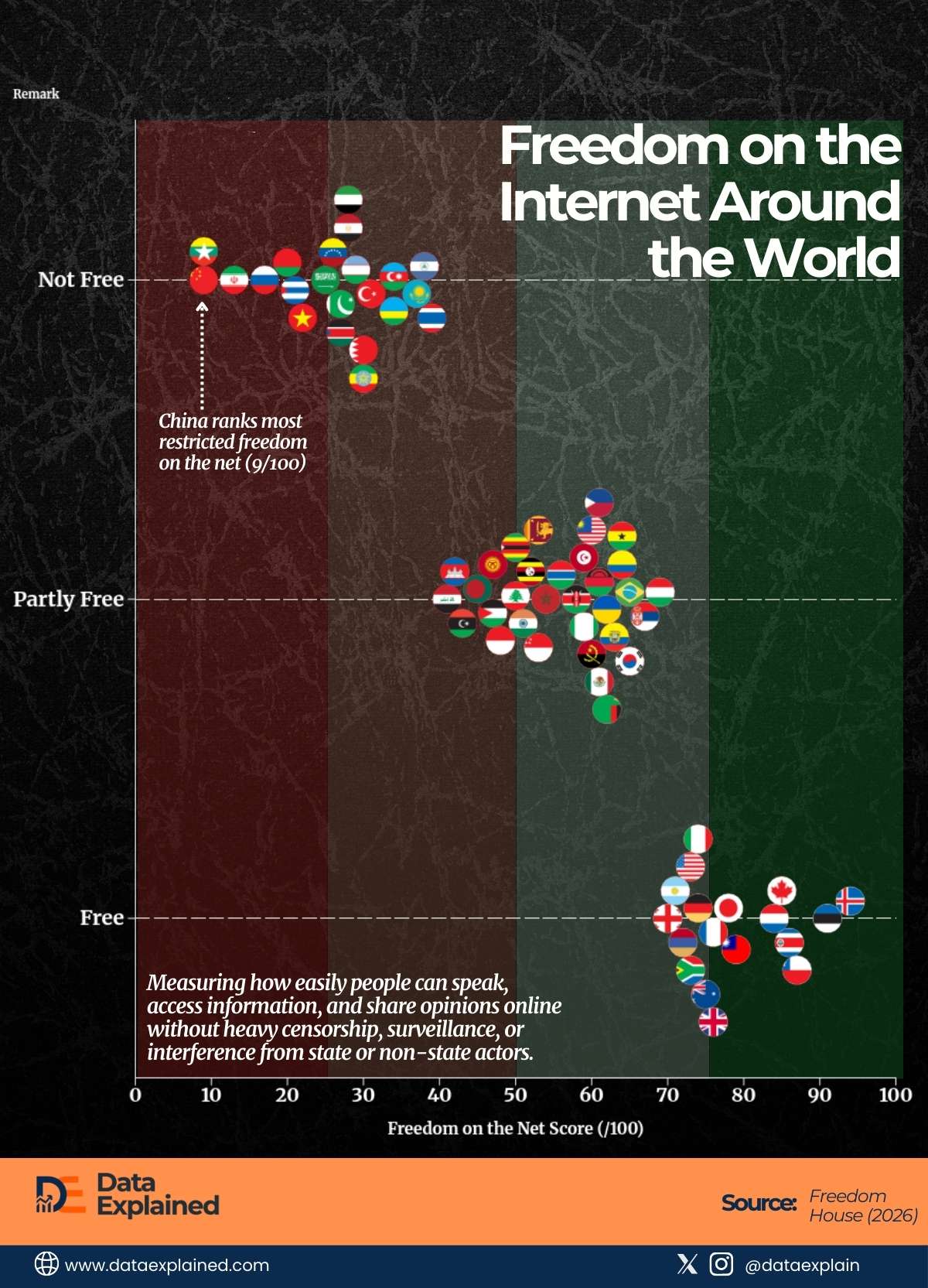
The Internet Freedom Index measures how easily people can speak, access information, and share opinions online without heavy censorship, surveillance, or interference from state or non-state actors.
Currently, it’s worse in specific Asian countries such as China and Myanmar.
The data for this explainer comes from Freedom House.
Its “Freedom on the Net” tracks political and civil liberties in 208 countries, measuring internet freedom through classifications of Free, Partly Free, or Not Free.
TL;DR
- China and Myanmar are the most restricted, scoring 9/100 with no improvement from last year.
- South Korea is partly free at 65 and on a downward trend.
- India shows an upward climb at 51, indicating a recent improvement in digital rights.
Ranked: Countries by Internet Freedom Scores
| wdt_ID | wdt_created_by | wdt_created_at | wdt_last_edited_by | wdt_last_edited_at | Country or Territory | Freedom on the Net Score (/100) | Remark |
|---|---|---|---|---|---|---|---|
| 1 | emmanuel-ashemiriogwa | 14/03/2026 03:10 PM | emmanuel-ashemiriogwa | 14/03/2026 03:10 PM | China | 9 | Not Free |
| 2 | emmanuel-ashemiriogwa | 14/03/2026 03:10 PM | emmanuel-ashemiriogwa | 14/03/2026 03:10 PM | Myanmar | 9 | Not Free |
| 3 | emmanuel-ashemiriogwa | 14/03/2026 03:10 PM | emmanuel-ashemiriogwa | 14/03/2026 03:10 PM | Iran | 13 | Not Free |
| 4 | emmanuel-ashemiriogwa | 14/03/2026 03:10 PM | emmanuel-ashemiriogwa | 14/03/2026 03:10 PM | Russia | 17 | Not Free |
| 5 | emmanuel-ashemiriogwa | 14/03/2026 03:10 PM | emmanuel-ashemiriogwa | 14/03/2026 03:10 PM | Belarus | 20 | Not Free |
| 6 | emmanuel-ashemiriogwa | 14/03/2026 03:10 PM | emmanuel-ashemiriogwa | 14/03/2026 03:10 PM | Cuba | 21 | Not Free |
| 7 | emmanuel-ashemiriogwa | 14/03/2026 03:10 PM | emmanuel-ashemiriogwa | 14/03/2026 03:10 PM | Vietnam | 22 | Not Free |
| 8 | emmanuel-ashemiriogwa | 14/03/2026 03:10 PM | emmanuel-ashemiriogwa | 14/03/2026 03:10 PM | Saudi Arabia | 25 | Not Free |
| 9 | emmanuel-ashemiriogwa | 14/03/2026 03:10 PM | emmanuel-ashemiriogwa | 14/03/2026 03:10 PM | Venezuela | 26 | Not Free |
| 10 | emmanuel-ashemiriogwa | 14/03/2026 03:10 PM | emmanuel-ashemiriogwa | 14/03/2026 03:10 PM | Pakistan | 27 | Not Free |
“Democratic Decline” in the West
Even in Western democracies, freedom on the internet is not guaranteed.
The United States (73) and the United Kingdom (76) remain classified as Free, yet both recorded declines from the previous year.
This means that while citizens can still speak, vote, or express themselves online, certain protections are weakening.
Compared with countries like Costa Rica (86) and Estonia (91), which are smaller or less historically dominant democracies, the decline in the U.S. and the UK becomes more striking.
That these traditionally leading nations now score lower signals a gradual erosion of democratic standards.
Irony in South Korea
Aside from the United States and the United Kingdom, South Korea is another highly advanced nation, leading the world in technology and digital infrastructure.
Yet, despite its rapid innovation and global tech influence, it is classified as Partly Free with a score of 65.
This indicates that even in technologically sophisticated countries, digital freedoms are not guaranteed.
South Korea’s score reflects the limits on how citizens can use technology. While the country offers fast internet, popular platforms, and cutting-edge devices, government regulations and surveillance can restrict online expression.
Political considerations, including content monitoring and legal controls over digital platforms, shape what people can post or access.
Even with excellent technological resources, these policies curtail full digital liberty, preventing citizens from freely using technology for civic engagement or personal expression.
India’s Upward Climb
Moving from South Korea’s downward trend, India presents a contrasting story.
As a major global power and digital hub, India is classified as Partly Free with a score of 51. Unlike South Korea, India shows an upward arrow, signaling a recent improvement in internet freedom compared to the previous year.
This upward trend reflects tangible gains in digital rights.
It may indicate fewer internet shutdowns, improved access to online platforms, or stronger protections for online expression.
Citizens can increasingly use digital tools to communicate, share opinions, and participate in civic discussions with fewer interruptions or restrictions.
While India is still Partly Free, the progress is significant.
It shows that targeted reforms or better enforcement of digital rights can improve online freedoms even in large, complex democracies.
The Floor of the World
At the opposite end of the spectrum, China and Myanmar share the grim title of having the world’s most restricted internet, each scoring just 9 out of 100.
Their scores have remained unchanged from the previous year, reflecting a consistently tight grip on digital spaces.
This extreme limitation places both countries firmly in the “Not Free” category.
In China, the low score reflects widespread censorship, monitoring of online activity, and strict control over news and social media platforms.
Citizens face restrictions on political discussion, content deemed sensitive, and even private digital channels can be surveilled.
Similarly, Myanmar enforces tight internet restrictions, with government oversight limiting access to independent reporting and social platforms, often under the justification of national security or political control.
ELI5
From the latest Freedom House report on internet freedom, countries are grouped as Free, Partly Free, or Not Free. China and Myanmar rank the lowest at 9/100. South Korea, despite being a tech leader, scores 65 and is declining. India shows improvement at 51. The US and UK remain free but are slipping.
Sources