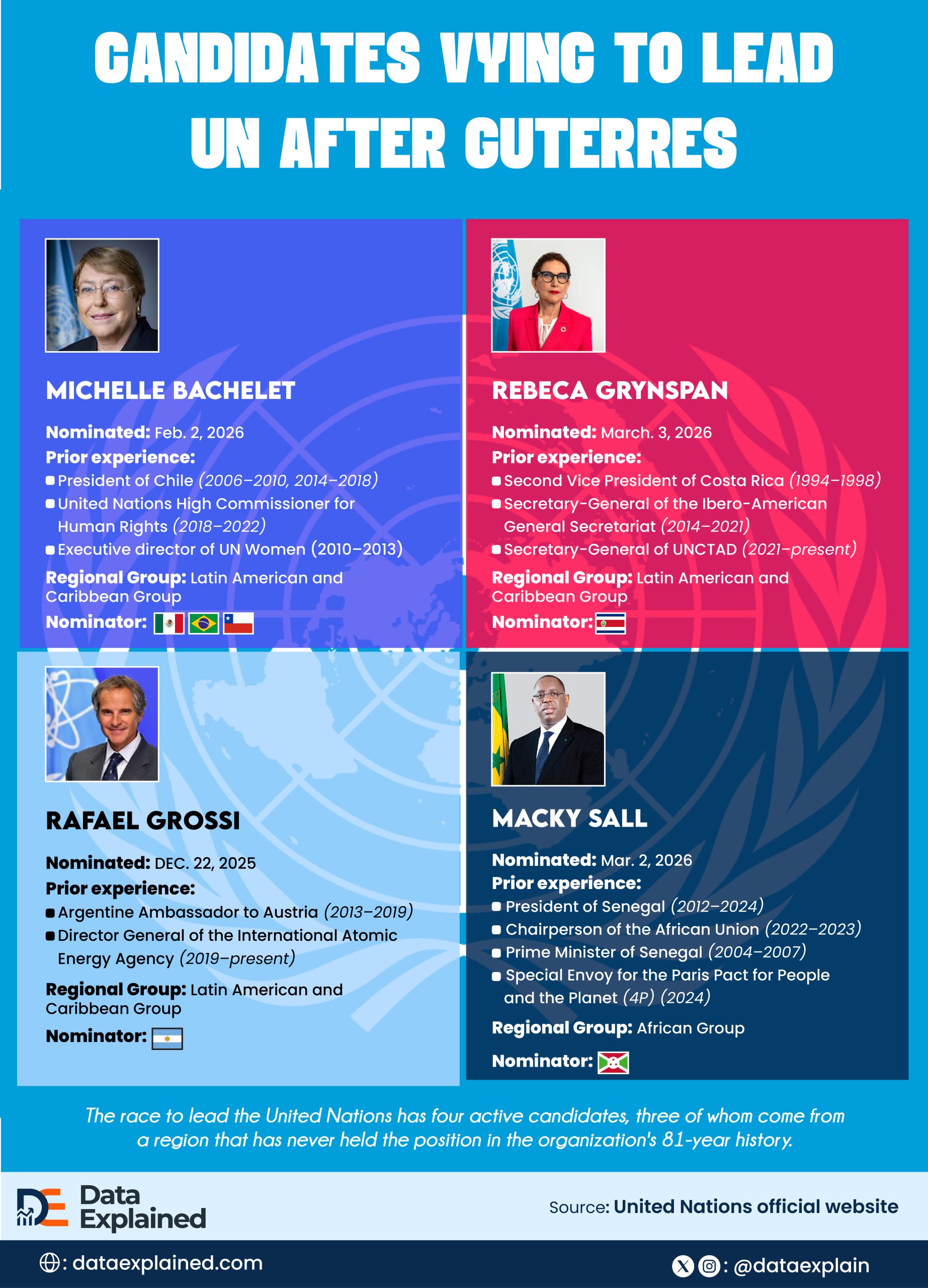
The race to lead the United Nations has four active candidates, three of whom come from a region that has never held the position in the organization’s 81-year history.
The selection process to find a successor to António Guterres, whose term ends on December 31, 2026.
Five candidates were nominated. One subsequently withdrew. Four remain, and the field they represent tells a specific story about regional ambition.
TL;DR
- Three of the four remaining candidates come from the Latin American and Caribbean Group.
- The world’s most consequential diplomatic job is awarded by a committee of five to a candidate whom none of them put forward.
The data for these candidate profiles comes directly from the United Nations Selection and Appointment page.
| wdt_ID | wdt_created_by | wdt_created_at | wdt_last_edited_by | wdt_last_edited_at | Candidate | Nominator | Nominated | Regional Group | Prior experience |
|---|---|---|---|---|---|---|---|---|---|
| 1 | emmanuel-ashemiriogwa | 25/04/2026 06:06 PM | emmanuel-ashemiriogwa | 25/04/2026 06:06 PM | Michelle Bachelet | Brazil, Mexico, Chile | 02/02/2026 | Latin American and Caribbean Group | President of Chile (2006–2010, 2014–2018) United Nations High Commissioner for Human Rights (2018–2022) Executive director of UN Women (2010–2013) |
| 2 | emmanuel-ashemiriogwa | 25/04/2026 06:06 PM | emmanuel-ashemiriogwa | 25/04/2026 06:06 PM | Rafael Grossi | Argentina | 22/12/2025 | Latin American and Caribbean Group | Argentine Ambassador to Austria (2013–2019) Director General of the International Atomic Energy Agency (2019–present) |
| 3 | emmanuel-ashemiriogwa | 25/04/2026 06:06 PM | emmanuel-ashemiriogwa | 25/04/2026 06:06 PM | Rebeca Grynspan | Costa Rica | 03/03/2026 | Latin American and Caribbean Group | Second Vice President of Costa Rica (1994–1998) Secretary-General of the Ibero-American General Secretariat (2014–2021) Secretary-General of UNCTAD (2021–present) |
| 4 | emmanuel-ashemiriogwa | 25/04/2026 06:06 PM | emmanuel-ashemiriogwa | 25/04/2026 06:06 PM | Macky Sall | Burundi | 02/03/2026 | African Group | President of Senegal (2012–2024) Chairperson of the African Union (2022–2023) Prime Minister of Senegal (2004–2007) Special Envoy for the Paris Pact for People and the Planet (4P) (2024) |
The Latin American Pile-Up
Three of the four remaining candidates come from the Latin American and Caribbean Group.
Michelle Bachelet, nominated jointly by Brazil, Mexico, and Chile on February 2, 2026, is the field’s most prominent figure.
- She served as President of Chile twice (from 2006 to 2010 and again from 2014 to 2018) and subsequently led two major UN bodies.
- She is the only candidate in the field with both head-of-state experience and senior leadership at a UN agency on her record.
- She is also the only candidate nominated by more than one country (Brazil and Mexico).
Africa’s Unified Position
Macky Sall is the only non-LACG candidate.
Nominated by Burundi on March 2, 2026 (notably not by Senegal, the country he led for 12 years), Sall represents the African Group, which, with 54 member states, is the largest regional bloc in the UN system.
He served as President of Senegal from 2012 to 2024, as Chairperson of the African Union from 2022 to 2023, and as Prime Minister of Senegal from 2004 to 2007.
He also serves as Special Envoy for the Paris Climate Agreement.
Africa has produced two Secretaries-General:
- Boutros Boutros-Ghali of Egypt, who served from 1992 to 1996
- Kofi Annan of Ghana, who served from 1997 to 2006.
The African Group is presenting a single unified candidate, while the LACG is presenting three, creating a specific strategic dynamic:
If the Security Council’s permanent members cannot reach consensus on any of the three Latin American candidates, Sall is positioned as the natural point of consolidation.
The Historic Gender Moment
The United Nations has never had a female Secretary-General.
In 81 years and across nine consecutive appointments, every person to hold the role has been a man.
Bachelet and Grynspan are both women (and both are from the LACG).
If either is selected, it would be simultaneously the first female Secretary-General and the first from Latin America.
The Veto Calculation
The Security Council’s permanent members each hold the power to block any candidate they find unacceptable.
China’s position is the most analytically significant in the current field.
Bachelet’s tenure as UN High Commissioner for Human Rights produced a report on human rights conditions in Xinjiang that drew sharp official condemnation from Beijing.
China has never publicly confirmed whether it would use its veto against Bachelet, but the report’s existence is an acknowledged complication in her path to the Security Council’s recommendation.
Grossi’s Iran-related work at the IAEA intersects with the P5 members’ interests in various ways.
Russia and China have both used the Security Council to resist Western-backed resolutions on Iran’s nuclear program.
Grossi’s agency is the neutral monitor in that dispute.
Whether that neutrality is seen as a qualification or a liability depends on which P5 member is doing the assessing.
What Next?
The ultimate decision will be made by five countries.
- United States
- United Kingdom
- France
- Russia
- China
They hold permanent veto power on the Security Council, which recommends the Secretary-General to the General Assembly, which then confirms the appointment.
All five permanent members are from outside the regional groups represented in the current candidate field.
The world’s most consequential diplomatic job is awarded by a committee of five to a candidate whom none of them put forward.
Source: