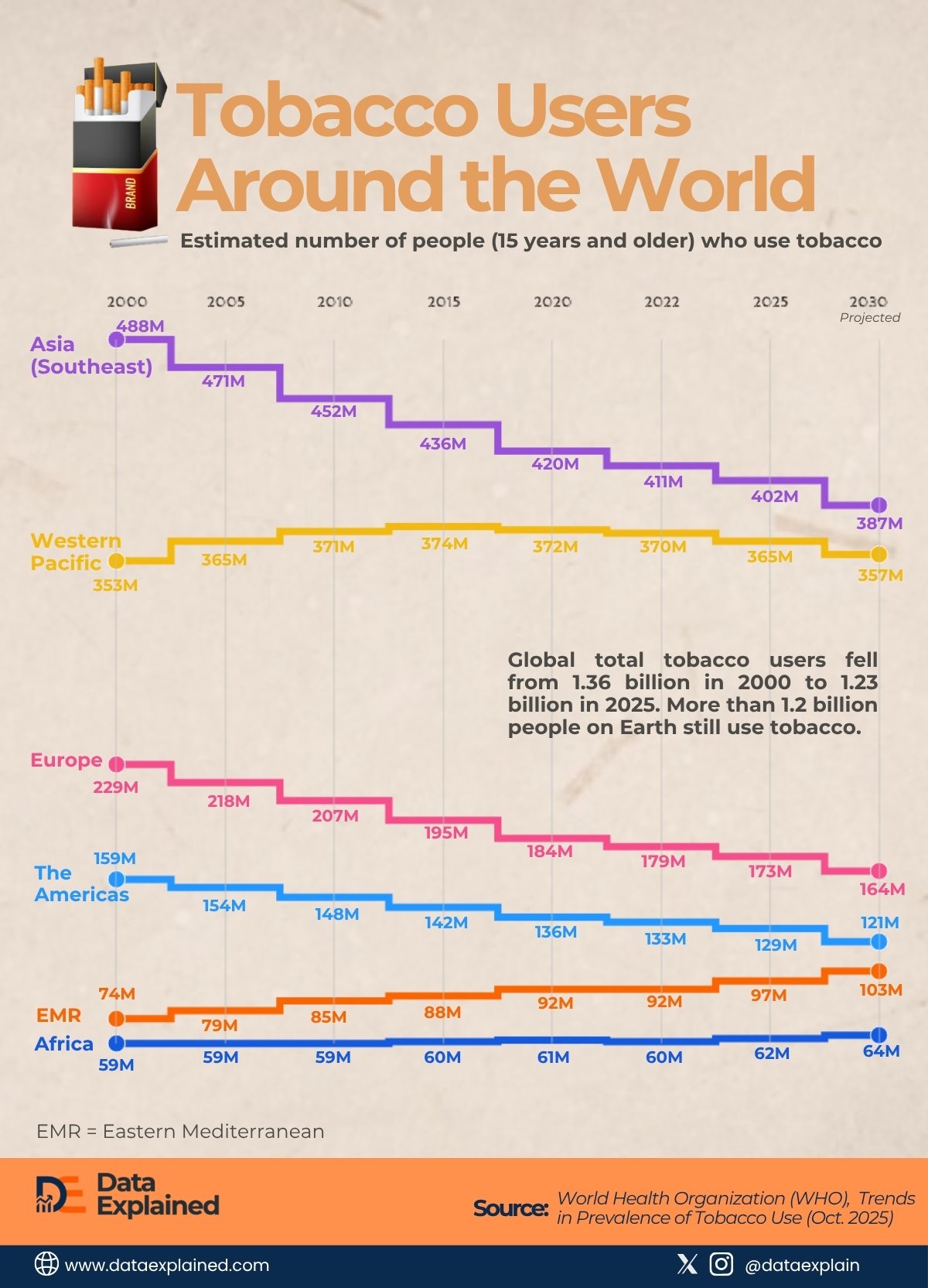
The world has fewer tobacco users today than it did 25 years ago.
It’s not dramatically fewer. The reduction took three decades of public health effort, international treaty enforcement, legislative action, and billions in cessation program funding to achieve.
Using data from the WHO Global Report, the infographic above shows the trends in the global number of tobacco users (millions) aged 15 years and older
TL;DR
- The number of tobacco users aged 15 and older fell from 1,362 million in 2000 to 1,227 million in 2025. More than 1.2 billion people on Earth still use tobacco.
| wdt_ID | wdt_created_by | wdt_created_at | wdt_last_edited_by | wdt_last_edited_at | WHO region | 2000 | 2005 | 2010 | 2015 | 2020 | 2022 | 2025 | 2030 |
|---|---|---|---|---|---|---|---|---|---|---|---|---|---|
| 1 | emmanuel-ashemiriogwa | 26/04/2026 09:22 AM | emmanuel-ashemiriogwa | 26/04/2026 09:22 AM | African Region | 59 | 59 | 59 | 60 | 61 | 60 | 62 | 64 |
| 2 | emmanuel-ashemiriogwa | 26/04/2026 09:22 AM | emmanuel-ashemiriogwa | 26/04/2026 09:22 AM | Region of the Americas | 159 | 154 | 148 | 142 | 136 | 133 | 129 | 121 |
| 3 | emmanuel-ashemiriogwa | 26/04/2026 09:22 AM | emmanuel-ashemiriogwa | 26/04/2026 09:22 AM | South-East Asia Region | 488 | 471 | 452 | 436 | 420 | 411 | 402 | 387 |
| 4 | emmanuel-ashemiriogwa | 26/04/2026 09:22 AM | emmanuel-ashemiriogwa | 26/04/2026 09:22 AM | European Region | 229 | 218 | 207 | 195 | 184 | 179 | 173 | 164 |
| 5 | emmanuel-ashemiriogwa | 26/04/2026 09:22 AM | emmanuel-ashemiriogwa | 26/04/2026 09:22 AM | Eastern Mediterranean Region | 74 | 79 | 85 | 88 | 92 | 92 | 97 | 103 |
| 6 | emmanuel-ashemiriogwa | 26/04/2026 09:22 AM | emmanuel-ashemiriogwa | 26/04/2026 09:22 AM | Western Pacific Region | 353 | 365 | 371 | 374 | 372 | 370 | 365 | 357 |
| 7 | emmanuel-ashemiriogwa | 26/04/2026 09:22 AM | emmanuel-ashemiriogwa | 26/04/2026 09:22 AM | Global | 1,362 | 1,345 | 1,322 | 1,296 | 1,264 | 1,245 | 1,227 | 1,197 |
*numbers represent millions of tobacco users
The Global Decline… and Its Limits
The 135 million reduction in the number of global tobacco users between 2000 and 2025 occurred while the world population grew by approximately 2.1 billion people.
On a population-adjusted basis, accounting for how many more people are potentially eligible to use tobacco, the decline in prevalence rates is considerably greater than the raw user numbers suggest.
The world added billions of people and still reduced the number of tobacco users in absolute terms.
It is also a number that has 1,227 million on the wrong side of it.
The WHO projects global tobacco users will reach 1,197 million by 2030, meaning three more decades of effort, under current policy trajectories, will produce an additional reduction of approximately 30 million.
The pace of decline is slowing, and two regions are actively bucking it.
Africa: Growth Against the Trend
The African Region is the only WHO region with a consistent upward trajectory across the entire dataset.
Tobacco users in Africa grew from 59 million in 2000 to 61 million in 2020 and are projected to reach 64 million by 2030.
Population growth is the primary driver.
Africa’s population is expanding faster than tobacco control measures are reducing use rates.
The tobacco industry has explicitly identified sub-Saharan Africa as a priority growth market as Western markets contract under increasingly strict legislation.
Eastern Mediterranean is the Fastest-Growing Epidemic
The Eastern Mediterranean Region, which covers the Middle East, North Africa, and parts of Central Asia, shows the most alarming trajectory in the dataset.
Tobacco users grew from 74 million in 2000 to 92 million in 2022 and are projected to reach 103 million by 2030.
That is a 39.2% increase over three decades.
It’s the largest proportional growth among WHO regions.
Waterpipe tobacco, known as shisha or hookah, has expanded rapidly across the region alongside cigarette use, particularly among young people and women who have historically had lower tobacco use rates.
Where Decline Is Happening
The South-East Asia Region, which is home to the world’s largest concentration of tobacco users, is the primary engine of global improvement.
Users fell from 488 million in 2000 to a projected 387 million in 2030, a reduction of 101 million that accounts for the overwhelming majority of the global decline.
Without South-East Asia’s trajectory, global tobacco user counts would be rising.
Europe has achieved the largest proportional decline of any region (from 229 million in 2000 to a projected 164 million in 2030, a 28.4% reduction)
Last week, the United Kingdom’s Parliament passed the Tobacco and Vapes Bill, making it permanently illegal for anyone born after December 31, 2008, to purchase tobacco products.
The law is the most radical tobacco prohibition currently in force in any country.
It’s a permanent, generational prohibition that follows a birth cohort for life.
New Zealand passed similar legislation in 2022 and repealed it under a new government in 2023.
The Data’s Blind Spot
The WHO dataset covers traditional tobacco products, such as cigarettes, cigars, pipe tobacco, smokeless tobacco, and waterpipe.
It does not capture e-cigarettes, heated tobacco products, or nicotine pouches.
These products, produced and marketed largely by tobacco companies, are not classified as tobacco by most national regulators and are not included in the 1,227 million figure.
The actual prevalence of nicotine addiction globally is higher than the WHO data reflects.
ELI5
The number of people using tobacco worldwide has dropped by 135 million since 2000, but over 1.2 billion people still use it. Africa and the Middle East are actually seeing more tobacco users, not fewer, while Europe and Asia are improving. This week, the UK passed a law making it permanently illegal for anyone born after 2008 to ever buy tobacco. It’s the toughest tobacco law in the world right now.
Source:
WHO Global Report on Trends in Prevalence of Tobacco Use