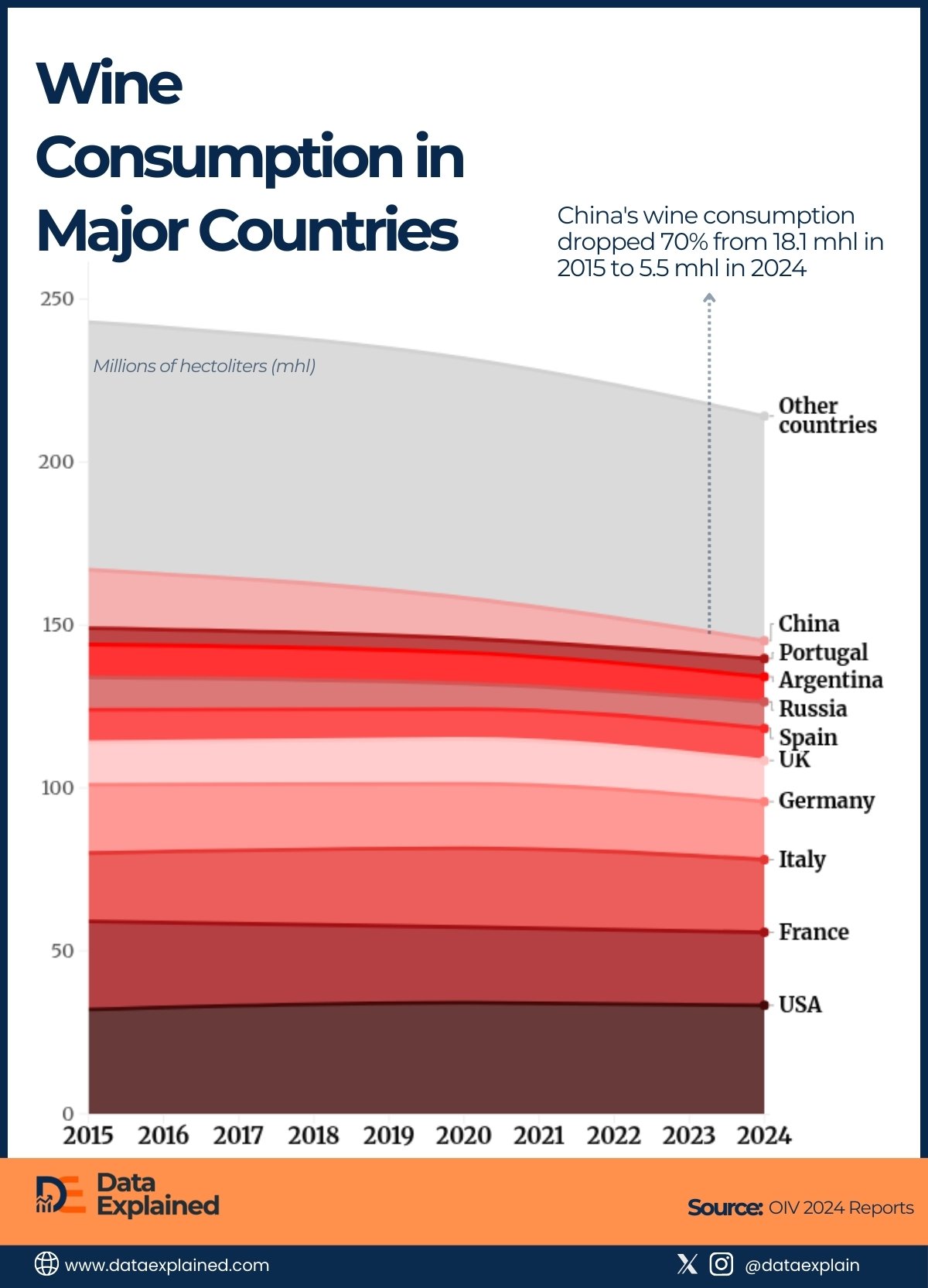
China’s wine consumption has declined dramatically over the past nine years, dropping from 18.1 million hectoliters in 2015 to just 5.5 million in 2024.
This sharp decrease has erased what was once the world’s fastest-growing wine market.
Based on the data from the International Organization of Vine and Wine (OIV), the chart above presents global wine production and consumption from 2015 to 2024 in millions of hectoliters (mhl).
For context, one hectoliter equal to 100 liters or roughly 133 standard wine bottles.
TL;DR
- China’s wine consumption dropped 70% from 18.1 mhl in 2015 to 5.5 mhl in 2024
- Globally, consumption fell 11% over nine years amid oversupply, with Italy’s output down 12% and Germany consuming twice its production.
Ranked: Wine consumption in major countries (mhl)
| wdt_ID | wdt_created_by | wdt_created_at | wdt_last_edited_by | wdt_last_edited_at | Country | 2015 | 2020 | 2024 | 2024 % of market |
|---|---|---|---|---|---|---|---|---|---|
| 1 | emmanuel-ashemiriogwa | 18/02/2026 06:11 PM | emmanuel-ashemiriogwa | 18/02/2026 06:11 PM | USA | 32.0 | 34.1 | 33.3 | 16 |
| 2 | emmanuel-ashemiriogwa | 18/02/2026 06:11 PM | emmanuel-ashemiriogwa | 18/02/2026 06:11 PM | France | 27.0 | 23.2 | 22.4 | 10 |
| 3 | emmanuel-ashemiriogwa | 18/02/2026 06:11 PM | emmanuel-ashemiriogwa | 18/02/2026 06:11 PM | Italy | 21.0 | 24.2 | 22.3 | 10 |
| 4 | emmanuel-ashemiriogwa | 18/02/2026 06:11 PM | emmanuel-ashemiriogwa | 18/02/2026 06:11 PM | Germany | 21.0 | 19.8 | 17.8 | 8 |
| 5 | emmanuel-ashemiriogwa | 18/02/2026 06:11 PM | emmanuel-ashemiriogwa | 18/02/2026 06:11 PM | UK | 13.0 | 13.7 | 12.6 | 6 |
| 6 | emmanuel-ashemiriogwa | 18/02/2026 06:11 PM | emmanuel-ashemiriogwa | 18/02/2026 06:11 PM | Spain | 10.0 | 9.2 | 9.9 | 5 |
| 7 | emmanuel-ashemiriogwa | 18/02/2026 06:11 PM | emmanuel-ashemiriogwa | 18/02/2026 06:11 PM | Russia | 10.0 | 7.9 | 8.1 | 4 |
| 8 | emmanuel-ashemiriogwa | 18/02/2026 06:11 PM | emmanuel-ashemiriogwa | 18/02/2026 06:11 PM | Argentina | 10.0 | 9.4 | 7.7 | 4 |
| 9 | emmanuel-ashemiriogwa | 18/02/2026 06:11 PM | emmanuel-ashemiriogwa | 18/02/2026 06:11 PM | Portugal | 5.0 | 4.4 | 5.6 | 3 |
| 10 | emmanuel-ashemiriogwa | 18/02/2026 06:11 PM | emmanuel-ashemiriogwa | 18/02/2026 06:11 PM | China | 18.0 | 12.4 | 5.5 | 3 |
How China’s Crash Affects Tourism
China’s wine consumption has plummeted by 70%, dropping from 18.1 million hectolitres in 2015 to just 5.5 million in 2024.
This decline has significantly reduced demand for premium imports and negatively impacted wine tourism in key regions such as Bordeaux, Napa Valley, Tuscany, and Piedmont.
In Bordeaux, exports to China have halved since 2017, now totaling around 40 million bottles annually.
The Drinks Business reports that Chinese investors, who purchased 176 estates in the 2010s, are now selling many of them in distressed sales.
Vineyard prices have dropped from €55,000 to €10,000 per hectare, with hundreds of properties available at deep discounts.
In Napa Valley, high hopes for Chinese visitors were never realized.
They previously spent an average of $6,000 per trip to the U.S., according to Napa Valley Focus.
Trade tariffs (up to 79% on U.S. wine) and changing consumer preferences have made 2024’s growth forecasts overly optimistic. Consequently, there are fewer tasting tours, less estate investment, and a slowdown in enotourism.
Tuscany and Piedmont in Italy are also feeling the effects.
These regions relied on wealthy Chinese groups for high-margin private tours, cellar-door sales, and luxury accommodations, all of which have sharply declined.
The era of luxury gifting, once bringing Chinese groups into châteaux and tasting rooms, has shifted focus to domestic markets and more affordable wines.
As a result, Bordeaux, Napa, and other premium destinations now see fewer high-value international wine tourists.
Italy’s Shocking Production Collapse
Italy’s wine production dropped from 50.0 million hectolitres in 2015 to 44.1 million hectolitres in 2024.
This represents a 12% decline over nine years.
Despite the decrease, Italy still produces nearly twice as much wine as it consumes domestically: 44.1 million hectolitres produced, compared to 22.3 million hectolitres drunk within the country.
This surplus makes the industry heavily reliant on exports.
The decline highlights vulnerabilities, including extreme weather and declining global demand.
As the world’s leading wine producer, Italy now faces increased challenges in maintaining the profitability of its vineyards.
Germany Drinks More Than It Makes
Germany’s wine consumption in 2024 reaches 17.8 million hectoliters (mhl), while domestic production is only 7.8 mhl, resulting in a deficit of 10 mhl.
This indicates that Germans consume more than twice as much wine as they produce locally.
To meet this demand, Germany imports 12.8 mhl of wine. Although exports amount to 3.2 mhl, the country’s reliance on foreign wine remains significant.
This consumption trend challenges stereotypes of a beer-dominated culture.
Despite a decline in production due to climate change, consumption remains relatively stable.
The Global Consumption Crisis
Global wine consumption dropped from 241.1 million hectoliters in 2015 to 214.1 million hectoliters in 2024, an 11% decrease over nine years.
Meanwhile, wine production decreased from 278.3 million hectoliters to 225.6 million hectoliters, a sharper decline that has led to surplus wine globally.
This surplus puts pressure on producers and markets alike.
The oversupply has caused declining prices, vineyard closures, and difficulties in exporting, especially in key regions.
Climate issues and weaker demand further intensify these problems.
ELI5
China’s wine consumption dropped significantly, from 18.1 million hectoliters in 2015 to just 5.5 million in 2024, about 70%. This happened due to financial problems and changing consumer tastes, so China lost its position as the world’s top wine market.
Because fewer people bought expensive imported wines, wine tourism in places like Bordeaux and Napa Valley slowed down. There were fewer visitors, some wineries struggled to sell, and investments dropped.
Around the world, overall wine consumption also fell 11% over nine years because supply exceeded demand.
Sources:
OIV, Drink Business, Napa Valley Focus