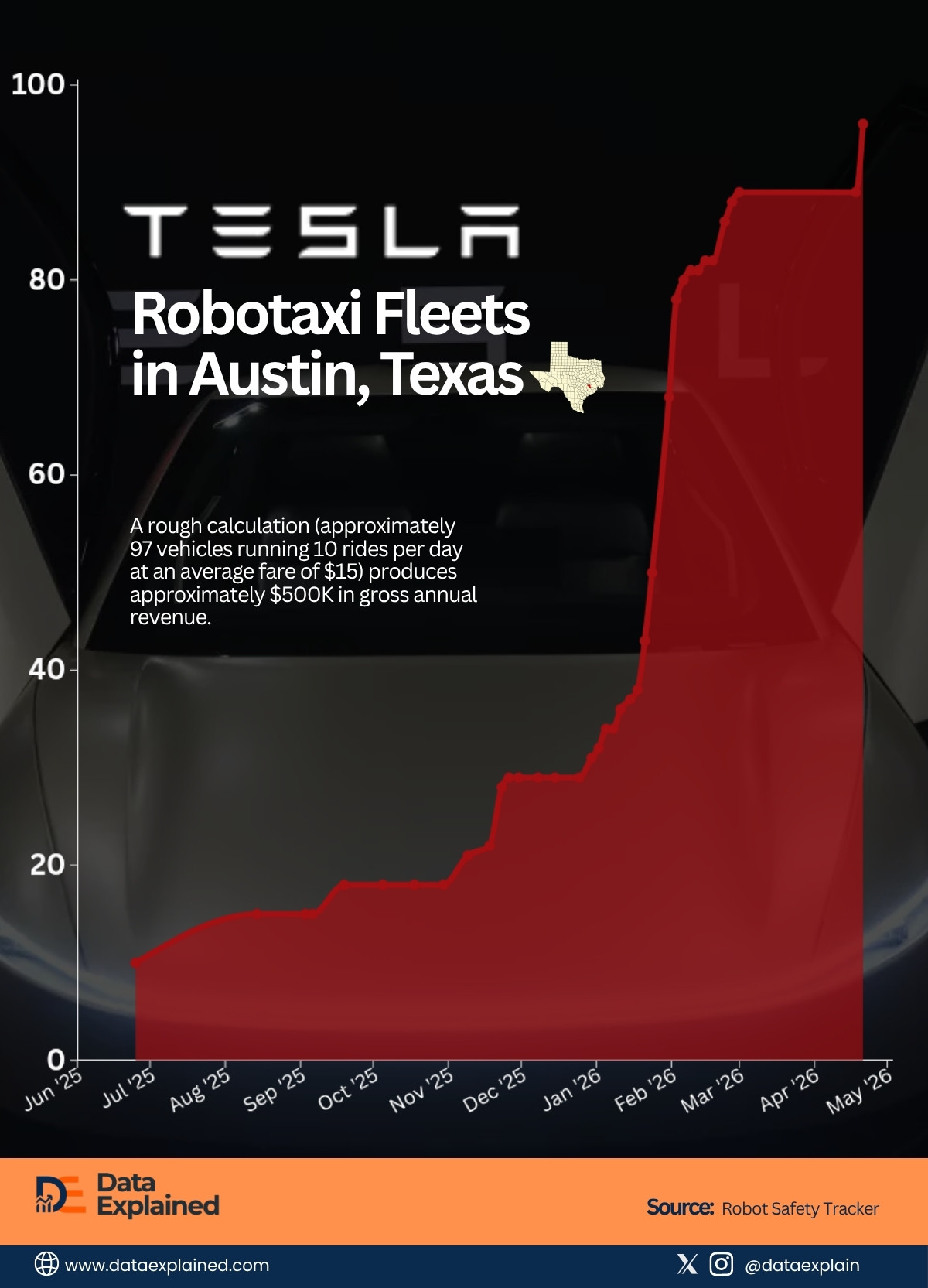
Tesla’s self-driving taxi service has approximately 97 vehicles operating in Austin, Texas. Elon Musk wants the service running in a dozen or so states by the end of 2026.
Those two facts, placed side by side, define the distance between where Tesla’s Robotaxi is and where its CEO says it is going.
Robot Safety Tracker, a third-party tool that monitors Tesla’s autonomous vehicle deployment, has logged every addition to the Austin Robotaxi fleet since the service launched.
Ten months later, the fleet stands at approximately 97 vehicles.
We use the data to show a granular, publicly available picture of how Tesla’s autonomous taxi operation has actually developed (not as announced, but as deployed).
TL;DR
- The fleet reached approximately 85 to 90 vehicles through February and March before approaching its current level of approximately 95 to 97 vehicles.
- A rough calculation (approximately 97 vehicles running 10 rides per day at an average fare of $15) produces approximately $500,000 in gross annual revenue.
| wdt_ID | wdt_created_by | wdt_created_at | wdt_last_edited_by | wdt_last_edited_at | Date | Fleet Size (Austin ADS) |
|---|---|---|---|---|---|---|
| 1 | emmanuel-ashemiriogwa | 05/05/2026 09:57 AM | emmanuel-ashemiriogwa | 05/05/2026 09:57 AM | 25/06/2025 | 10 |
| 2 | emmanuel-ashemiriogwa | 05/05/2026 09:57 AM | emmanuel-ashemiriogwa | 05/05/2026 09:57 AM | 14/08/2025 | 15 |
| 3 | emmanuel-ashemiriogwa | 05/05/2026 09:57 AM | emmanuel-ashemiriogwa | 05/05/2026 09:57 AM | 03/09/2025 | 15 |
| 4 | emmanuel-ashemiriogwa | 05/05/2026 09:57 AM | emmanuel-ashemiriogwa | 05/05/2026 09:57 AM | 06/09/2025 | 15 |
| 5 | emmanuel-ashemiriogwa | 05/05/2026 09:57 AM | emmanuel-ashemiriogwa | 05/05/2026 09:57 AM | 19/09/2025 | 18 |
| 6 | emmanuel-ashemiriogwa | 05/05/2026 09:57 AM | emmanuel-ashemiriogwa | 05/05/2026 09:57 AM | 05/10/2025 | 18 |
| 7 | emmanuel-ashemiriogwa | 05/05/2026 09:57 AM | emmanuel-ashemiriogwa | 05/05/2026 09:57 AM | 18/10/2025 | 18 |
| 8 | emmanuel-ashemiriogwa | 05/05/2026 09:57 AM | emmanuel-ashemiriogwa | 05/05/2026 09:57 AM | 30/10/2025 | 18 |
| 9 | emmanuel-ashemiriogwa | 05/05/2026 09:57 AM | emmanuel-ashemiriogwa | 05/05/2026 09:57 AM | 09/11/2025 | 21 |
| 10 | emmanuel-ashemiriogwa | 05/05/2026 09:57 AM | emmanuel-ashemiriogwa | 05/05/2026 09:57 AM | 18/11/2025 | 22 |
How the Fleet Grew
Through September and October 2025, the fleet held approximately 18 to 20 vehicles for roughly three months.
Growth resumed in November and December 2025, with the number gradually climbing to approximately 30 vehicles by late December.
January 2026 brought a more decisive acceleration, reaching approximately 45-50 vehicles by mid-month.
Then, between approximately January 21 and January 24, 2026, something specific happened.
The fleet jumped from approximately 50 to approximately 80 vehicles in roughly 72 hours (a 60% expansion in three days).
This is not how organic fleet growth works. It is how deliberate batch deployment works: vehicles pre-staged, software-certified, and held ready for simultaneous activation.
Tesla had the cars ready and chose a specific window to turn them on.
Since that January surge, growth has been gradual. The fleet reached approximately 85 to 90 vehicles through February and March before approaching its current level of approximately 95 to 97 vehicles.
It has held near that threshold for several weeks without crossing 100.
What Nearly 100 Cars Means for Revenue
Musk told investors on April 22, during Tesla’s Q1 earnings call, that revenue from the Robotaxi service will likely not be significant in 2026 but will be in 2027.
The fleet data explains that assessment precisely.
A rough calculation (approximately 97 vehicles running 10 rides per day at an average fare of $15) produces approximately $500,000 in gross annual revenue.
That figure is not a rounding error in Tesla’s financial statements.
It is essentially invisible at the scale of a company generating approximately $97 billion in annual revenue.
Waymo, the autonomous vehicle service operated by Alphabet, runs approximately 700 vehicles across four U.S. cities ( San Francisco, Los Angeles, Phoenix, and Austin).
Tesla’s entire Austin fleet is approximately one-seventh of Waymo’s total across multiple cities.
The competitive gap in current deployment is significant, though Tesla’s approach using production Model Y vehicles with software-based autonomy rather than purpose-built hardware carries different scaling economics that could close the gap faster if the software performs.
The Expansion Musk Announced
Tesla has already expanded the service to Dallas and Houston, adding to its presence in Austin.
Musk stated on the April 22 earnings call that the goal is to reach a dozen or so states by year’s end.
The Austin trajectory, ten months to reach approximately 97 vehicles, is the operational template for what each new city launch looks like.
If Dallas and Houston follow the same pattern, a meaningful multi-city fleet size will take the better part of a year per market to develop.
ELI5
Tesla has a self-driving taxi service in Austin, Texas, with about 97 cars. It started with just 10 cars in June 2025. The fleet barely makes any money yet because 97 cars is very small. Tesla’s boss, Elon Musk, says he wants the service running across a dozen U.S. states by the end of this year, but the data show it’s still in its very early stages.
Source: