The UAE’s decision to exit OPEC has sent ripples through global energy markets, but the underlying reasons become clearer when looking at the numbers behind the group’s internal dynamics.
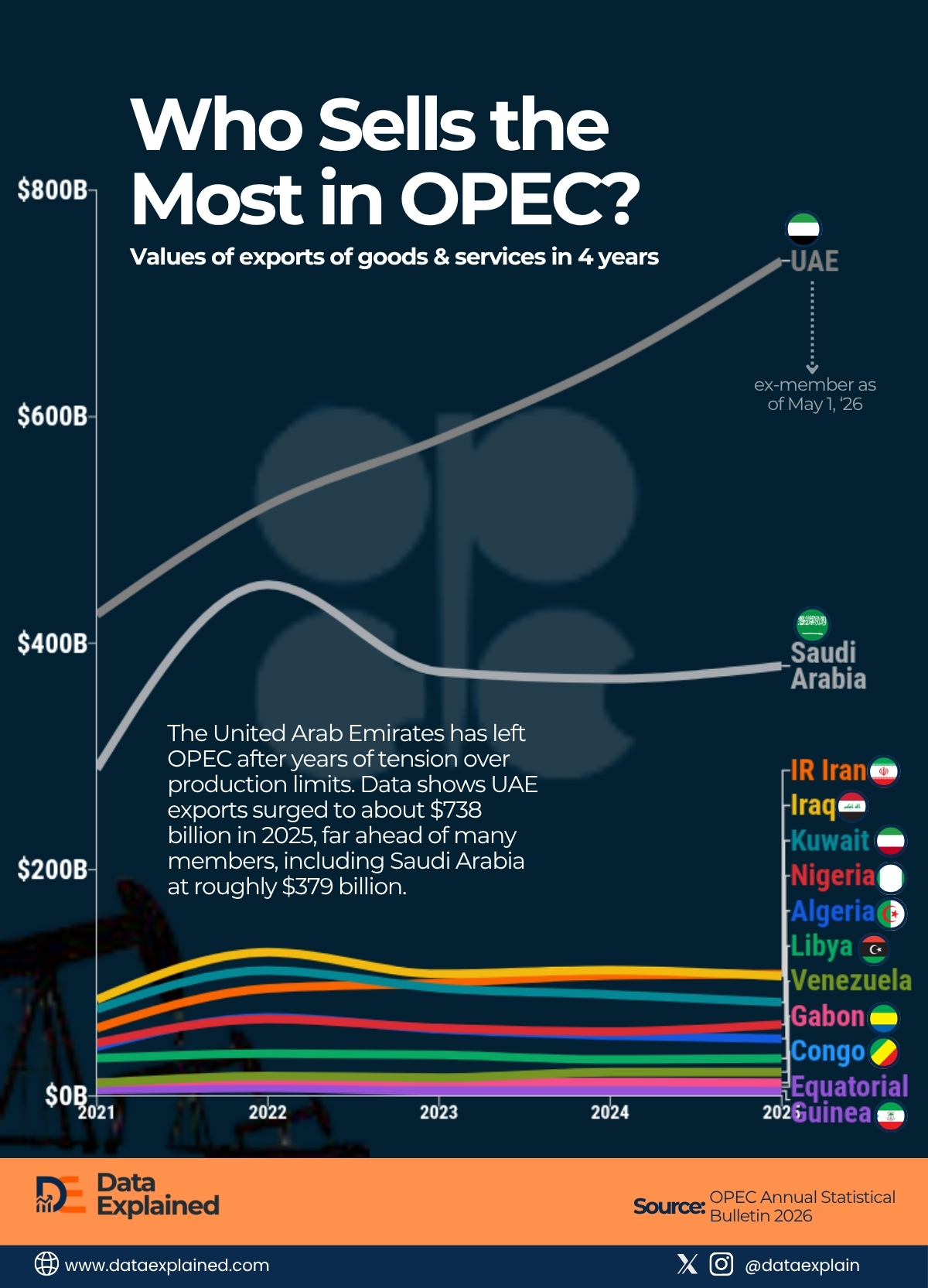
Data published by OPEC on member countries’ exports of goods and services from 2021 to 2025 shows a bloc that has grown overall, but unevenly.
Total OPEC exports rose from about $1.10 trillion in 2021 to $1.61 trillion in 2025.
Beneath that headline growth, however, the balance of power inside the group has shifted significantly.
TL;DR
- The United Arab Emirates has left OPEC after years of tension over production limits.
- New OPEC data shows UAE exports surged to about $738 billion in 2025, far ahead of many members, including Saudi Arabia at roughly $379 billion.
- The numbers point to a deeper shift: economic power inside OPEC has changed, and the UAE no longer fits neatly within the group’s structure.
| wdt_ID | wdt_created_by | wdt_created_at | wdt_last_edited_by | wdt_last_edited_at | Country | 2021 ($m) | 2022 ($m) | 2023 ($m) | 2024 ($m) | 2025 ($m) |
|---|---|---|---|---|---|---|---|---|---|---|
| 1 | emmanuel-ashemiriogwa | 05/05/2026 10:38 AM | emmanuel-ashemiriogwa | 05/05/2026 10:38 AM | Algeria | 43,647.0 | 69,459.0 | 58,978.0 | 53,468.0 | 50,781.0 |
| 2 | emmanuel-ashemiriogwa | 05/05/2026 10:38 AM | emmanuel-ashemiriogwa | 05/05/2026 10:38 AM | Congo | 7,833.0 | 10,093.0 | 8,717.0 | 8,600.0 | 8,252.0 |
| 3 | emmanuel-ashemiriogwa | 05/05/2026 10:38 AM | emmanuel-ashemiriogwa | 05/05/2026 10:38 AM | Equatorial Guinea | 5,513.0 | 7,250.0 | 4,516.0 | 4,500.0 | 4,515.0 |
| 4 | emmanuel-ashemiriogwa | 05/05/2026 10:38 AM | emmanuel-ashemiriogwa | 05/05/2026 10:38 AM | Gabon | 11,850.0 | 13,814.0 | 12,356.0 | 12,536.0 | 11,860.0 |
| 5 | emmanuel-ashemiriogwa | 05/05/2026 10:38 AM | emmanuel-ashemiriogwa | 05/05/2026 10:38 AM | IR Iran | 60,135.0 | 95,033.0 | 99,690.0 | 106,604.0 | 107,616.0 |
| 6 | emmanuel-ashemiriogwa | 05/05/2026 10:38 AM | emmanuel-ashemiriogwa | 05/05/2026 10:38 AM | Iraq | 85,224.0 | 127,079.0 | 107,852.0 | 111,195.0 | 106,004.0 |
| 7 | emmanuel-ashemiriogwa | 05/05/2026 10:38 AM | emmanuel-ashemiriogwa | 05/05/2026 10:38 AM | Kuwait | 76,736.0 | 110,924.0 | 95,472.0 | 89,719.0 | 82,901.0 |
| 8 | emmanuel-ashemiriogwa | 05/05/2026 10:38 AM | emmanuel-ashemiriogwa | 05/05/2026 10:38 AM | Libya | 33,417.0 | 37,686.0 | 36,343.0 | 32,262.0 | 33,254.0 |
| 9 | emmanuel-ashemiriogwa | 05/05/2026 10:38 AM | emmanuel-ashemiriogwa | 05/05/2026 10:38 AM | Nigeria | 46,868.0 | 68,119.0 | 60,197.0 | 56,961.0 | 63,142.0 |
| 10 | emmanuel-ashemiriogwa | 05/05/2026 10:38 AM | emmanuel-ashemiriogwa | 05/05/2026 10:38 AM | Saudi Arabia | 288,946.0 | 451,766.0 | 374,788.0 | 368,567.0 | 379,894.0 |
UAE’s Rapid Rise
The UAE stands out as the fastest-growing major exporter in the dataset.
Its total exports climbed from roughly $425 billion in 2021 to $738 billion in 2025, showing consistent year-on-year growth.
By contrast, Saudi Arabia, long considered OPEC’s dominant force, followed a different trajectory.
Its exports rose sharply to about $452 billion in 2022, then declined and stabilized at around $379 billion by 2025.
That means that by the end of the period, the UAE’s total export value was nearly double that of Saudi Arabia.
NOTE:
- While OPEC’s production quotas focus on crude oil, the export data includes both goods and services.
- This matters because it highlights a key difference. The UAE’s growth is not driven by oil alone.
- Its economy has expanded through trade, logistics, finance, and other services, making it less dependent on restrictions on oil output.
A Growing Imbalance
Countries such as Iran showed steady growth, with exports rising from about $60 billion to over $107 billion, even amid external constraints.
Others, like Iraq and Kuwait, experienced peaks around 2022 followed by declines.
Meanwhile, smaller producers, including Gabon and Equatorial Guinea, remained largely flat over the period.
Why the Exit Now
OPEC’s structure is built around coordinating oil production to influence global prices.
Member countries agree to output limits, or quotas, designed to manage supply.
For a country like the UAE, whose export capacity and economic base have expanded rapidly, those limits can become restrictive.
As its output potential rises, being bound by collective quotas may conflict with national growth ambitions. At the same time, its diversified economy reduces its reliance on OPEC’s core function of oil market coordination.
Tensions between the UAE and Saudi Arabia over production targets have surfaced repeatedly in recent years.
Structural Shift for OPEC
The UAE’s departure raises questions about OPEC’s cohesion going forward.
If one of its fastest-growing and most economically dynamic members chooses to leave, it highlights the challenge of maintaining unity among countries with increasingly different priorities.
Export data also shows that 2022 marked a high point for many members, with several countries experiencing declines or stagnation afterward.
This suggests that OPEC’s recent growth was partly driven by temporary market conditions rather than sustained expansion across all members.
What It Means for Markets
For global energy markets, the UAE’s exit could signal a move toward more independent production strategies. While the country remains a major oil exporter, it may now have greater flexibility in setting output levels.
For OPEC, the challenge will be maintaining influence in a landscape where internal economic realities are shifting.
The data makes one point clear: the balance of power within the group is no longer what it once was.
ELI5:
The UAE left OPEC because it has grown much faster than many other members. New data shows it now exports far more than some countries in the group, including Saudi Arabia. Since OPEC limits how much oil its members can produce, those limits may no longer suit the UAE. In simple terms, the UAE has grown and wants more freedom to expand.
Source:
OPEC Annual Statistical bulletin