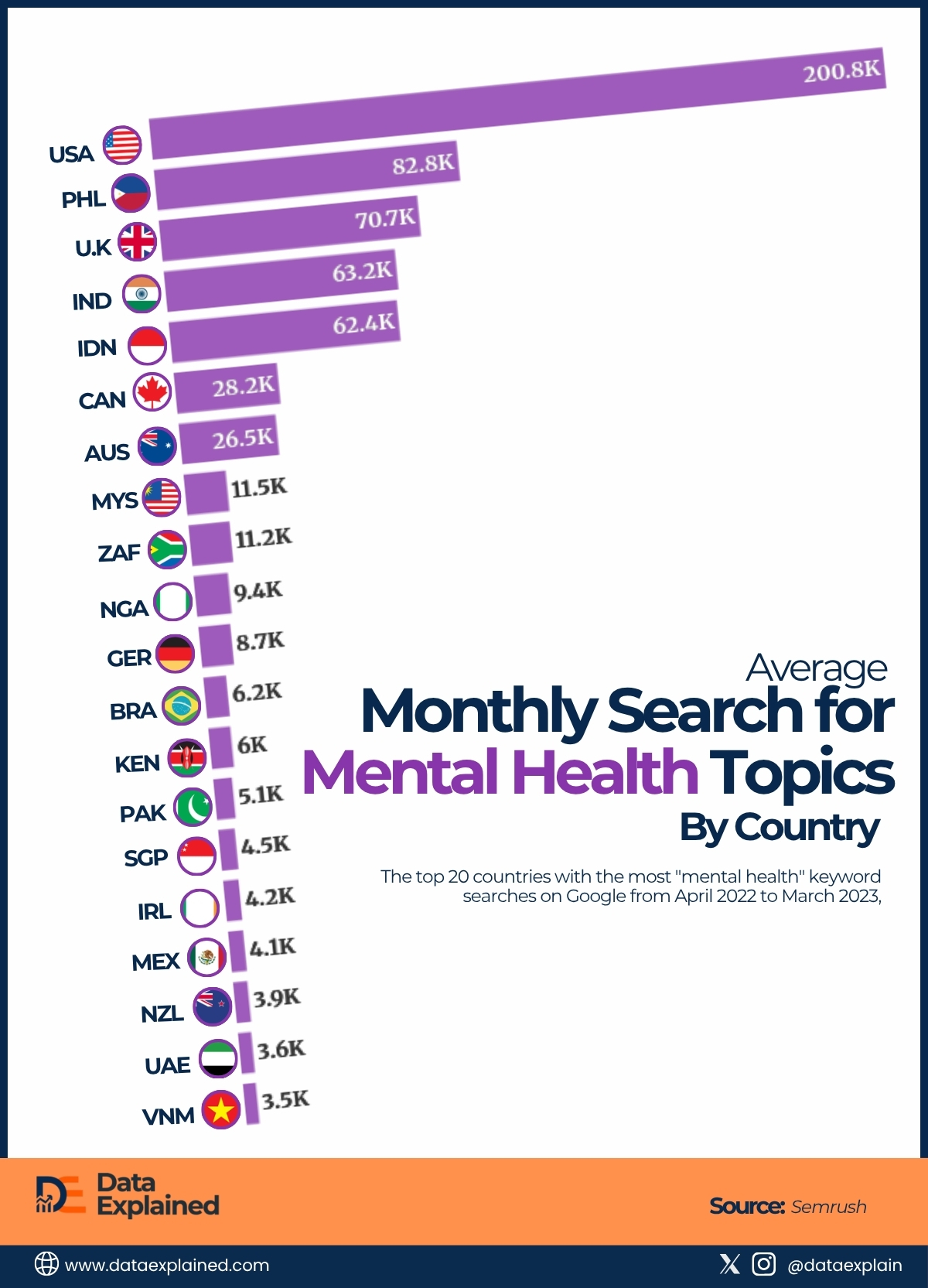
Between April 2022 and March 2023, people around the world searched the term “mental health” an average of approximately 727,000 times per month across 20 countries.
This data comes from Semrush and was accessed via Statista.
The information helps reflect the enduring psychological impact of the COVID-19 pandemic era, coupled with more recent economic and societal stressors.
TL;DR
- The United States led with an average of 200,750 monthly searches for the keyword “mental health.”
- The Philippines followed with 82,840, ahead of the United Kingdom at 70,670, India at 63,210, and Indonesia at 62,380.
For context, mental health search volume can mean many things, including people in clinical distress seeking help or people engaging with mental health as a wellness, self-improvement, or consumer topic.
It doesn’t necessarily mean countries with more people in distress, and the intent could have been anything.
Still, volume tells a story.
What the Rankings Are Actually Measuring
| wdt_ID | wdt_created_by | wdt_created_at | wdt_last_edited_by | wdt_last_edited_at | Country | Avg. search/month (thousands) |
|---|---|---|---|---|---|---|
| 1 | emmanuel-ashemiriogwa | 08/04/2026 02:13 PM | emmanuel-ashemiriogwa | 08/04/2026 02:13 PM | United States | 200.80 |
| 2 | emmanuel-ashemiriogwa | 08/04/2026 02:13 PM | emmanuel-ashemiriogwa | 08/04/2026 02:13 PM | Philippines | 82.80 |
| 3 | emmanuel-ashemiriogwa | 08/04/2026 02:13 PM | emmanuel-ashemiriogwa | 08/04/2026 02:13 PM | United Kingdom | 70.70 |
| 4 | emmanuel-ashemiriogwa | 08/04/2026 02:13 PM | emmanuel-ashemiriogwa | 08/04/2026 02:13 PM | India | 63.20 |
| 5 | emmanuel-ashemiriogwa | 08/04/2026 02:13 PM | emmanuel-ashemiriogwa | 08/04/2026 02:13 PM | Indonesia | 62.40 |
| 6 | emmanuel-ashemiriogwa | 08/04/2026 02:13 PM | emmanuel-ashemiriogwa | 08/04/2026 02:13 PM | Canada | 28.20 |
| 7 | emmanuel-ashemiriogwa | 08/04/2026 02:13 PM | emmanuel-ashemiriogwa | 08/04/2026 02:13 PM | Australia | 26.50 |
| 8 | emmanuel-ashemiriogwa | 08/04/2026 02:13 PM | emmanuel-ashemiriogwa | 08/04/2026 02:13 PM | Malaysia | 11.50 |
| 9 | emmanuel-ashemiriogwa | 08/04/2026 02:13 PM | emmanuel-ashemiriogwa | 08/04/2026 02:13 PM | South Africa | 11.20 |
| 10 | emmanuel-ashemiriogwa | 08/04/2026 02:13 PM | emmanuel-ashemiriogwa | 08/04/2026 02:13 PM | Nigeria | 9.40 |
Before any country figure is taken at face value, one structural caveat must be stated clearly: this dataset tracks searches for the English-language term “mental health.”
It does not capture searches conducted in Spanish, Portuguese, German, French, Mandarin, Arabic, or any other language.
Countries where mental health is discussed and searched in other languages are structurally underrepresented.
Mental Health Topic Searches in the Philippines
At 82,840 monthly searches, the Philippines is not just second on this list. It is an outlier that demands explanation.
The Philippines passed the Mental Health Act in 2018, one of the first comprehensive mental health policy frameworks in Southeast Asia, which brought national attention to the issue and may have contributed to a more open digital conversation.
The country consistently ranks among the world’s highest for daily social media usage hours. It also has a significant overseas worker population.
Approximately 10 million Filipinos work abroad.
The World Health Organization (WHO) estimated in 2022 that the COVID-19 pandemic triggered a 25% increase in anxiety and depression globally in its first year.
Southeast Asia’s Digital Mental Health Turn
Indonesia, with 62,380 monthly searches, tells a parallel story.
Together, Indonesia and the Philippines generate more mental health searches than the United Kingdom.
Meanwhile, according to WHO data, Indonesia has approximately 300 psychiatrists per 100 million people (one of the lowest ratios in the Asia-Pacific region).
Africa’s Quiet Signal
Nigeria, at 9,430, and South Africa, at 11,240, are the only two African countries in the top 20 by raw volume. Kenya follows at 5,960.
South Africa’s 11,240, higher than Nigeria despite a population nearly four times smaller, reflects higher English internet penetration and a more developed national mental health discourse
ELI5
When it comes to internet searches for the keyword “Mental health”, the highest number is from the U.S., with over 200,000 searches in 2023. While it could signal an inquiry into mental health help, that’s not necessarily the full picture.
The dataset measures a specific act: typing two English words into a search engine. It does not measure what happened next. It does not show whether the person who searched found useful information, accessed professional help, or closed the browser and found nothing relevant.
Sources: