Food prices don’t rise equally around the world.
While some countries are dealing with mild increases in grocery prices, others are facing a full-blown food crisis in which basic meals are becoming unaffordable almost overnight.
In countries hit by conflict, currency collapse, drought, or heavy dependence on imports, food inflation has surged to extreme levels, forcing millions of families to spend more just to survive.
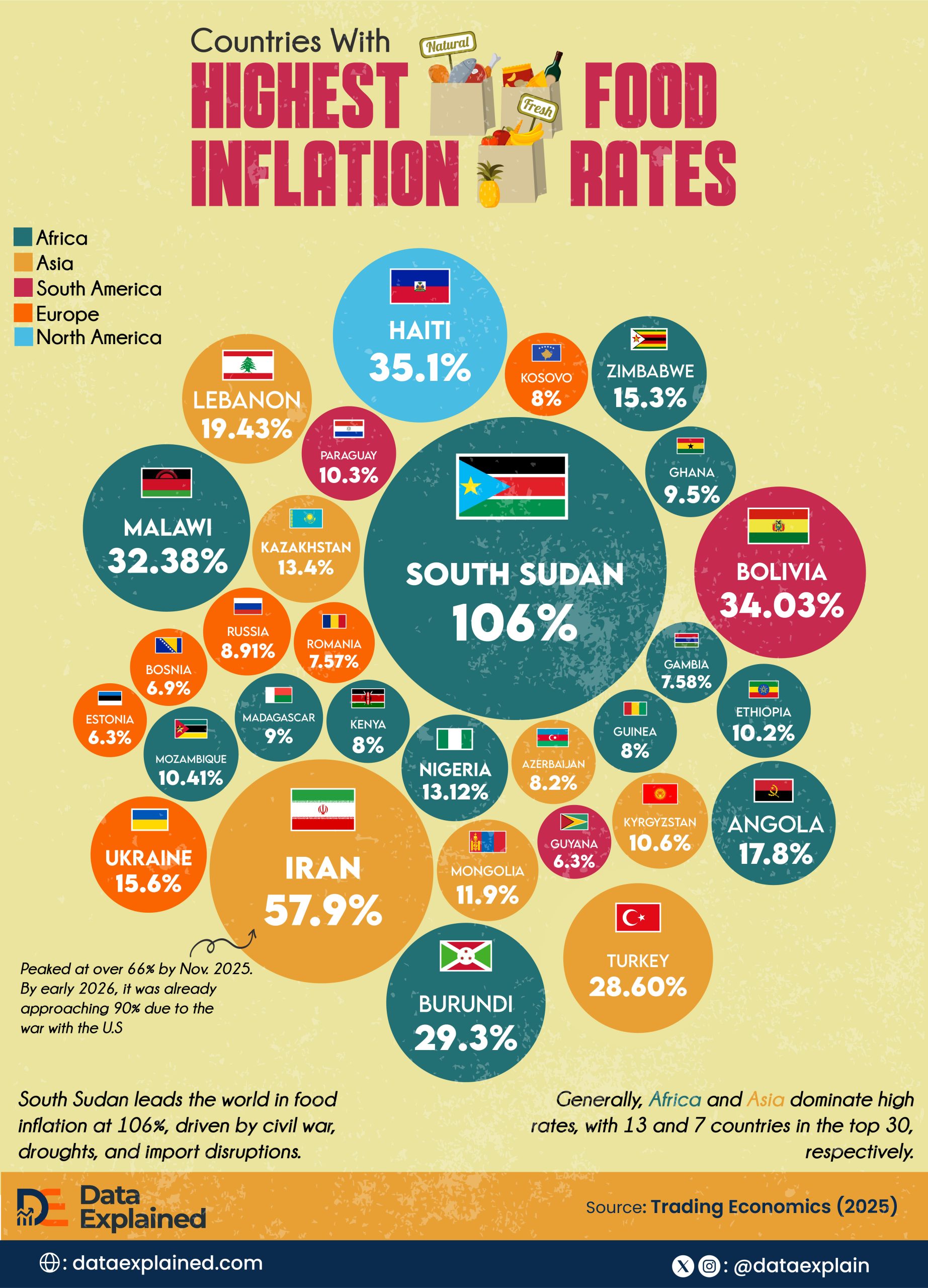
This visualization ranks the 30 countries with the highest food inflation rates in the latest fiscal year, revealing where food costs are rising fastest and why Africa and Asia remain at the center of the global food affordability crisis.
TL;DR
- South Sudan leads the world in food inflation at 106%, driven by civil war, droughts, and import disruptions.
- Generally, Africa and Asia dominate high rates, with 13 and 7 countries in the top 30, respectively.
The data for this explainer comes from the global index tracker Trading Economics.
Top 30 Countries by Food Inflation Rate
| wdt_ID | wdt_created_by | wdt_created_at | wdt_last_edited_by | wdt_last_edited_at | Rank | Country | Food Inflation Rate (%) | Continent |
|---|---|---|---|---|---|---|---|---|
| 1 | Monica Ebunoluwa | 08/05/2026 03:04 PM | Monica Ebunoluwa | 08/05/2026 03:04 PM | 1 | South Sudan | 106 | Africa |
| 2 | Monica Ebunoluwa | 08/05/2026 03:04 PM | Monica Ebunoluwa | 08/05/2026 03:04 PM | 2 | Iran | 58 | Asia |
| 3 | Monica Ebunoluwa | 08/05/2026 03:04 PM | Monica Ebunoluwa | 08/05/2026 03:04 PM | 3 | Haiti | 35 | North America |
| 4 | Monica Ebunoluwa | 08/05/2026 03:04 PM | Monica Ebunoluwa | 08/05/2026 03:04 PM | 4 | Malawi | 32 | Africa |
| 5 | Monica Ebunoluwa | 08/05/2026 03:04 PM | Monica Ebunoluwa | 08/05/2026 03:04 PM | 5 | Bolivia | 34 | South America |
| 6 | Monica Ebunoluwa | 08/05/2026 03:04 PM | Monica Ebunoluwa | 08/05/2026 03:04 PM | 6 | Burundi | 29 | Africa |
| 7 | Monica Ebunoluwa | 08/05/2026 03:04 PM | Monica Ebunoluwa | 08/05/2026 03:04 PM | 7 | Turkey | 29 | Asia |
| 8 | Monica Ebunoluwa | 08/05/2026 03:04 PM | Monica Ebunoluwa | 08/05/2026 03:04 PM | 8 | Lebanon | 19 | Asia |
| 9 | Monica Ebunoluwa | 08/05/2026 03:04 PM | Monica Ebunoluwa | 08/05/2026 03:04 PM | 9 | Angola | 18 | Africa |
| 10 | Monica Ebunoluwa | 08/05/2026 03:04 PM | Monica Ebunoluwa | 08/05/2026 03:04 PM | 10 | Ukraine | 16 | Europe |
Food prices skyrocketed in conflict zones, like South Sudan, where inflation reached 106% due to civil war.
Generally, the most affected are African nations, which account for 13 of the 30 countries with the highest inflation rates.
Drought, currency instability, and reliance on imports worsen inflation.
Note: In the case of Iran’s 57.9% inflation rate, it peaked at over 66% by November 2025. By early 2026, it was already approaching 90% due to the war with the U.S.
The Bigger Picture
Africa has the most countries with the highest food inflation.
Asia and Europe each have six countries on the list affected by food inflation, including Ukraine and Kazakhstan.
In the US, grocery prices rose 2.3% by September 2025, putting pressure on food banks.
According to Reuters, the eurozone is attempting to reduce energy costs, but this effort is not halting the overall increase in energy prices. In Japan, inflation is around 3% due to similar issues, as energy costs continue to add to it.
What This Means For You
The food inflation rate of your country directly shows how much your budget is shrinking.
If the rate is high, it means that a $100 food item in your local currency buys fewer items today than it did last year.
Since food takes a larger chunk of the average person’s income, you might switch from fresh produce to cheaper, processed alternatives.
Knowing what’s going on helps people make better choices.
ELI5: Food Inflation Rate by Country
Food inflation occurs when food prices rise sharply, making it hard to buy groceries. South Sudan has the worst at 106%, meaning prices doubled.
Countries in Africa and Asia have the highest rankings due to adverse weather conditions and weak currencies, which make imports costly. This forces low-income families to allocate a larger portion of their budget to essentials.
Sources: