
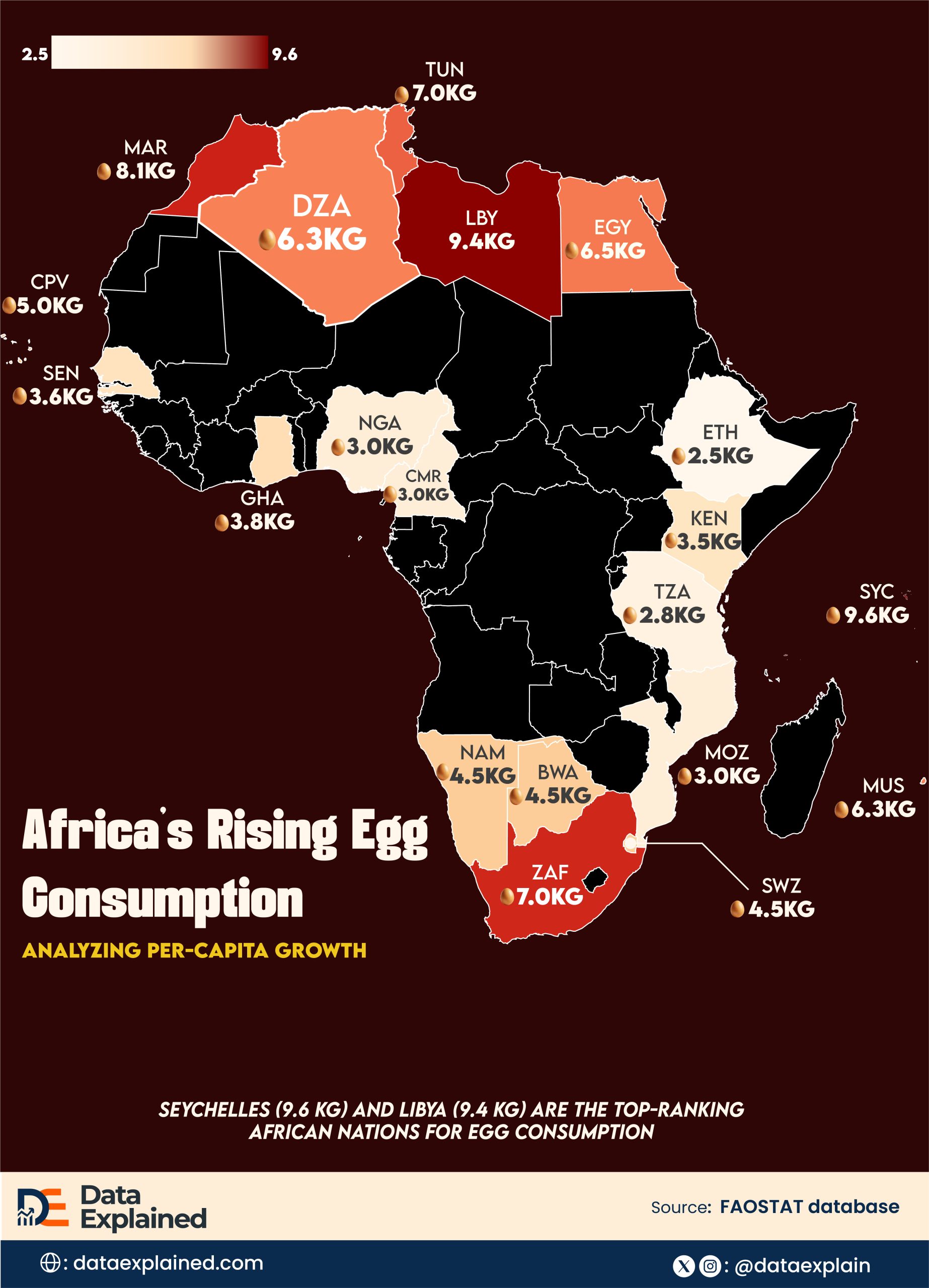
At what rate are eggs consumed across African countries?
Some nations produce and consume more eggs annually than others, especially in the northern region.
In this explainer, we crack open the data behind per-capita egg consumption across the continent.
TL;DR
- In Africa, the average annual egg consumption per person is approximately 3–5 kg, equivalent to 60–80 eggs.
- Seychelles presently consumes the most eggs per person on the continent.
- Africa’s average is much lower than that of continents such as Asia, Europe, and North America, where people eat three to five times as many eggs per year.
The data for this visualization comes from World Population Review.
It gathered data from the Food and Agriculture Organization of the United Nations (FAO) via the FAOSTAT database.
Per-capita egg consumption refers to the average number of eggs consumed per person per year, typically measured in kilograms per person (kg/person) or as the total number of eggs consumed annually.
Top Countries in Africa by Per-Capita Egg Consumption
| wdt_ID | wdt_created_by | wdt_created_at | wdt_last_edited_by | wdt_last_edited_at | Rank | Country | Egg Consumption Rate (kg/person) |
|---|---|---|---|---|---|---|---|
| 1 | Monica Ebunoluwa | 08/05/2026 04:03 PM | Monica Ebunoluwa | 08/05/2026 04:03 PM | 1 | Seychelles | 9.6 kg |
| 2 | Monica Ebunoluwa | 08/05/2026 04:03 PM | Monica Ebunoluwa | 08/05/2026 04:03 PM | 2 | Libya | 9.4 kg |
| 3 | Monica Ebunoluwa | 08/05/2026 04:03 PM | Monica Ebunoluwa | 08/05/2026 04:03 PM | 3 | Morocco | 8.1 kg |
| 4 | Monica Ebunoluwa | 08/05/2026 04:03 PM | Monica Ebunoluwa | 08/05/2026 04:03 PM | 4 | South Africa | 7.0 kg |
| 5 | Monica Ebunoluwa | 08/05/2026 04:03 PM | Monica Ebunoluwa | 08/05/2026 04:03 PM | 5 | Tunisia | 7.0 kg |
| 6 | Monica Ebunoluwa | 08/05/2026 04:03 PM | Monica Ebunoluwa | 08/05/2026 04:03 PM | 6 | Egypt | 6.5 kg |
| 7 | Monica Ebunoluwa | 08/05/2026 04:03 PM | Monica Ebunoluwa | 08/05/2026 04:03 PM | 7 | Mauritius | 6.3 kg |
| 8 | Monica Ebunoluwa | 08/05/2026 04:03 PM | Monica Ebunoluwa | 08/05/2026 04:03 PM | 8 | Algeria | 6.3 kg |
| 9 | Monica Ebunoluwa | 08/05/2026 04:03 PM | Monica Ebunoluwa | 08/05/2026 04:03 PM | 9 | Cape Verde | 5.0 kg |
| 10 | Monica Ebunoluwa | 08/05/2026 04:03 PM | Monica Ebunoluwa | 08/05/2026 04:03 PM | 10 | Botswana | 4.5 kg |
As you can see, there’s a higher consumption in places like Seychelles, Libya, Morocco, and South Africa.
It’s an indicator of their stronger poultry sectors, greater egg availability, and rising protein demand.
Additionally, there is a significant disparity between the highest and lowest per-capita values in Africa. Countries like Morocco and South Africa are far ahead of Nigeria in this respect.
However, these figures indicate that while some African countries have relatively high egg consumption (reflecting better availability, higher income levels, and more developed poultry systems), others consume much less.
How African Countries Compare to Global Benchmarks
When you take a look at Africa’s top egg consumers, namely Seychelles (9.6kg), Libya (9.4 kg), Morocco (8.1 kg), and South Africa (8.0 kg) per person, they stand out on the continent, but still fall short of the global average of roughly 10–12 kg per person.
Countries like Japan, Mexico, and China consume more than 18 kg per person annually, almost doubling the figures of African countries.
This gap highlights how Africa’s most developed poultry markets are still evolving to meet global standards.
An interesting fact is how the regional spread shapes these numbers.
North African nations, such as Morocco, Algeria, and Tunisia, top the list, recording over 6 kg per person, while most of Sub-Saharan Africa falls below 3 kg per person.
This illustrates the distribution of industrial poultry farming, where eggs are more accessible and affordable in North Africa.
Meanwhile, in countries like Nigeria and Kenya, feed costs are higher, and markets are less formalized, which limits both supply and consumption.
What’s Driving Egg Consumption in Africa?
Africa’s egg boom begins with population growth and urbanization.
According to the 2024 Forbes report, Africa accounts for approximately 4.1% of global egg consumption, despite comprising 17.2% of the world’s population.
In fast-growing nations like Egypt and Ethiopia, more people are migrating to cities and eating quick, protein-rich meals.
Eggs are inexpensive, versatile, and readily available. This is why urban countries like South Africa now average over 7 kg per person, while rural economies consume less.
Diet changes are another driver. As incomes increase, diets across North and Southern Africa are shifting toward a greater reliance on animal protein.
A poultry opportunity identification study in Morocco indicates that egg consumption has increased significantly since 2010.
In fact, per capita consumption almost doubled over a decade, from 90 eggs per person in 2010 to 177-180 eggs per person in 2020. From breakfast dishes to street snacks, eggs have become the norm.
Finally, affordability seals the deal. Better poultry farming and stable feed prices have dropped egg costs in Morocco and Egypt to under $0.10 each.
Where supply chains are seamless, eggs are cheap and abundant, making high-consuming countries stand out from those still catching up.
ELI5: Egg Consumption in Africa
Countries like Seychelles, Libya, and Morocco are leading the way, with egg consumption rising rapidly due to improved farming practices, higher incomes, and more people opting for affordable protein sources.
Sources: