A fresh wave of deadly xenophobic violence and anti-immigrant protests in South Africa targeting African foreign nationals, including Nigerians, has escalated into a major diplomatic crisis between the two countries.
Meanwhile, the Nigerian Bureau of Statistics published its Foreign Trade in Goods Statistics for Q1 2026 as part of its routine quarterly releases.
The figures for South Africa inside it are anything but routine, given current events.
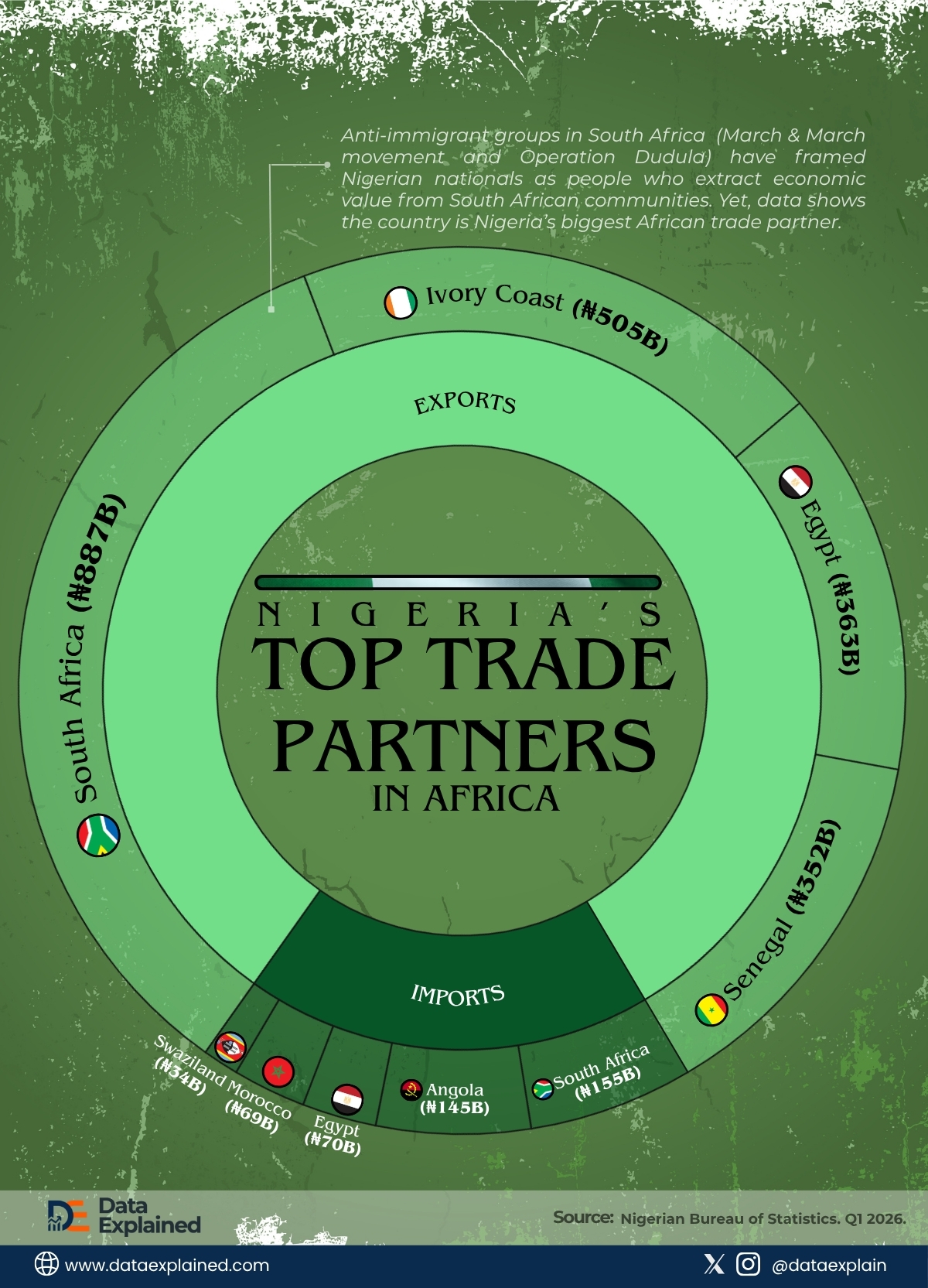
According to NBS data, Nigeria imported N155.26 billion from South Africa and exported N887.13 billion to South Africa between January and March 2026.
TL;DR
- In the first three months of 2026, South Africa ranked as Nigeria’s most significant bilateral African trade partner, with combined import and export volumes of approximately N1.04 trillion.
- Nigeria runs an approximately N731.87 billion trade surplus with South Africa (exporting nearly six times as many goods to South Africa as it imports).
| wdt_ID | wdt_created_by | wdt_created_at | wdt_last_edited_by | wdt_last_edited_at | Country | Trade type | Value (N bn) | Share (%) |
|---|---|---|---|---|---|---|---|---|
| 1 | emmanuel-ashemiriogwa | 19/06/2026 10:21 AM | emmanuel-ashemiriogwa | 19/06/2026 10:21 AM | South Africa | Import | 155 | 23.71 |
| 2 | emmanuel-ashemiriogwa | 19/06/2026 10:21 AM | emmanuel-ashemiriogwa | 19/06/2026 10:21 AM | Angola | Import | 145 | 22.21 |
| 3 | emmanuel-ashemiriogwa | 19/06/2026 10:21 AM | emmanuel-ashemiriogwa | 19/06/2026 10:21 AM | Egypt | Import | 70 | 10.69 |
| 4 | emmanuel-ashemiriogwa | 19/06/2026 10:21 AM | emmanuel-ashemiriogwa | 19/06/2026 10:21 AM | Morocco | Import | 69 | 10.48 |
| 5 | emmanuel-ashemiriogwa | 19/06/2026 10:21 AM | emmanuel-ashemiriogwa | 19/06/2026 10:21 AM | Swaziland | Import | 34 | 5.17 |
| 6 | emmanuel-ashemiriogwa | 19/06/2026 10:21 AM | emmanuel-ashemiriogwa | 19/06/2026 10:21 AM | Togo | Export | 1,076 | 26.49 |
| 7 | emmanuel-ashemiriogwa | 19/06/2026 10:21 AM | emmanuel-ashemiriogwa | 19/06/2026 10:21 AM | South Africa | Export | 887 | 21.84 |
| 8 | emmanuel-ashemiriogwa | 19/06/2026 10:21 AM | emmanuel-ashemiriogwa | 19/06/2026 10:21 AM | Ivory Coast | Export | 505 | 12.44 |
| 9 | emmanuel-ashemiriogwa | 19/06/2026 10:21 AM | emmanuel-ashemiriogwa | 19/06/2026 10:21 AM | Egypt | Export | 363 | 8.94 |
| 10 | emmanuel-ashemiriogwa | 19/06/2026 10:21 AM | emmanuel-ashemiriogwa | 19/06/2026 10:21 AM | Senegal | Export | 352 | 8.66 |
The Trade Surplus That Contradicts the Narrative
Anti-immigrant groups in South Africa have framed Nigerian nationals as people who extract economic value from South African communities.
This includes the March and March movement, as well as Operation Dudula.
Their actions involved taking jobs and business opportunities from local citizens.
However, the NBS trade data describes a different economic relationship.
Nigeria exports approximately N887 billion worth of goods to South Africa quarterly. It imports approximately N155 billion back.
The net surplus, approximately N731.87 billion in Nigeria’s favor, means Nigeria contributes more to South Africa’s trade balance than South Africa contributes to Nigeria’s, by a ratio of nearly six to one.
The trade relationship that the anti-immigrant groups are implicitly threatening is a relationship that currently benefits South Africa on balance, not just Nigeria.
Meanwhile, it’s important to note that the Q1 2026 NBS data predates the April-May 2026 violence by weeks.
ALSO READ: Mapped: South Africa’s Xenophobic Violence, by Province
The Togo Question
Togo ranks as Nigeria’s largest African export destination at N1,076.33 billion (26.49% of all documented Nigerian exports to African partners in Q1 2026)
Togo is a country of approximately 9 million people.
The volume does not represent Togolese domestic consumption of Nigerian goods. It represents the Lomé corridor.
In other words, Togo’s port serves as a West African transshipment hub, with goods declared as Nigerian exports to Togo subsequently:
- Redistributed across the region
- Re-exported to third countries
- Moved through informal cross-border networks.
Nigeria’s officially documented top African export partner is almost certainly not Nigeria’s top African consumer market.
The same transshipment logic applies at the import end.
Swaziland (officially the Kingdom of Eswatini), a landlocked country of approximately 1.1 million people entirely surrounded by South Africa, is Nigeria’s fifth-largest African import source, with imports totaling N33.89 billion.
Eswatini has no major port, no direct shipping route to Nigeria, and no obvious manufacturing base generating N33.89 billion in quarterly goods flows.
The figure likely captures South African goods channeled through Eswatini’s trade corridors and recorded in official Nigerian import statistics.
ALSO READ: Africa’s Population On Track to Hit 2.5 billion By 2050
What the Attacks Put at Risk
The xenophobic violence of 2026 has produced repatriations from Ghana, Malawi, and Mozambique, a formal African Union debate request from Ghana, and direct diplomatic engagement between Nigerian and South African foreign ministers.
The NBS data adds a specific economic dimension to that diplomatic picture.
That is because Nigeria’s approximately N1.04 trillion in quarterly bilateral trade with South Africa is at economic risk if the diplomatic fallout from the violence disrupts trade.
South Africa’s anti-immigrant groups do not appear to be operating with awareness of the NBS data.
The economic argument animating the attacks (that Nigerian nationals extract value from South Africa) is partially contradicted by the trade statistics of the country being attacked.
ELI5 (Explain It Like I’m 5)
South Africa is attacking Nigerian nationals while being Nigeria’s biggest African trading partner. Nigeria actually sells six times as many goods to South Africa as it buys from South Africa, meaning Nigeria helps South Africa’s economy more than South Africa helps Nigeria’s. The official data also show something strange: tiny Togo is technically Nigeria’s largest African export market, largely because goods pass through Togo’s port to reach other countries. The attacks are putting a trillion-naira trade relationship at risk.
Source:
Nigerian Bureau of Statistics (NBS)