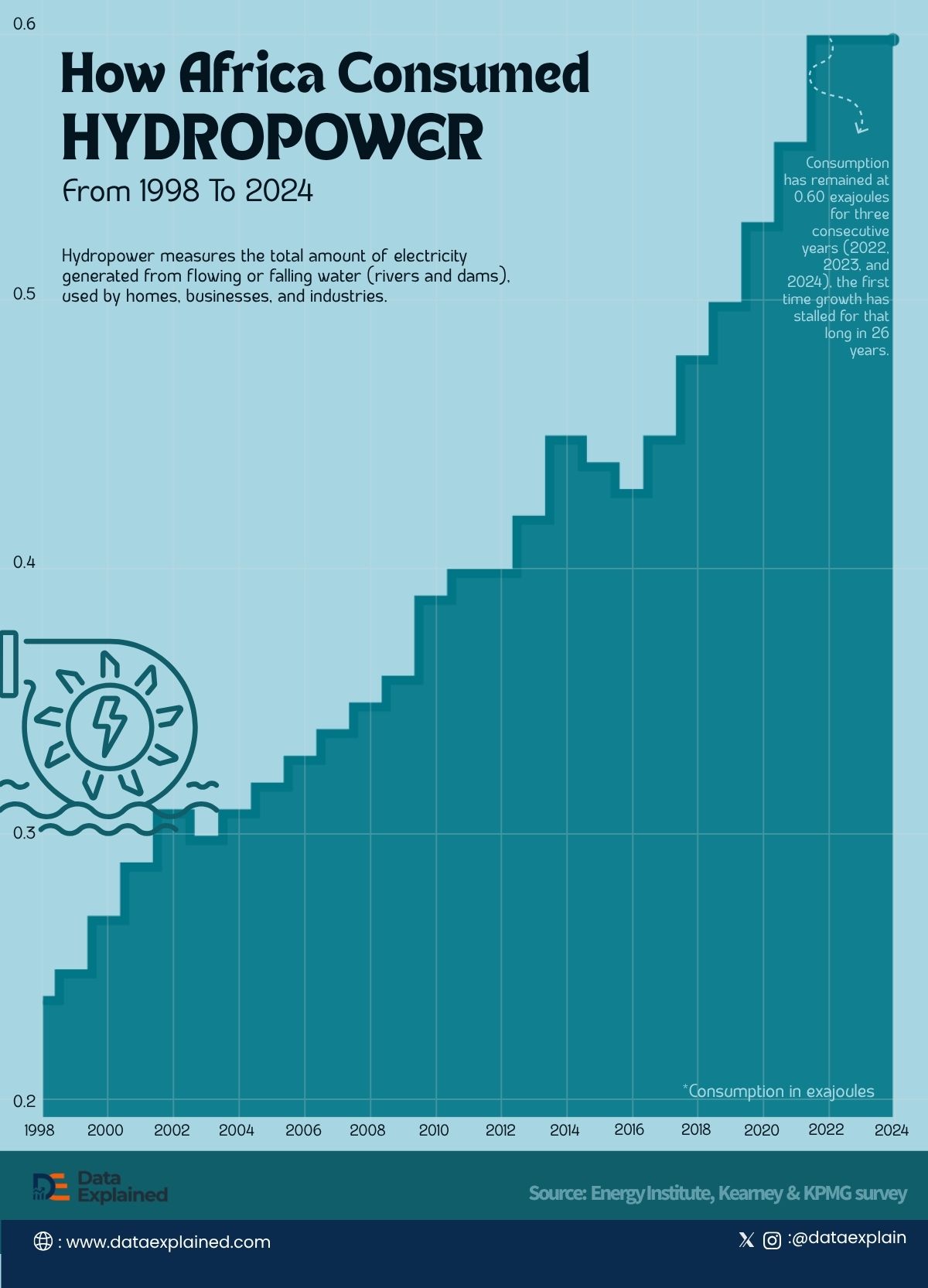
The chart above shows Hydropower consumption in Africa from 1998 to 2024.
Africa’s hydropower consumption has not grown in three years.
In 2022, the continent consumed 0.60 exajoules of hydropower, and that has remained flat until 2024.
The data comes from the Energy Institute’s statistical review, which is based on surveys conducted by Kearney and KPMG.
In 26 years of recorded data stretching back to 1998, this has never happened before.
Do You Know?
- Consuming 0.60 exajoules of hydropower amounts to about 167 terawatt-hours of electricity, which is like running the entire country of Argentina, or about 6 million average US homes, for a whole year using only the power of rushing river water.
ALSO READ: Charted: America’s Major Source of Renewable Energy Since 2000
TL;DR
- Africa’s hydropower consumption has remained at exactly 0.60 exajoules for three consecutive years (2022, 2023, and 2024), the first time growth has stalled for that long in 26 years.
- The continent saw its hydropower consumption grow by 150% between 1998 and 2022.
- Africa holds some of the world’s greatest untapped hydropower resources, yet its entire continental output equals that of Norway.
| wdt_ID | wdt_created_by | wdt_created_at | wdt_last_edited_by | wdt_last_edited_at | Years | Consumption in exajoules |
|---|---|---|---|---|---|---|
| 1 | Monica Ebunoluwa | 04/08/2026 01:41 PM | Monica Ebunoluwa | 04/08/2026 01:41 PM | 2024 | 0.60 |
| 2 | Monica Ebunoluwa | 04/08/2026 01:41 PM | Monica Ebunoluwa | 04/08/2026 01:41 PM | 2023 | 0.60 |
| 3 | Monica Ebunoluwa | 04/08/2026 01:41 PM | Monica Ebunoluwa | 04/08/2026 01:41 PM | 2022 | 0.60 |
| 4 | Monica Ebunoluwa | 04/08/2026 01:41 PM | Monica Ebunoluwa | 04/08/2026 01:41 PM | 2021 | 0.56 |
| 5 | Monica Ebunoluwa | 04/08/2026 01:41 PM | Monica Ebunoluwa | 04/08/2026 01:41 PM | 2020 | 0.53 |
| 6 | Monica Ebunoluwa | 04/08/2026 01:41 PM | Monica Ebunoluwa | 04/08/2026 01:41 PM | 2019 | 0.50 |
| 7 | Monica Ebunoluwa | 04/08/2026 01:41 PM | Monica Ebunoluwa | 04/08/2026 01:41 PM | 2018 | 0.48 |
| 8 | Monica Ebunoluwa | 04/08/2026 01:41 PM | Monica Ebunoluwa | 04/08/2026 01:41 PM | 2017 | 0.45 |
| 9 | Monica Ebunoluwa | 04/08/2026 01:41 PM | Monica Ebunoluwa | 04/08/2026 01:41 PM | 2016 | 0.43 |
| 10 | Monica Ebunoluwa | 04/08/2026 01:41 PM | Monica Ebunoluwa | 04/08/2026 01:41 PM | 2015 | 0.44 |
Quarter Century of Steady Expansion
Africa’s hydropower consumption stood at 0.24 exajoules in 1998.
By 2024 it had reached 0.60, a 150% increase over 26 years. The growth came in phases, interrupted twice by forces.
- The first interruption came in 2003, when consumption dipped from 0.31 to 0.30 exajoules.
- The second came in 2015 and 2016, when output fell from 0.45 to 0.44 to 0.43 exajoules across two consecutive years.
Both dips connect directly to drought.
The 2015-2016 decline coincided with one of the strongest El Niño events on record, which drastically reduced rainfall across East and Southern Africa.
In Zambia, water levels at the Kariba Dam fell so severely that the government imposed rolling electricity blackouts lasting up to 18 hours per day.
The decade of Acceleration
Between 2010 and 2019, Africa recorded its fastest sustained period of hydropower growth, according to the data.
Consumption rose from 0.39 exajoules to 0.50 exajoules—a 28% increase, driven in part by a wave of new project completions.
For example, Ethiopia’s Gilgel Gibe III, one of Africa’s largest hydropower plants at 1,870 megawatts, was commissioned in 2016.
Guinea’s Kaleta Dam came online in 2015.
Meanwhile, expansions across the Congo Basin added further capacity.
The acceleration continued into the early 2020s. Between 2019 and 2022, consumption jumped from 0.50 to 0.60 exajoules (the fastest three-year increase on record), partly driven by the Grand Ethiopian Renaissance Dam (GERD) beginning electricity generation in 2022.
At 6,450 megawatts when fully operational, GERD is Africa’s largest hydropower plant.
Its commissioning contributed to the step-change that brought the continental figure to 0.60 exajoules. It has not moved since.
So What?
Climate change is intensifying drought frequency across the Sahel, East Africa, and Southern Africa.
These are the same regions where hydropower facilities are most concentrated.
A drier continent produces less from its dams. The 2003 dip and the 2015-2016 decline both suggest that when rainfall drops, continental consumption declines.
At the same time, solar energy is expanding rapidly across East and West Africa, absorbing electricity demand that might otherwise have driven hydropower consumption higher.
Where a new dam takes a decade to plan, finance, and build, solar panels can be deployed in months.
ELI5
Africa uses water from rivers and dams to generate electricity, and that usage grew steadily for over 20 years.
But for the past three years it has completely stopped growing, stuck at the same level.
This is partly because drought is reducing river water levels, partly because solar power is growing faster, and partly because the continent’s largest potential dam projects remain unbuilt.
Meanwhile, 600 million Africans still lack reliable electricity.
Source:
Energy Institute, sourced via surveys by Kearney and KPMG.