Several countries, including Ghana, Malawi, and Mozambique, have recently repatriated their nationals due to safety concerns.
Manipulated videos, fabricated crime reports, and misleading social media content have circulated widely in South Africa’s 2026 xenophobic violence wave, portraying migrants as responsible for criminal activity or economic decline.
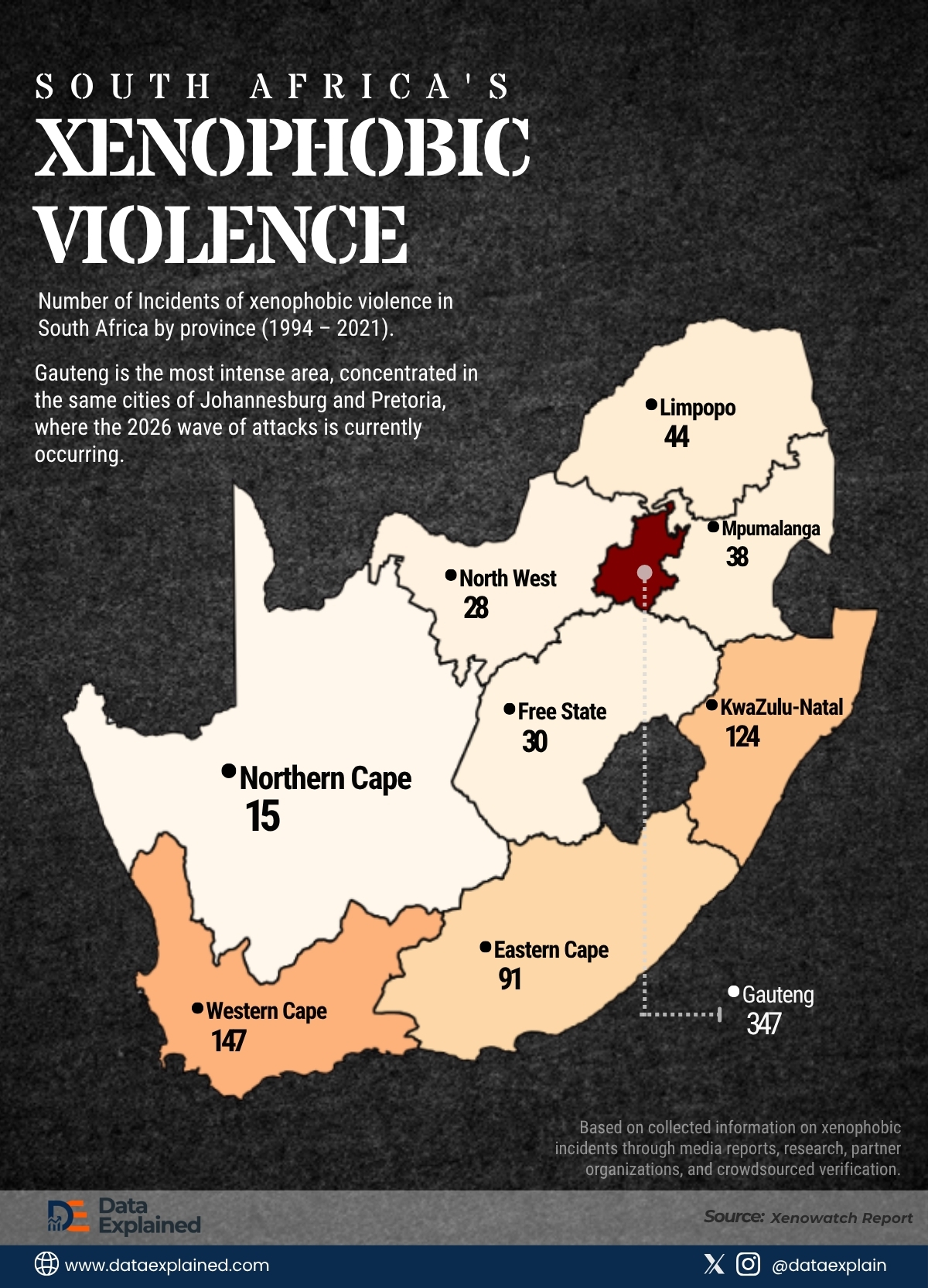
The graphic above shows the number of reported incidents of xenophobic violence in South Africa by province from 1994 to 2021.
This data comes from The Xenowatch Report.
It is based on collected information on xenophobic incidents through media reports, research, partner organizations, and crowdsourced verification
The cities currently generating the most alarming reports are the same ones that have dominated three decades of historical data.
TL;DR
- Gauteng alone accounts for 347 of xenophobic incidents (39.7%), concentrated in the same Johannesburg and Pretoria cities where the 2026 wave of attacks is currently occurring.
- The current 2026 wave, driven by anti-immigrant groups including the March and March movement and Operation Dudula, is occurring at South Africa’s worst recorded unemployment level of over 43%
ALSO READ: Charted: All African Nobel Laureate Winners
Where the Incidents Concentrate
| wdt_ID | wdt_created_by | wdt_created_at | wdt_last_edited_by | wdt_last_edited_at | Province | Total number of incidents |
|---|---|---|---|---|---|---|
| 1 | emmanuel-ashemiriogwa | 19/06/2026 07:20 AM | emmanuel-ashemiriogwa | 19/06/2026 07:20 AM | Gauteng | 347 |
| 2 | emmanuel-ashemiriogwa | 19/06/2026 07:20 AM | emmanuel-ashemiriogwa | 19/06/2026 07:20 AM | Western Cape | 147 |
| 3 | emmanuel-ashemiriogwa | 19/06/2026 07:20 AM | emmanuel-ashemiriogwa | 19/06/2026 07:20 AM | KwaZulu-Natal | 124 |
| 4 | emmanuel-ashemiriogwa | 19/06/2026 07:20 AM | emmanuel-ashemiriogwa | 19/06/2026 07:20 AM | Eastern Cape | 91 |
| 5 | emmanuel-ashemiriogwa | 19/06/2026 07:20 AM | emmanuel-ashemiriogwa | 19/06/2026 07:20 AM | Limpopo | 44 |
| 6 | emmanuel-ashemiriogwa | 19/06/2026 07:20 AM | emmanuel-ashemiriogwa | 19/06/2026 07:20 AM | Mpumalanga | 38 |
| 7 | emmanuel-ashemiriogwa | 19/06/2026 07:20 AM | emmanuel-ashemiriogwa | 19/06/2026 07:20 AM | Free State | 30 |
| 8 | emmanuel-ashemiriogwa | 19/06/2026 07:20 AM | emmanuel-ashemiriogwa | 19/06/2026 07:20 AM | North West | 28 |
| 9 | emmanuel-ashemiriogwa | 19/06/2026 07:20 AM | emmanuel-ashemiriogwa | 19/06/2026 07:20 AM | Northern Cape | 15 |
| 10 | emmanuel-ashemiriogwa | 19/06/2026 07:20 AM | emmanuel-ashemiriogwa | 19/06/2026 07:20 AM | Unallocated | 9 |
Gauteng records the highest number of incidents, at 347.
The province contains Johannesburg and Pretoria.
It is the economic hub of sub-Saharan Africa, the largest destination for foreign nationals seeking work, and the location of the April and May 2026 demonstrations organized by groups including the March and March movement.
Human Rights Watch documented violent and sometimes fatal results from protests in Pretoria, Johannesburg, and Durban, with little apparent police response.
Western Cape follows at 147 incidents (16.8%), then KwaZulu-Natal at 124 (14.2%).
Malawi said it was bringing hundreds more citizens home by bus from Durban. Durban is KwaZulu-Natal’s largest city.
The province ranks third in the historical dataset for a specific reason: the 2008 outbreak (the deadliest in the period at 62 people killed) began in KwaZulu-Natal before spreading nationally.
Since that 2008 violence, South Africa has been grappling with intermittent but widespread xenophobic harassment against African and Asian foreign nationals, with sporadic waves erupting in 2015, 2019, and 2021-2022.
ALSO READ: Mapped: Majority of Humans Live With Restricted Freedom of Expression
What Drives the Number?
South Africa’s unemployment rate exceeds 43%.
The Xenowatch data covers a 27-year period during which unemployment moved from approximately 20% in the late 1990s to its current historic high.
The 2026 wave is occurring at the highest sustained unemployment level in the dataset’s entire corresponding period.
Vigilante groups feed off the country’s frustrations and socioeconomic rights regression, unemployment, and lack of efforts to address the equity gaps that we have as a country, according to activists at the Kopanang Africa Against Xenophobia coalition.
A 2018 Pew Research poll found that 62% of South Africans expressed negative sentiment toward foreign nationals.
It revealed that they believed immigrants are a burden on society by taking jobs and social benefits.
In that same poll, 61% thought immigrants were more responsible for crime than other groups.
Migration researchers and economists consistently dispute those claims, noting that migrants account for a small percentage of South Africa’s population and contribute significantly through entrepreneurship and trade.
There’s an Undercount Problem
The 873-incident figure is a floor, not a complete accounting.
Many incidents go unreported due to fear of retaliation, arrest, or deportation.
The South African government has also disputed specific death counts from the 2026 violence.
For example, South Africa’s foreign ministry disputed accounts of Ethiopian and Mozambican nationals killed, saying the Ethiopian deaths were due to organized crime rather than xenophobic violence, while Mozambican deaths remained under investigation.
The definitional gap between what governments count as xenophobic and what communities experience as xenophobic is part of why Xenowatch’s multi-source methodology exists.
The Xenowatch dataset ends in November 2021 with 873 incidents.
The 2026 additions to that count have not yet been documented in a comparable report. When they are, Gauteng will almost certainly still lead.
ALSO READ: Africa’s Population On Track to Hit 2.5 billion By 2050
ELI5 (Explain It Like I’m 5)
South Africa has had 873 documented attacks on foreign African nationals since 1994, with Gauteng province (home to Johannesburg) accounting for 40% of all incidents. This violence has happened every few years since apartheid ended.
The latest wave in 2026 is in the same cities that the data always highlighted. Unemployment above 43% is fuelling the attacks, even though experts say migrants don’t actually cause unemployment.
Countries like Ghana, Malawi, and Nigeria are now flying their citizens home to safety.
Source: