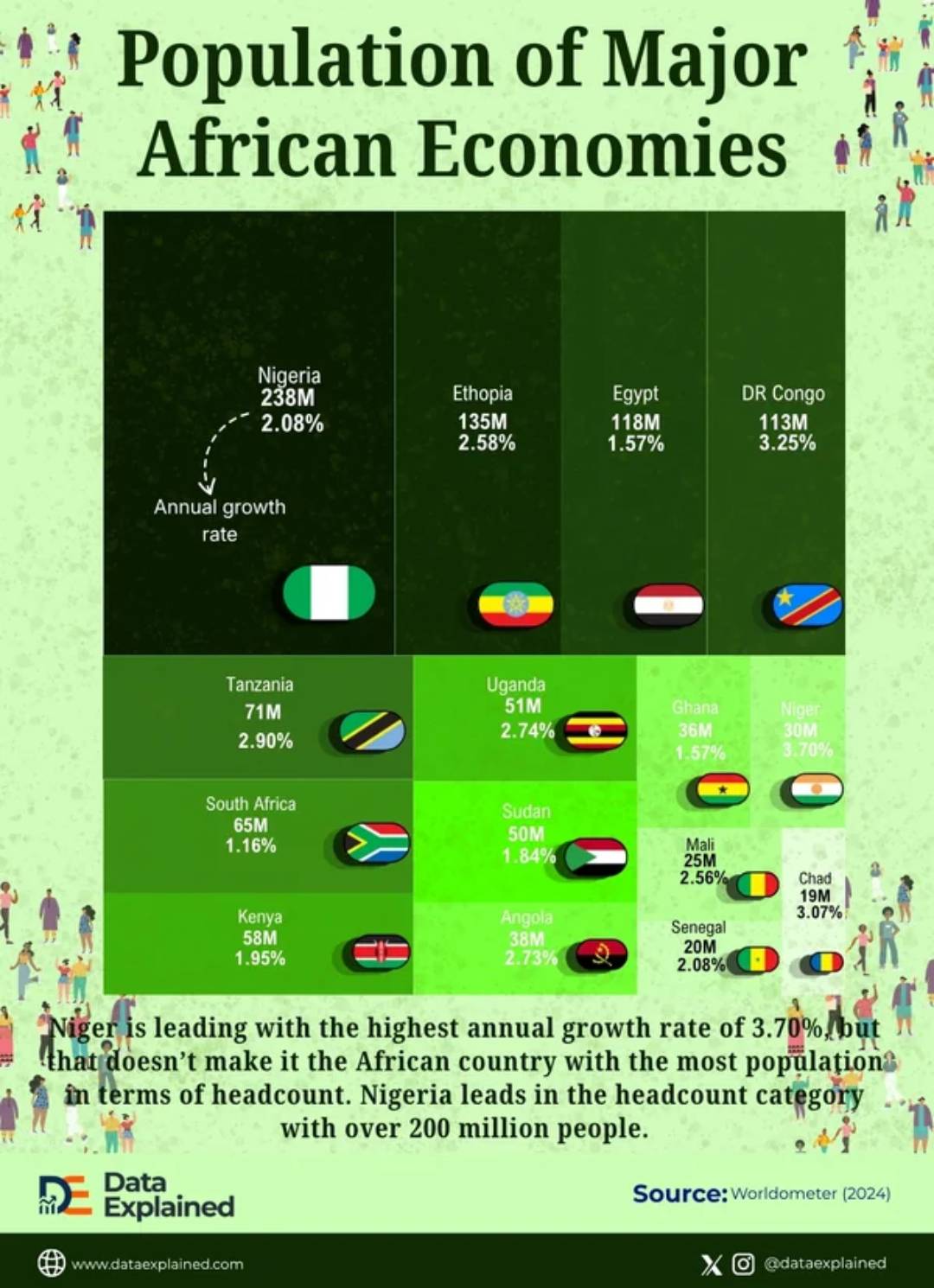
Africa’s population is growing faster than any other region in the world.
Population growth rate represents the annual percentage change in a country’s population, determined by the balance of births, deaths, and migration over a given period.
TL;DR
- Nigeria leads in headcount, while Niger leads in annual population growth rate.
- Africa’s population is projected to reach 2.5 billion by 2050, more than one-quarter of the world’s population.
- 60% of the African population is 24 years old and below.
This is gathered from Worldometer’s 2024 population estimates and the United Nations DESA demographic projections.
Top-Ranking Countries by Growth Rate (2025)
Niger leads with the highest annual growth rate of 3.70%, but that doesn’t make it the African country with the largest population by headcount.
Nigeria leads in the headcount category with over 237.5 million people.
| wdt_ID | wdt_created_by | wdt_created_at | wdt_last_edited_by | wdt_last_edited_at | Rank | Country | Population (2025 est.) | Annual Growth Rate (%) |
|---|---|---|---|---|---|---|---|---|
| 1 | Monica Ebunoluwa | 20/04/2026 03:46 PM | Monica Ebunoluwa | 20/04/2026 03:46 PM | 1 | Niger | 29,816,000 | 3.70 |
| 2 | Monica Ebunoluwa | 20/04/2026 03:46 PM | Monica Ebunoluwa | 20/04/2026 03:51 PM | 2 | DR Congo | 112,832,000 | 3.25 |
| 3 | Monica Ebunoluwa | 20/04/2026 03:46 PM | Monica Ebunoluwa | 20/04/2026 03:46 PM | 3 | Chad | 19,449,000 | 3.07 |
| 4 | Monica Ebunoluwa | 20/04/2026 03:46 PM | Monica Ebunoluwa | 20/04/2026 03:46 PM | 4 | Tanzania | 70,545,000 | 2.90 |
| 5 | Monica Ebunoluwa | 20/04/2026 03:46 PM | Monica Ebunoluwa | 20/04/2026 03:46 PM | 5 | Uganda | 51,384,000 | 2.74 |
| 6 | Monica Ebunoluwa | 20/04/2026 03:46 PM | Monica Ebunoluwa | 20/04/2026 03:46 PM | 6 | Angola | 37,771,000 | 2.73 |
| 7 | Monica Ebunoluwa | 20/04/2026 03:46 PM | Monica Ebunoluwa | 20/04/2026 03:52 PM | 7 | Ethiopia | 135,472,000 | 2.58 |
| 8 | Monica Ebunoluwa | 20/04/2026 03:46 PM | Monica Ebunoluwa | 20/04/2026 03:46 PM | 8 | Mali | 24,705,000 | 2.56 |
| 9 | Monica Ebunoluwa | 20/04/2026 03:46 PM | Monica Ebunoluwa | 20/04/2026 03:52 PM | 9 | Nigeria | 237,528,000 | 2.08 |
| 10 | Monica Ebunoluwa | 20/04/2026 03:46 PM | Monica Ebunoluwa | 20/04/2026 03:46 PM | 10 | Senegal | 19,584,000 | 2.08 |
Interestingly, Africa’s fastest-growing populations are concentrated mainly in the Sahel and Central Africa, where fertility rates remain among the highest in the world.
In contrast, Northern and Southern Africa show signs of demographic transition, with growth gradually slowing as education, urbanization, and access to healthcare expand.
Countries With Low Growth Rate
Some African nations, particularly in the north and south, are experiencing a steady slowdown in population growth.
| wdt_ID | wdt_created_by | wdt_created_at | wdt_last_edited_by | wdt_last_edited_at | Country | Population (2025 est.) | Annual Growth Rate (%) |
|---|---|---|---|---|---|---|---|
| 1 | Monica Ebunoluwa | 20/04/2026 03:22 PM | Monica Ebunoluwa | 20/04/2026 03:22 PM | Mauritius | 1,268,280 | −0.23 |
| 2 | Monica Ebunoluwa | 20/04/2026 03:22 PM | Monica Ebunoluwa | 20/04/2026 03:22 PM | Cabo Verde | 527,326 | 0.47 |
| 3 | Monica Ebunoluwa | 20/04/2026 03:22 PM | Monica Ebunoluwa | 20/04/2026 03:22 PM | Tunisia | 12,348,573 | 0.58 |
| 4 | Monica Ebunoluwa | 20/04/2026 03:22 PM | Monica Ebunoluwa | 20/04/2026 03:22 PM | Morocco | 38,430,770 | 0.92 |
| 5 | Monica Ebunoluwa | 20/04/2026 03:22 PM | Monica Ebunoluwa | 20/04/2026 03:22 PM | Libya | 7,458,555 | 1.05 |
| 6 | Monica Ebunoluwa | 20/04/2026 03:22 PM | Monica Ebunoluwa | 20/04/2026 03:22 PM | South Africa | 64,747,000 | 1.16 |
| 7 | Monica Ebunoluwa | 20/04/2026 03:22 PM | Monica Ebunoluwa | 20/04/2026 03:22 PM | Algeria | 47,435,312 | 1.33 |
| 8 | Monica Ebunoluwa | 20/04/2026 03:22 PM | Monica Ebunoluwa | 20/04/2026 03:59 PM | Egypt | 118,366,000 | 1.57 |
Egypt stands out, with its annual growth rate falling to about 1.57% in 2023, the lowest in decades.
The decline is linked to improved access to education, urbanization, and family planning campaigns such as the government’s Two Is Enough initiative.
Similarly, Algeria and Tunisia have both seen fertility rates drop below 2.8 births per woman, according to data from Macrotrends and the Institute for Security Studies (ISS Africa).
Rising education levels, later marriages, and greater use of contraception have contributed to this shift.
In South Africa, population growth now averages around 1.2 % per year.
Declining fertility and outward migration are slowing expansion, signaling an advanced stage of demographic transition compared with much of Sub-Saharan Africa.
Regional Patterns
In the Sahel, countries such as Niger, Chad, and Mali record some of the continent’s highest growth rates, averaging about 3% a year.
High fertility and gradual declines in infant mortality continue to sustain rapid expansion in these areas.
In Central Africa, nations such as the Democratic Republic of the Congo and Angola maintain similarly high rates, supported by young populations and improving health conditions.
Economic disparities and limited access to reproductive healthcare have slowed the pace of demographic transition.
East Africa shows steady but moderating growth. The populations in Kenya, Tanzania, and Ethiopia, for instance, grow by 2%-2.9% annually.
Expanding education and urbanization are beginning to influence family size and fertility decisions.
Meanwhile, North Africa and Southern Africa are seeing slower increases, around 1–1.5%, as fertility rates decline and living standards rise.
Drivers of High Growth Rate
Africa’s high population growth is mainly sustained by elevated fertility rates.
Cultural norms, limited access to contraception, and lower female education levels keep birth rates high.
A young population also drives momentum. About 60% of Africans are under 25, meaning more people are entering childbearing age each year. Even as fertility begins to fall, the number of births remains large.
At the same time, mortality rates are declining, thanks to better healthcare and nutrition.
Internal migration, especially toward urban centers and resource-rich countries, adds to population concentration, further sustaining growth in key regions.
Projections & What’s Ahead (2030–2050)
Africa’s population is projected to rise from 1.5 billion in 2025 to about 2.5 billion by 2050, according to the United Nations.
The fastest-growing countries, such as Niger, the Democratic Republic of Congo, Tanzania, and Uganda, will account for much of this increase.
These nations are expected to double their populations within the next 25 years if current fertility patterns continue.
By contrast, regions in North and Southern Africa will experience slower expansion as fertility stabilizes and median ages increase.
Egypt, Algeria, and South Africa are projected to approach replacement-level fertility before 2050, reflecting a shift toward urban, aging populations.
Overall, Africa will remain the youngest continent, with about one in four people worldwide living there by mid-century.
This growth presents both opportunities and pressures, driving labor force expansion and market potential while also testing infrastructure, education, and resource systems across the continent.
ELI5
Africa’s population is growing really fast. By 2050, there could be 67% as many people as today.
Countries like Niger, Congo, and Tanzania will grow the most. However, growth rate doesn’t mean the most populous. Nigeria remains the most populous country in Africa.
Source: