In late March 2026, jurors in California found that Meta Platforms and Google were partly responsible for the depression and anxiety of a woman who began compulsively using social media as a child.
The jury awarded $6 million in damages ($3 million in compensatory and $3 million in punitive), with Meta responsible for 70% of the total.
While the financial penalty is small compared with the companies’ vast resources, legal observers say the decision is significant because it marks one of the first times a jury has treated social media apps as potentially defective products engineered in ways that can harm young users.
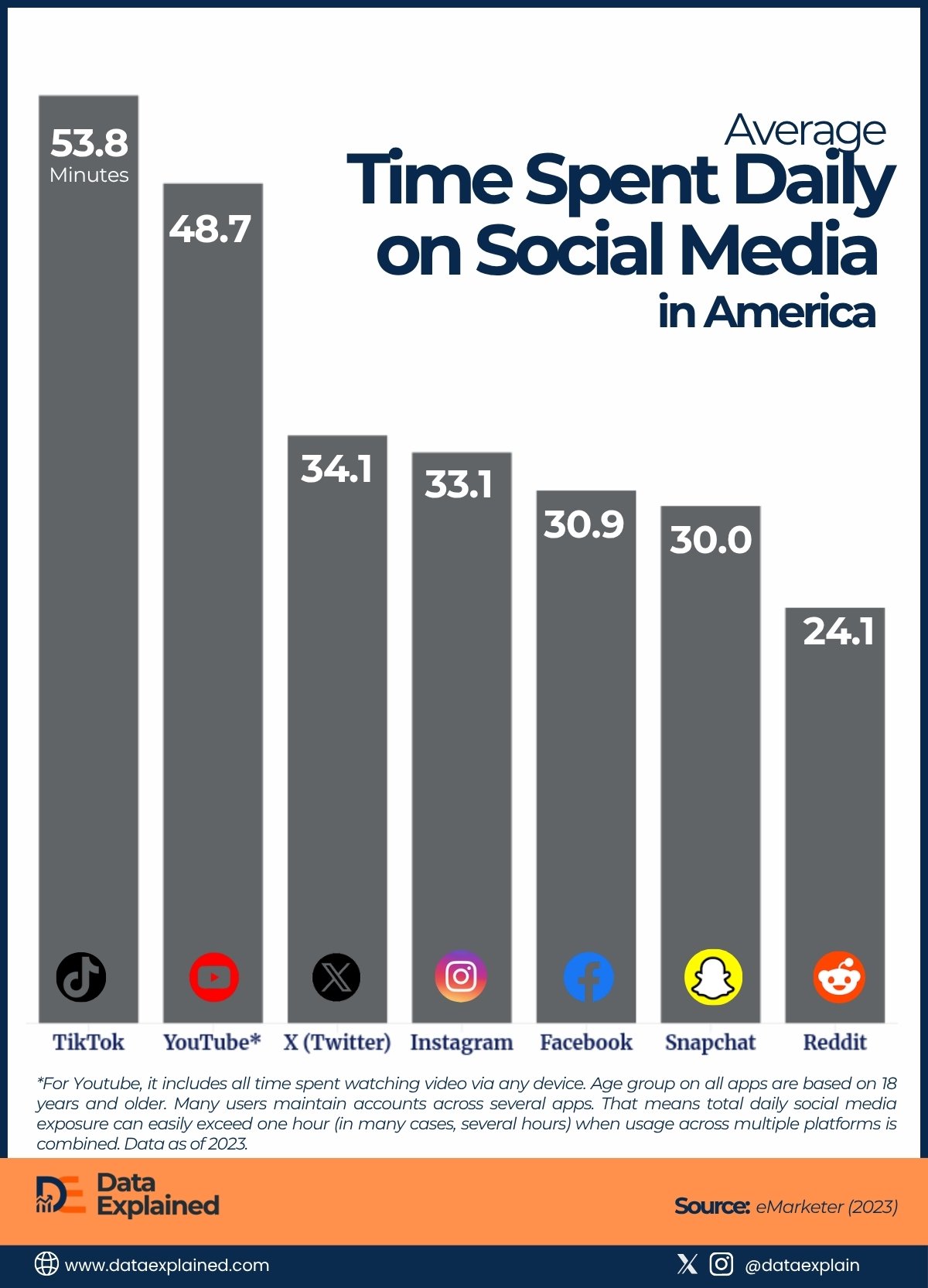
In light of that, today’s visualization shows the average time spent per day on select social media platforms among adults aged 18 years and above in the United States as of 2023.
TL;DR
- Americans aged 18 and older spent an average of 53.8 minutes per day on TikTok, the highest among all tracked social media platforms.
- Correlation does not necessarily mean causation when it comes to mental health and technology use
The data comes from eMarketer.
Ranked: Average Time Spent Daily on Select Social Media Platforms
| wdt_ID | wdt_created_by | wdt_created_at | wdt_last_edited_by | wdt_last_edited_at | Platform | Time spent in minutes |
|---|---|---|---|---|---|---|
| 1 | emmanuel-ashemiriogwa | 07/04/2026 03:16 PM | emmanuel-ashemiriogwa | 07/04/2026 03:16 PM | TikTok | 53.80 |
| 2 | emmanuel-ashemiriogwa | 07/04/2026 03:16 PM | emmanuel-ashemiriogwa | 07/04/2026 03:16 PM | YouTube* | 48.70 |
| 3 | emmanuel-ashemiriogwa | 07/04/2026 03:16 PM | emmanuel-ashemiriogwa | 07/04/2026 03:16 PM | 34.10 | |
| 4 | emmanuel-ashemiriogwa | 07/04/2026 03:16 PM | emmanuel-ashemiriogwa | 07/04/2026 03:16 PM | 33.10 | |
| 5 | emmanuel-ashemiriogwa | 07/04/2026 03:16 PM | emmanuel-ashemiriogwa | 07/04/2026 03:16 PM | 30.90 | |
| 6 | emmanuel-ashemiriogwa | 07/04/2026 03:16 PM | emmanuel-ashemiriogwa | 07/04/2026 03:16 PM | Snapchat | 30.00 |
| 7 | emmanuel-ashemiriogwa | 07/04/2026 03:16 PM | emmanuel-ashemiriogwa | 07/04/2026 03:16 PM | 24.10 |
For context, while each number refers to time spent on a single platform, many users maintain accounts across several apps.
That means total daily social media exposure can easily exceed one hour (in many cases, several hours) when usage across multiple platforms is combined.
Nearly an Hour a Day on TikTok
Data from research firm eMarketer shows that Americans aged 18 and older spent an average of 53.8 minutes per day on TikTok, the highest among major social platforms.
In other words, TikTok users spend more than 5 minutes per day longer on the platform than YouTube users and roughly 20 minutes more than users on Instagram or Twitter.
That difference matters because time spent is often viewed as the clearest measure of engagement.
Platforms invest heavily in design features intended to keep users watching, scrolling, and returning.
Short-form video platforms, in particular, rely on rapid, personalized recommendations that deliver new content continuously.
This design style encourages long viewing sessions and frequent repeat visits.
But platforms such as Reddit, where the average time spent was about 24 minutes per day, often rely more on text discussions and slower-paced interaction.
Correlation Is Not Causation, But Exposure Matters
Researchers have long warned that correlation does not necessarily mean causation when it comes to mental health and technology use.
Factors such as family environment, sleep patterns, school stress, and offline relationships all influence emotional well-being. Simply spending time on social media does not automatically lead to anxiety or depression.
However, the scale of time spent has raised concerns among policymakers and researchers alike.
Longer usage times increase the likelihood of:
- Repeated exposure to algorithmically selected content
- Targeted advertising
- Social comparison
In legal settings, the argument is shifting from whether platforms cause harm directly to whether their design choices increase risk.
From Screen Time to Courtroom Evidence
The growing scale of daily social media exposure is central to the legal arguments emerging in recent lawsuits.
In the California case, jurors concluded that platform design choices (rather than simple user preference) played a role in fostering compulsive use.
The case focused on exposure beginning in childhood, when brain development and impulse control are still forming.
Although usage data alone cannot prove that social media causes mental health problems, high engagement levels help explain why regulators and courts are taking a closer look.
Source: