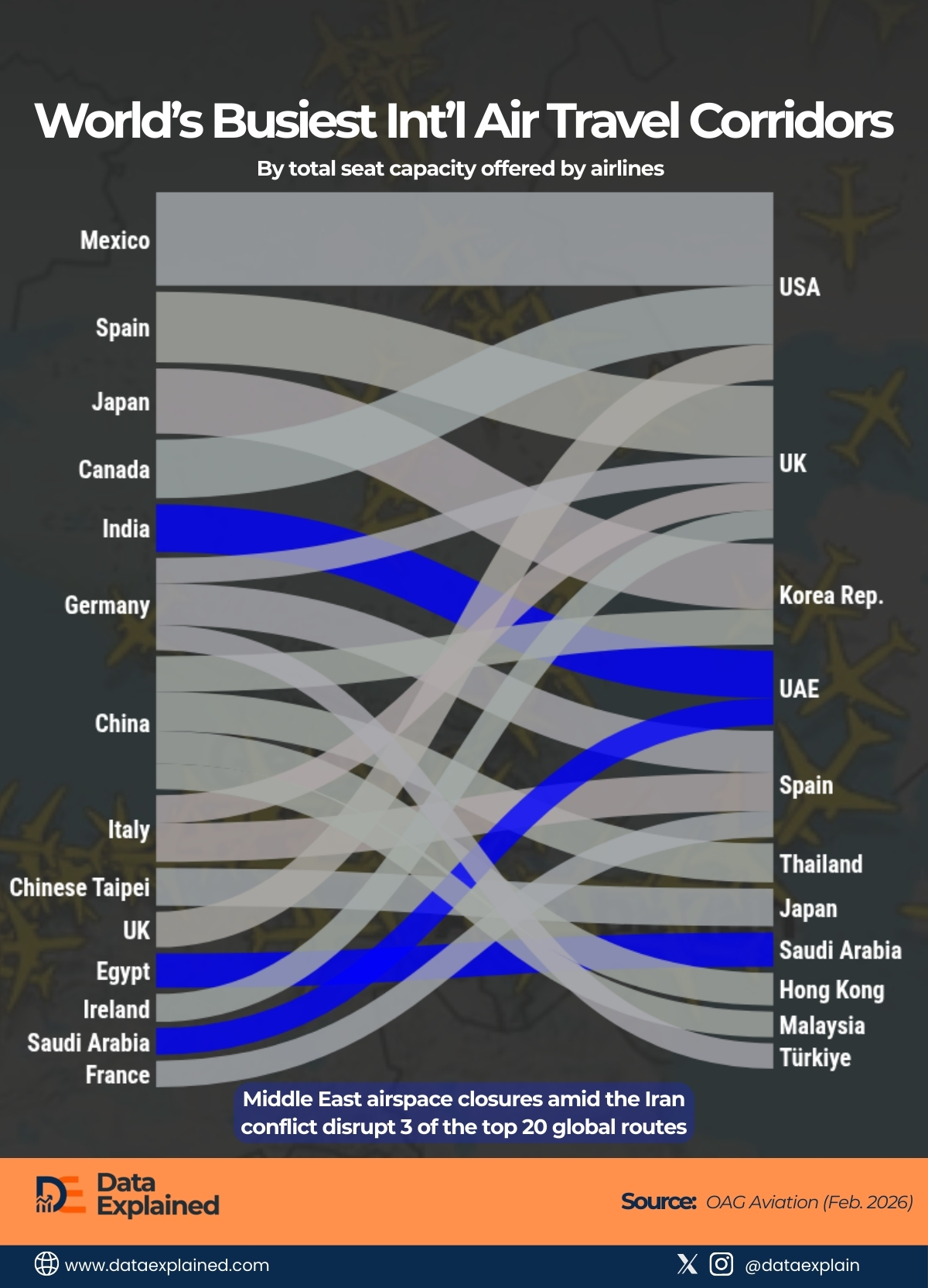
Amid the ongoing U.S.-Iran tension, the top 20 destinations for airline frequency contain Middle Eastern countries caught up in the war.
Dubai International Airport, the world’s busiest for international passengers, anchors two of the globe’s top 20 flight routes with a combined 3.2 million monthly seats.
This turned Monday’s strike amid Iran’s retaliatory attacks into a global aviation nightmare that ripples far beyond the Middle East.
The visualization above shows the busiest international air corridors in the world, ranked by total seat capacity (supply) offered by airlines, rather than actual passengers (demand). It is as of February 2026.
The data comes from OAG, a leading aviation data platform.
TL;DR
- Middle East airspace closures amid the Iran conflict disrupt three of the top 20 global routes, stranding millions and increasing fuel costs by 20%.
- Dubai, the world’s busiest international hub with 3.2 million seats on affected routes, turns regional strikes into a global crisis by disrupting transit links for Asia-Europe-Africa.
| wdt_ID | wdt_created_by | wdt_created_at | wdt_last_edited_by | wdt_last_edited_at | Rank | From Country | To Country | Number of Seats |
|---|---|---|---|---|---|---|---|---|
| 1 | emmanuel-ashemiriogwa | 05/03/2026 11:15 AM | emmanuel-ashemiriogwa | 05/03/2026 11:15 AM | 1 | Mexico | USA | 4,112,126.00 |
| 2 | emmanuel-ashemiriogwa | 05/03/2026 11:15 AM | emmanuel-ashemiriogwa | 05/03/2026 11:15 AM | 2 | Spain | United Kingdom | 3,099,508.00 |
| 3 | emmanuel-ashemiriogwa | 05/03/2026 11:15 AM | emmanuel-ashemiriogwa | 05/03/2026 11:15 AM | 3 | Japan | Republic of Korea | 2,860,218.00 |
| 4 | emmanuel-ashemiriogwa | 05/03/2026 11:15 AM | emmanuel-ashemiriogwa | 05/03/2026 11:15 AM | 4 | Canada | USA | 2,576,117.00 |
| 5 | emmanuel-ashemiriogwa | 05/03/2026 11:15 AM | emmanuel-ashemiriogwa | 05/03/2026 11:15 AM | 5 | India | United Arab Emirates | 2,084,744.00 |
| 6 | emmanuel-ashemiriogwa | 05/03/2026 11:15 AM | emmanuel-ashemiriogwa | 05/03/2026 11:15 AM | 6 | Germany | Spain | 1,836,316.00 |
| 7 | emmanuel-ashemiriogwa | 05/03/2026 11:15 AM | emmanuel-ashemiriogwa | 05/03/2026 11:15 AM | 7 | China | Thailand | 1,717,336.00 |
| 8 | emmanuel-ashemiriogwa | 05/03/2026 11:15 AM | emmanuel-ashemiriogwa | 05/03/2026 11:15 AM | 8 | Italy | Spain | 1,689,348.00 |
| 9 | emmanuel-ashemiriogwa | 05/03/2026 11:15 AM | emmanuel-ashemiriogwa | 05/03/2026 11:15 AM | 9 | Chinese Taipei | Japan | 1,651,813.00 |
| 10 | emmanuel-ashemiriogwa | 05/03/2026 11:15 AM | emmanuel-ashemiriogwa | 05/03/2026 11:15 AM | 10 | United Kingdom | USA | 1,566,553.00 |
India-UAE: The Critical Route in Crisis
The India-UAE corridor ranks fifth worldwide with 2,084,744 seats scheduled for February 2026, serving as a crucial link for millions of South Asian migrant workers commuting to Gulf countries.
Due to the Iran conflict, airspace closures have grounded flights, leaving over 2 million potential monthly passengers stranded and disrupting billions in remittances.
CNN reported that Dubai International Airport, a major hub for this route, suffered minor damage from an explosion during Iran’s retaliatory strikes, leading to a complete halt in operations.
Debris from intercepted missiles and drones injured staff members, increasing chaos at one of the world’s busiest airports.
This crisis severely impacts the 3.5 million Indian expatriates in the UAE, many of whom are low-wage workers dependent on affordable flights home.
However, media coverage often underestimates the scale, neglecting the human and economic toll on migrant communities.
According to a recent AOL report, rerouting flights through safer regions like the Caucasus adds hours and raises fuel costs by 20%, threatening the long-term sustainability of airlines such as Emirates and IndiGo.
If the situation remains unresolved, it could alter global migration trends in the region.
Dubai: More Than Point-to-Point
Dubai ranks in the top 20 airport routes, number 5 (India-UAE, 2.08 million seats) and number 16 (Saudi Arabia-UAE, 1.17 million seats), with over 3.2 million seats in February 2026.
According to OAG, Dubai International (DXB) is the world’s busiest international airport, handling 4.9 million seats per month and serving as a key global hub.
Dubai is also a major transit hub, connecting Asia, Europe, Africa, and beyond via airlines such as Emirates.
Recent Iranian strikes have halted operations, stranding millions and disrupting connections. The closures affect entire networks, with rerouted flights adding hours and increasing fuel costs by 20%.
This shows how one hub’s closure can disrupt international travel on a large scale.
While Emirates and others are gradually resuming flights, ongoing conflicts threaten longer disruptions.
Double Closure Problem
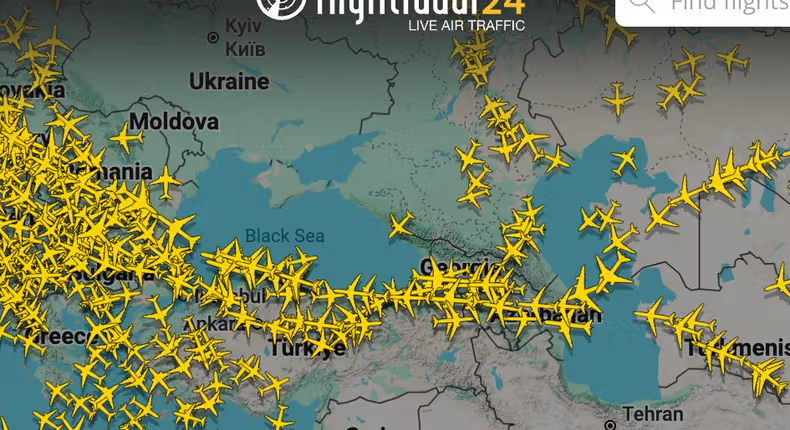
The Russia-Ukraine conflict has long cut off northern routes, forcing Europe-Asia flights to take southern detours through the Middle East.
Now, escalating tensions in Iran have closed the southern airspace over Iran, Iraq, and nearby countries.
This double blockade constricts transcontinental travel into narrow corridors such as the Caucasus region north of Iran.
Reports from Business Insider, airlines are now routing through Armenia, Georgia, and Azerbaijan, but even these corridors are near Russian airspace.
It comes down to this:
- Flights are experiencing significant detours, adding hours to travel times and increasing fuel costs by up to 20%, Reuters reported.
- Airline capacity is decreasing as schedules become more strained, which could lead to global fare increases.
ELI5
The airspace over the Middle East is closed. This is because of a fight between Iran and other countries.
Many planes can’t fly over this area now. Three big routes in the world are blocked. These routes go from India to the UAE, from Egypt to Saudi Arabia, and from Saudi Arabia to the UAE.
Because of this, many people are stuck. Fuel prices have gone up by 20%. That means it costs more to fly planes.
Dubai is one of the busiest airports in the world. It has 3.2 million seats on the affected routes. When planes can’t fly, it causes problems for many other places.
There are also other problems. Russia and Ukraine closed some northern roads. Now, there are new shutdowns in the south. This makes planes fly very long routes, resulting in higher costs and fewer passengers.
Sources:
OAG, CNN, AOL, USAToday, JakartaGlobe, PBS News, Business Insider, Reuters