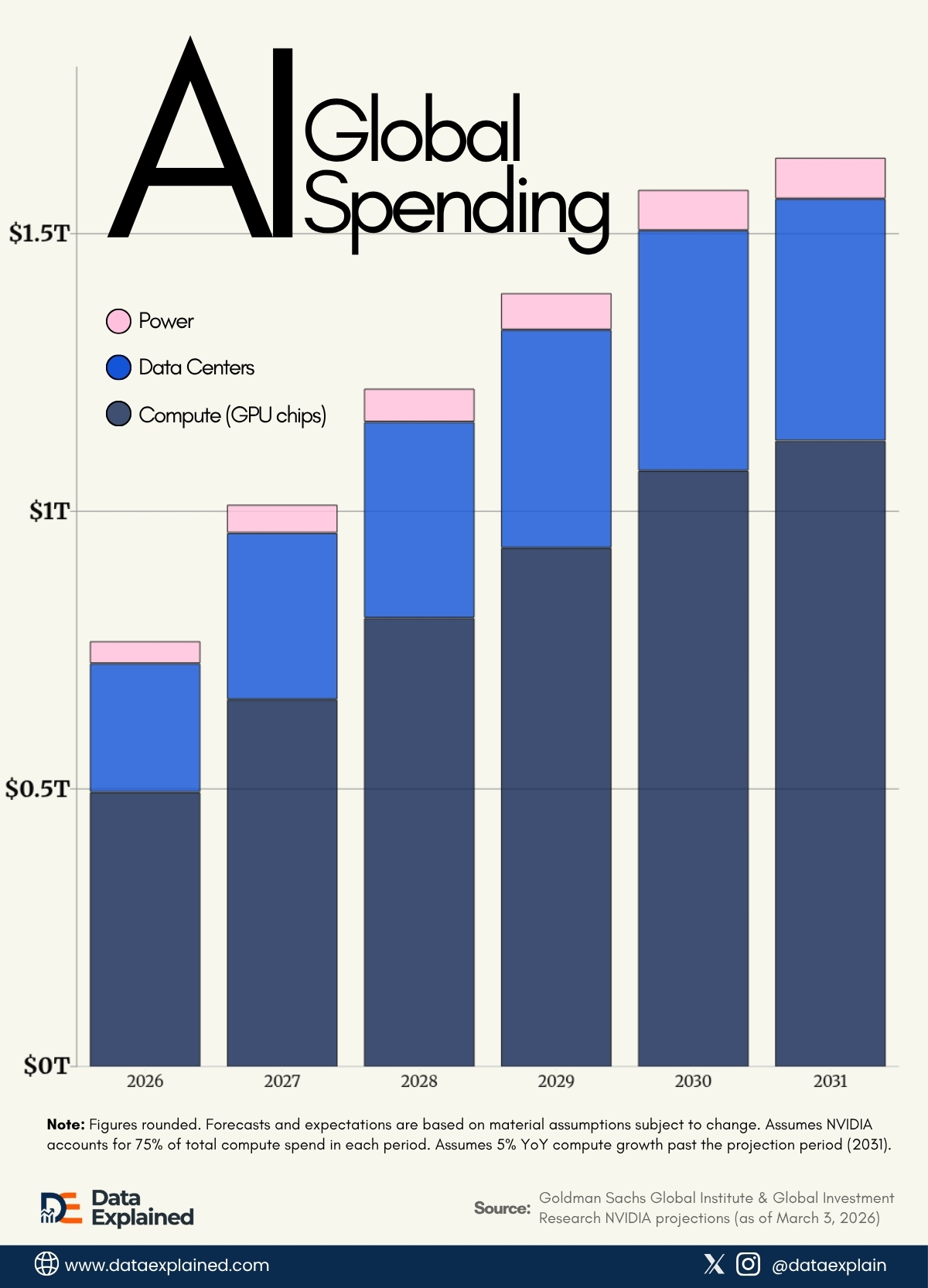
The world is projected to spend $7.6 trillion building the infrastructure that powers artificial intelligence (AI).
The visual above shows the baseline aggregate AI capital expenditure
It comes from the estimate prepared by Goldman Sachs Global Institute and Goldman Sachs Global Investment Research as of March 3, 2026.
The projection covers six years (2026 through 2031) across three categories: compute (chips and processors), data centers (the physical buildings and cooling systems), and power (energy infrastructure).
TL;DR
- Compute, primarily GPU chips, dominates the spending at approximately $5.1 trillion of the $7.6 trillion total
- Annual AI spending growth is decelerating sharply within the same projection: the 2026-to-2027 jump is 32.2%.
- The boom phase lasts approximately four years before the trajectory approaches maturity
AI Infrastructure Spend Projections (2026 – 2031)
| wdt_ID | wdt_created_by | wdt_created_at | wdt_last_edited_by | wdt_last_edited_at | Year | Compute ($bn) | Data Centers ($bn) | Power ($bn) | Total Projection ($bn) |
|---|---|---|---|---|---|---|---|---|---|
| 1 | emmanuel-ashemiriogwa | 20/06/2026 05:27 PM | emmanuel-ashemiriogwa | 20/06/2026 05:27 PM | 2026 | 494 | 232 | 39 | 765 |
| 2 | emmanuel-ashemiriogwa | 20/06/2026 05:27 PM | emmanuel-ashemiriogwa | 20/06/2026 05:27 PM | 2027 | 661 | 300 | 50 | 1,011 |
| 3 | emmanuel-ashemiriogwa | 20/06/2026 05:27 PM | emmanuel-ashemiriogwa | 20/06/2026 05:27 PM | 2028 | 808 | 353 | 59 | 1,220 |
| 4 | emmanuel-ashemiriogwa | 20/06/2026 05:27 PM | emmanuel-ashemiriogwa | 20/06/2026 05:27 PM | 2029 | 934 | 393 | 65 | 1,392 |
| 5 | emmanuel-ashemiriogwa | 20/06/2026 05:27 PM | emmanuel-ashemiriogwa | 20/06/2026 05:27 PM | 2030 | 1,073 | 433 | 72 | 1,578 |
| 6 | emmanuel-ashemiriogwa | 20/06/2026 05:27 PM | emmanuel-ashemiriogwa | 20/06/2026 05:27 PM | 2031 | 1,127 | 436 | 73 | 1,636 |
As shown in the table above, annual AI infrastructure spending in 2026 is $765 billion.
By 2027, it is projected to exceed $1 trillion, reaching $1,011 billion. By 2031, it will reach $1,636 billion, which is more than double the 2026 baseline.
The pattern in the data shows rapid acceleration followed by a sharp deceleration.
The 2026-to-2027 increase is $246 billion (a 32.2% jump). The 2027-to-2028 increase is $209 billion (20.7%). By 2029- 2030, the annual increase has fallen to $187 billion (13.4%).
ALSO READ: Top AI Chatbot Market Share in Africa
Who Gets the Money?
Compute is the dominant category by a significant margin. It gets $494 billion in 2026, rising to $1,127 billion in 2031.
Across the full six-year projection, compute totals approximately $5.1 trillion of the $7.6 trillion aggregate.
Data centers account for approximately $2.1 trillion. Power accounts for approximately $358 billion.
The Goldman Sachs model’s most specific assumption sits inside the compute category.
NVIDIA is assumed to account for 75% of total compute spend in each year of the projection. At 75% of $5.1 trillion, NVIDIA’s implied AI-specific revenue over six years is approximately $3.8 trillion.
The $7.6 trillion global AI infrastructure projection is simultaneously a single-company revenue forecast.
The model uses NVIDIA’s VR200 Rubin chip as the baseline specification ($80,500 per GPU, including node costs, 3,000 watts per package) as the price basis across all years.
ALSO READ: Market Size of Generative AI Tools by Category
Chip Efficiency Counter-Argument
This forecast comes fourteen months after DeepSeek demonstrated that highly capable AI reasoning could be achieved at significantly lower compute costs.
That event briefly triggered global debate about whether trillion-dollar infrastructure projections were overbuilt.
Goldman Sachs maintained its trajectory.
Lower unit costs for AI computation typically lead to more applications and users, rather than lower total spending. Historically, efficiency gains have expanded demand rather than compressed capital requirements.
The March 2026 projection also postdates the Trump administration’s Stargate initiative, a $500 billion AI infrastructure commitment announced in January 2025, as well as Microsoft’s $80 billion data center plan.
The Scale in Context
The $1.6 tillion projected for 2031 alone exceeds the annual GDP of South Korea, Australia, and Spain.
The cumulative $7.6 trillion over six years exceeds Japan’s GDP, the world’s fourth-largest economy.
ELI5 (Explain It Like I’m 5)
Goldman Sachs says the world will spend $7.6 trillion building the computers, buildings, and electricity systems that run AI between 2026 and 2031. Most of that money (about $5 trillion) goes on computer chips, and one company (NVIDIA) is expected to get about 75% of that chip spending. Annual spending is growing fast, but will slow significantly by 2031. Surprisingly, electricity infrastructure (the biggest bottleneck for AI) gets less than 5% of the total projected spending.
Source:
Goldman Sachs Global Institute and Goldman Sachs Global Investment Research