Prime Minister Sir Keir Starmer announced this week that children under 16 in the United Kingdom will be banned from accessing TikTok, Snapchat, Instagram, and a range of other social media platforms.
Regulation is expected before Christmas 2026. Enforcement begins in spring 2027.
In a similar vein, we investigated the status of social media bans for kids across America.
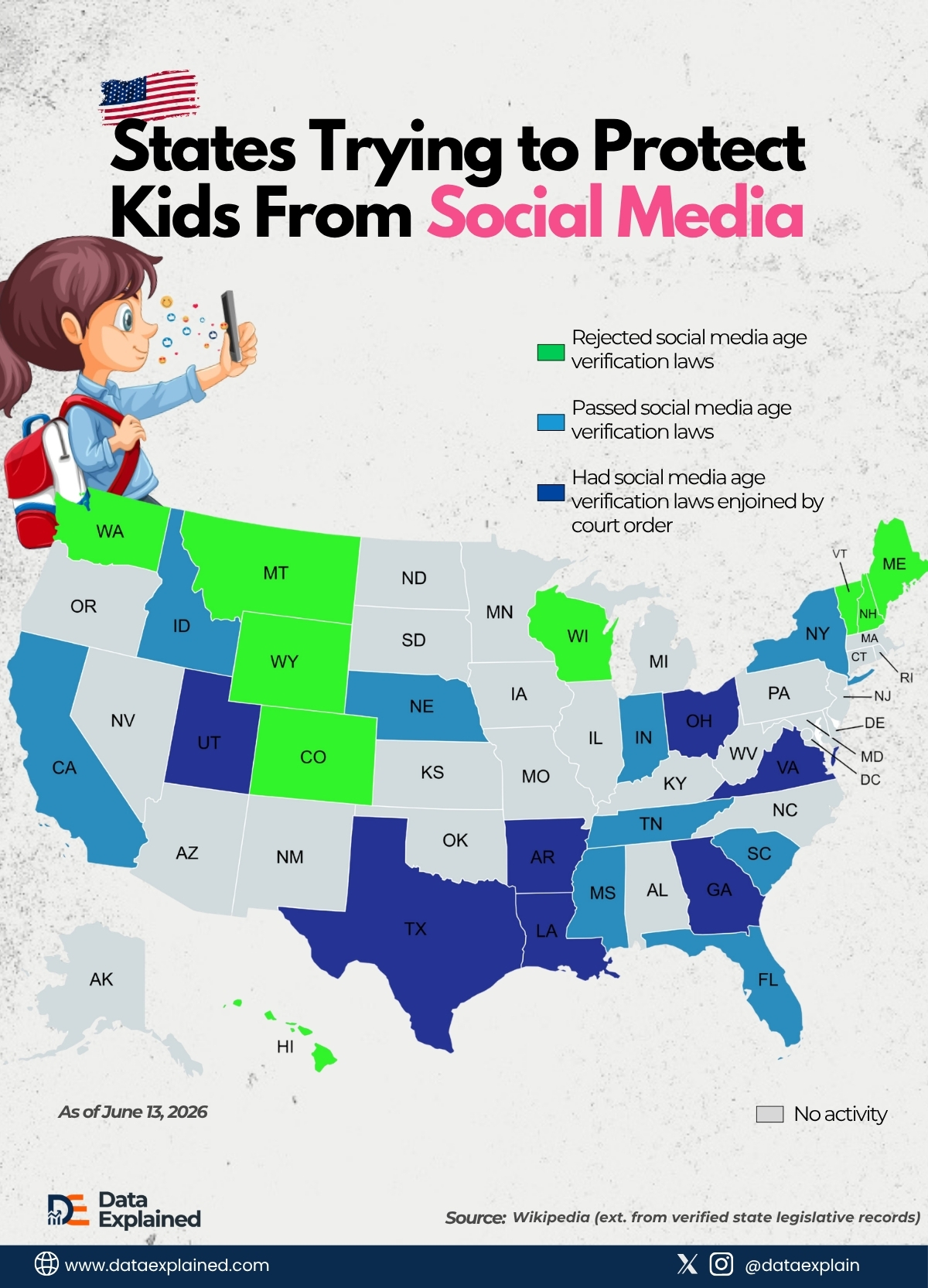
The map above is based on aggregated data from Wikipedia’s verified state legislative records and shows where the United States stood on the same question as of June 13, 2026.
The picture it shows is fundamentally different.
TL;DR
- As of June 13, 2026, approximately 9 U.S. states have active social media age verification laws
- Approximately 8 have passed laws that courts have subsequently blocked through injunctions
- Approximately 28 states have taken no visible legislative action.
| wdt_ID | wdt_created_by | wdt_created_at | wdt_last_edited_by | wdt_last_edited_at | State | Authority | Signed | Effective |
|---|---|---|---|---|---|---|---|---|
| 1 | emmanuel-ashemiriogwa | 16/06/2026 02:24 PM | emmanuel-ashemiriogwa | 16/06/2026 02:24 PM | California | Gavin Newsom | September 15, 2022 (AB 2273) September 20, 2024 (SB 976) March 2026 (AB 1043) | Both partly enjoined, January 1, 2027 (AB 1043) |
| 2 | emmanuel-ashemiriogwa | 16/06/2026 02:24 PM | emmanuel-ashemiriogwa | 16/06/2026 02:24 PM | Utah | Spencer Cox | March 23, 2023 | Preliminarily enjoined |
| 3 | emmanuel-ashemiriogwa | 16/06/2026 02:24 PM | emmanuel-ashemiriogwa | 16/06/2026 02:24 PM | Arkansas | Sarah Huckabee Sanders | April 11, 2023 | Permanently enjoined |
| 4 | emmanuel-ashemiriogwa | 16/06/2026 02:24 PM | emmanuel-ashemiriogwa | 16/06/2026 02:24 PM | Texas | Greg Abbott | June 13, 2023 | Partly enjoined |
| 5 | emmanuel-ashemiriogwa | 16/06/2026 02:24 PM | emmanuel-ashemiriogwa | 16/06/2026 02:24 PM | Louisiana | John Bel Edwards | June 28, 2023 | Permanently enjoined |
| 6 | emmanuel-ashemiriogwa | 16/06/2026 02:24 PM | emmanuel-ashemiriogwa | 16/06/2026 02:24 PM | Ohio | Mike DeWine | July 4, 2023 | Permanently enjoined |
| 7 | emmanuel-ashemiriogwa | 16/06/2026 02:24 PM | emmanuel-ashemiriogwa | 16/06/2026 02:24 PM | Florida | Ron DeSantis | March 25, 2024 | November 25, 2025 |
| 8 | emmanuel-ashemiriogwa | 16/06/2026 02:24 PM | emmanuel-ashemiriogwa | 16/06/2026 02:24 PM | Georgia (U.S. state) | Brian Kemp | April 23, 2024 | Preliminarily enjoined |
| 9 | emmanuel-ashemiriogwa | 16/06/2026 02:24 PM | emmanuel-ashemiriogwa | 16/06/2026 02:24 PM | Mississippi | Tate Reeves | April 30, 2024 | July 17, 2025 |
| 10 | emmanuel-ashemiriogwa | 16/06/2026 02:24 PM | emmanuel-ashemiriogwa | 16/06/2026 02:24 PM | Tennessee | Bill Lee | May 2, 2024 | January 1, 2025 |
ALSO READ: TikTok Ranks as Most Addictive Social Media Platform
What Does the Map Prove?
The U.S. map is divided into four categories.
- Green states have rejected age-verification laws through their legislatures (approximately 6 states, including Washington, Montana, Wyoming, Colorado, Maine, and Hawaii).
- Light blue states have passed laws that are currently active and not blocked (approximately 9 states, including Florida, New York, Tennessee, Indiana, Idaho, and Wisconsin).
- Dark navy states passed laws that courts subsequently enjoined through legal orders suspending enforcement (approximately 8 states, including Texas, Utah, Arkansas, Louisiana, Mississippi, Georgia, Virginia, and Ohio).
- The grey majority (approximately 28 states) have neither passed nor rejected anything, and have no active law in either direction.
The Court Injunction Problem
Nearly as many states have tried and been stopped as have succeeded.
The mechanism stopping them is the First Amendment.
Courts reviewing age-verification legislation have accepted arguments that requiring users to verify their age before accessing social media constitutes an unconstitutional prior restraint on protected speech.
That argument has worked in federal courts reviewing laws in Texas, Utah, Arkansas, Louisiana, Mississippi, Georgia, Virginia, and Ohio.
The same political profile appears across most of the blocked states.
For example, conservative-led legislatures passing child protection legislation, only to see federal courts suspend those laws on free speech grounds.
Legislators intending to restrict minors’ access are producing laws blocked by a constitutional framework designed to protect adults’ access.
ALSO READ: Top Countries Driving TikTok Traffic
California Sits Out
The grey state that draws the most analytical attention is California.
Meta is headquartered in Menlo Park. Google and YouTube are in Mountain View. Snap is in Santa Monica. TikTok has operated its U.S. business from Los Angeles.
In other words, the state with the deepest institutional relationship to the social media industry (and the most politically active technology regulatory environment) has produced no visible age verification legislation.
The UK Difference
Australia passed a national social media ban for under-16s in late 2024. The UK has now announced the same, covering the platforms named most frequently in the child safety debate.
Both countries are implementing what the U.S. map shows the United States has been unable to coordinate.
The U.S. constitutional framework makes a direct federal-level equivalent unlikely without legislation specifically drafted to withstand First Amendment scrutiny.
The Children’s Online Privacy Protection Act (COPPA) addresses data privacy for children under 13, but not platform access.
Also, the Children’s Online Safety Act has been proposed and debated in Congress, but has not passed.
ELI5 (Explain It Like I’m 5)
Many US states tried to pass laws making kids prove their age before using social media. About 9 states have laws that work. But about 8 states passed laws that courts then blocked, saying they broke free speech rules. About 28 states, including California, haven’t done anything. Meanwhile, the UK recently announced a single nationwide rule banning all kids under 16 from TikTok and Instagram. The US has no such national rule, just a patchwork of state decisions.
Source:
UK Government | Wikipedia, aggregated verified state legislative records (as of June 13, 2026).