When Nigerian families complain of hard times, the fancy way to explain it is the high inflation rate.
As of November 2025, Nigeria’s inflation rate eased to 14.4%, which was the lowest in five years.
Ordinarily, that implies that prices have become more affordable. But it didn’t.
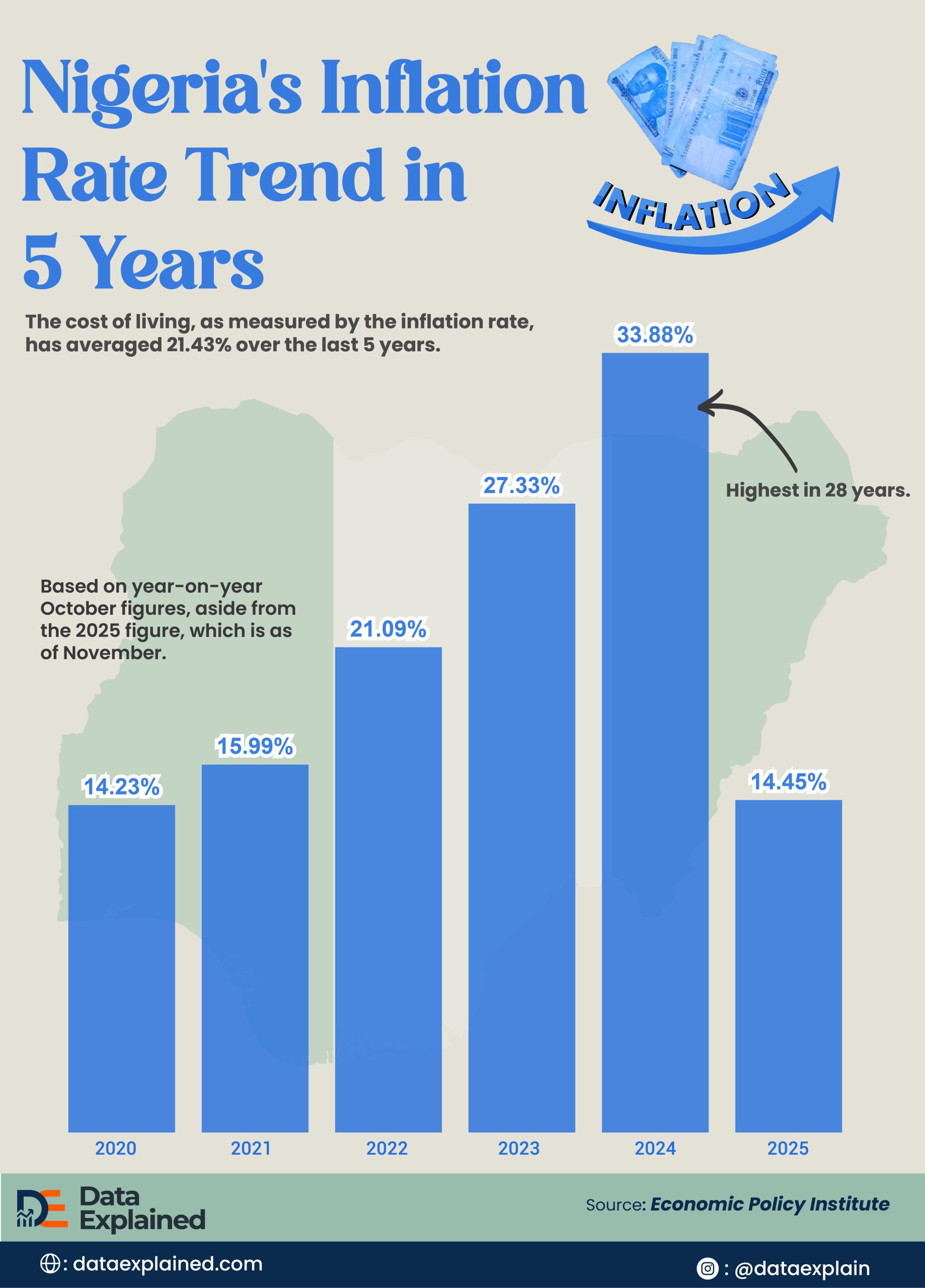
Over the past five years, Nigeria’s inflation has averaged 21.43%, peaking at 33.88% in 2024 due to economic shocks.
TL;DR
- In November 2025, Nigeria’s 14.45% inflation rate still surpassed the Sub-Saharan and West African averages, outpacing those of Kenya and South Africa.
- The 2026 tax reforms, including VAT exemptions on essentials, may reduce inflation by boosting disposable income and strengthening fiscal stability, despite short-term risks from fuel surcharges.
Today’s visualization shows the inflation rate trajectory of the West African country in the last five years, based on data from the National Bureau of Statistics (NBS)
Inflation Rate in 5 Years
Below is a table showing the inflation rate in 5 years.
| wdt_ID | wdt_created_by | wdt_created_at | wdt_last_edited_by | wdt_last_edited_at | Year | Inflation Rate (%) |
|---|---|---|---|---|---|---|
| 1 | Monica Ebunoluwa | 17/02/2026 09:48 AM | Monica Ebunoluwa | 17/02/2026 09:48 AM | 2020 | 14.23 |
| 2 | Monica Ebunoluwa | 17/02/2026 09:48 AM | Monica Ebunoluwa | 17/02/2026 09:48 AM | 2021 | 15.99 |
| 3 | Monica Ebunoluwa | 17/02/2026 09:48 AM | Monica Ebunoluwa | 17/02/2026 09:48 AM | 2022 | 21.09 |
| 4 | Monica Ebunoluwa | 17/02/2026 09:48 AM | Monica Ebunoluwa | 17/02/2026 09:48 AM | 2023 | 27.33 |
| 5 | Monica Ebunoluwa | 17/02/2026 09:48 AM | Monica Ebunoluwa | 17/02/2026 09:48 AM | 2024 | 33.88 |
| 6 | Monica Ebunoluwa | 17/02/2026 09:48 AM | Monica Ebunoluwa | 17/02/2026 09:48 AM | 2025 | 14.45 |
As shown, the average inflation rate in Nigeria from 2020 to 2025 is 21.43%, based on year-on-year October figures.
This was calculated by averaging the rates across years.
Inflation increased steadily from 14.23% in October 2020 to 33.88% in October 2024.
This was caused by rising food and energy prices, the removal of fuel subsidies, the naira devaluation, supply chain disruptions, and political instability.
These issues worsened the cost of living in both cities and the countryside.
In October 2025, inflation dropped to 16.05%.
The NBS noted that a slowdown in prices drove the drop, while increases across key segments, especially farm produce, utilities, clothing, and health, offset it.
What’s Driving Nigeria’s Inflation?
Nigeria’s inflation increased due to a weak exchange rate and high fuel prices following the removal of subsidies.
Recently, tighter monetary policies and improved food supplies have slowed this in 2025.
- The naira lost more than half its value from October 2023 to 2024 following currency liberalization, thereby making imports more expensive, particularly as oil prices fell.
- Before the removal of the subsidy in May 2023, fuel prices were regulated between N175 and N1,030 per litre.
- Food inflation rose due to insecurity, floods, low farm productivity, high transport costs driven by fuel prices, and an aging farming population.
However, in late 2025, good harvests reduced food inflation from 13.12% in October to 11.08% in November, driven by the suspension of import tariffs.
To control inflation, the Central Bank raised the policy rate to 27.25% in September 2024 and maintained it at this level in 2025.
This, along with increased oil production and a stable naira, helped lower inflation to 14.45% in November, the lowest since October 2020.
How Nigeria Compares Regionally
Nigeria’s inflation for November 2025 is 14.45%, higher than the IMF’s forecast of 13.1% for Sub-Saharan Africa.
This indicates that Nigeria remains vulnerable to a weaker naira, food supply issues, and rising energy costs, despite regional inflation decreasing due to lower global food and oil prices, tighter monetary policies, and improved harvests.
| wdt_ID | wdt_created_by | wdt_created_at | wdt_last_edited_by | wdt_last_edited_at | Country | Inflation | Period |
|---|---|---|---|---|---|---|---|
| 1 | Monica Ebunoluwa | 17/02/2026 10:16 AM | Monica Ebunoluwa | 17/02/2026 10:16 AM | South Sudan | 113.00 | 01/10/2024 |
| 2 | Monica Ebunoluwa | 17/02/2026 10:16 AM | Monica Ebunoluwa | 17/02/2026 10:16 AM | Nigeria | 14.40 | 01/11/2025 |
| 3 | Monica Ebunoluwa | 17/02/2026 10:16 AM | Monica Ebunoluwa | 17/02/2026 10:16 AM | Egypt* | 12.30 | 01/11/2025 |
| 4 | Monica Ebunoluwa | 17/02/2026 10:16 AM | Monica Ebunoluwa | 17/02/2026 10:16 AM | Kenya | 4.50 | 01/11/2025 |
| 5 | Monica Ebunoluwa | 17/02/2026 10:16 AM | Monica Ebunoluwa | 17/02/2026 10:16 AM | South Africa | 3.50 | 01/11/2025 |
In West Africa, Nigeria’s inflation is much higher than the West African Economic and Monetary Union (WAEMU) zone average of 1-3%.
While Ghana (6.3%), Senegal (2.9%), and Côte d’Ivoire (0%) have lower rates, Nigeria struggles more due to its reliance on imports and insecurity.
What 2026 Tax Reform Could Do To Nigeria’s Inflation Rate Trend
The 2025 Nigeria Tax Act that took effect from January 1, 2026, includes cutting VAT on essentials like food and medicine, which could make living costs lower and help curb inflation by giving low-income people more purchasing power.
At the same time, lower taxes for small businesses and lower rates might encourage people to spend and invest more, helping to control inflation if growth outpaces price increases.
However, a delayed 5% fuel surcharge could raise energy costs once it’s applied, leading to higher transport and goods prices.
Past reforms that removed subsidies have caused crises, so there’s a risk of similar issues arising.
With a proposed capital gains tax of 30%, investors may be hesitant at first, but offering incentives to reinvest could balance that out later.
ELI5: Nigeria’s Inflation Trend Over 5 Years
Inflation is that invisible hand reducing your power to buy the things you need.
In Nigeria, over the past five years (2020-2025), the average inflation rate increased from 21% yearly to 34% in 2024, primarily due to high fuel costs, food shortages, and a weak naira.
It fell to 16% in 2025, thanks to better harvests and government reforms.
Nigeria is just behind Sudan in the inflation rate rankings, and has higher numbers than many countries in Sub-Saharan Africa and West Africa, such as Ghana, Kenya, and South Africa.
Sources: