English proficiency influences access to education, employment, and international exchange.
It affects who can study abroad, compete in global business, and engage across borders.
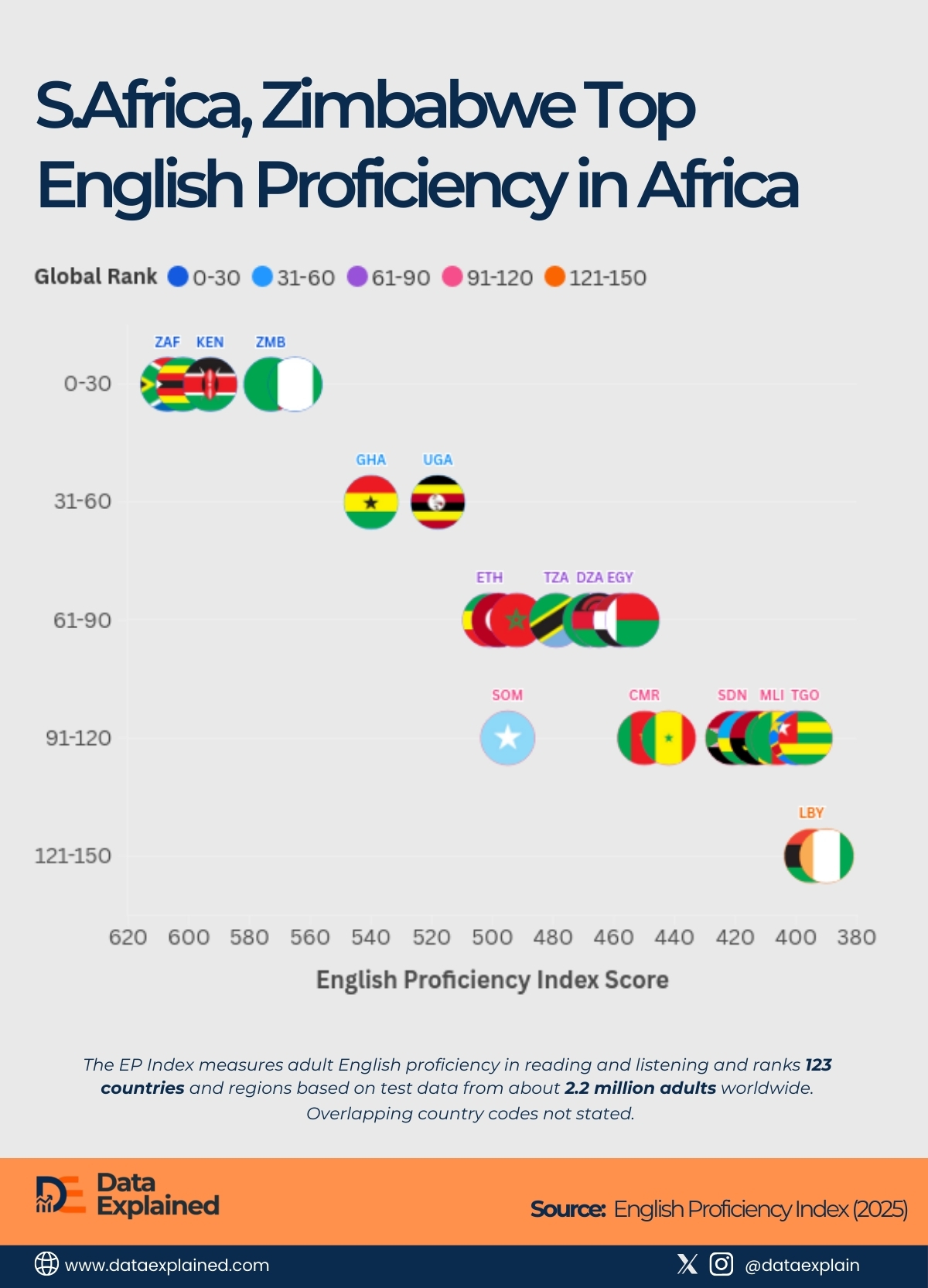
Using the 2025 English Proficiency Index (EPI) from EF, this visualization shows the English proficiency of African countries.
TL;DR
- South Africa has the highest English proficiency in Africa (602 Index) and ranks 13th globally.
- Southern and East Africa perform better overall than West, Central, and North Africa, where most countries fall into low or very low proficiency tiers.
- Despite high proficiency scores, countries like Nigeria and Namibia still face English testing requirements abroad.
The 2025 EPI was released in January 2026.
It measures adult English proficiency in reading and listening and ranks 123 countries and regions based on test data from about 2.2 million adults worldwide.
African Countries by English Proficiency Score
| wdt_ID | wdt_created_by | wdt_created_at | wdt_last_edited_by | wdt_last_edited_at | African country | Global rank | Proficiency index score |
|---|---|---|---|---|---|---|---|
| 1 | emmanuel-ashemiriogwa | 20/01/2026 01:50 PM | emmanuel-ashemiriogwa | 20/01/2026 01:50 PM | South Africa | 13 | 602 |
| 2 | emmanuel-ashemiriogwa | 20/01/2026 01:50 PM | emmanuel-ashemiriogwa | 20/01/2026 01:50 PM | Zimbabwe | 13 | 602 |
| 3 | emmanuel-ashemiriogwa | 20/01/2026 01:50 PM | emmanuel-ashemiriogwa | 20/01/2026 01:50 PM | Kenya | 19 | 593 |
| 4 | emmanuel-ashemiriogwa | 20/01/2026 01:50 PM | emmanuel-ashemiriogwa | 20/01/2026 01:50 PM | Zambia | 27 | 573 |
| 5 | emmanuel-ashemiriogwa | 20/01/2026 01:50 PM | emmanuel-ashemiriogwa | 20/01/2026 01:50 PM | Nigeria | 29 | 568 |
| 6 | emmanuel-ashemiriogwa | 20/01/2026 01:50 PM | emmanuel-ashemiriogwa | 20/01/2026 01:50 PM | Ghana | 36 | 540 |
| 7 | emmanuel-ashemiriogwa | 20/01/2026 01:50 PM | emmanuel-ashemiriogwa | 20/01/2026 01:50 PM | Uganda | 53 | 518 |
| 8 | emmanuel-ashemiriogwa | 20/01/2026 01:50 PM | emmanuel-ashemiriogwa | 20/01/2026 01:50 PM | Ethiopia | 65 | 499 |
| 9 | emmanuel-ashemiriogwa | 20/01/2026 01:50 PM | emmanuel-ashemiriogwa | 20/01/2026 01:50 PM | Tunisia | 66 | 498 |
| 10 | emmanuel-ashemiriogwa | 20/01/2026 01:50 PM | emmanuel-ashemiriogwa | 20/01/2026 01:50 PM | Morocco | 68 | 492 |
Which African Countries are Highly Proficient in English?
The EF English Proficiency Index groups countries into five categories, ranging from very high to very low proficiency, based on adult performance in reading and listening.
In Africa, only South Africa and Zimbabwe fall into the “very high proficiency” category, both scoring 602 and ranking 13th globally.
This level indicates a strong command of English for academic study, professional work, and complex communication.
Very high proficiency typically reflects the ability to use English effectively in demanding contexts, such as higher education, research, and international business.
Just below this tier are countries classified as having high proficiency, led by Kenya (593, 19th), Zambia (573, 27th), and Nigeria (568, 29th).
While English use is widespread and effective in these countries, high proficiency is associated with slightly weaker performance in advanced comprehension compared with the very high group.
Low English Mastery in Central, North Africa
While Nigeria ranks high and Ghana posts moderate proficiency, the majority of countries in the western and central regions fall into the low or very low categories.
This includes Senegal, Benin, Mali, Togo, Côte d’Ivoire, Cameroon, and the Democratic Republic of Congo.
Many of these are Francophone countries, where French dominates education and public life, limiting everyday English use despite regional economic integration.
North Africa also trends toward lower proficiency, with Tunisia, Morocco, Algeria, and Egypt all classified as low proficiency.
Meanwhile, Lusophone countries such as Angola and Mozambique appear mainly in the low and very low tiers.
It reflects similar challenges tied to non-English colonial language systems.
Petition with IELTS
Despite Nigeria’s strong showing on the 2025 English Proficiency Index, students and professionals are still widely required to take the International English Language Testing System (IELTS) for study, work, or migration abroad.
A petition titled “Stop asking Nigerians to write IELTS,” initiated by youth policy group Policy Shapers on Change(dot)org, has garnered over 26,000 signatures.
The argument is that Nigeria’s high proficiency should qualify it for exemption.
The petition, addressed to then-UK Home Secretary Priti Patel, highlights that no Anglophone African country appears on the UK Home Office’s list of nations exempted from English tests.
Though countries like Antigua and Barbuda, Jamaica, and Barbados are granted waivers.
Petitioners argue that English is the primary language of instruction and public life in Nigeria and that requiring IELTS imposes financial and logistical barriers.
UK officials have maintained that exemptions are based on whether a majority of a country’s population speaks English as a first language, a criterion not currently met in Nigeria’s case.
ELI5: English Proficiency in Africa
The latest English proficiency results show that South Africa and Zimbabwe are Africa’s top performers, ranking in the very high proficiency category alongside some of the world’s strongest English speakers.
Regionally, Southern and East Africa perform better overall than West, Central, and North Africa, where most countries fall into low or very low proficiency tiers.
Yet despite strong scores, countries such as Nigeria, Kenya, and Zambia are still required to take IELTS.
It shows there’s a gap between measured English ability and how global language policies are applied.
Sources: