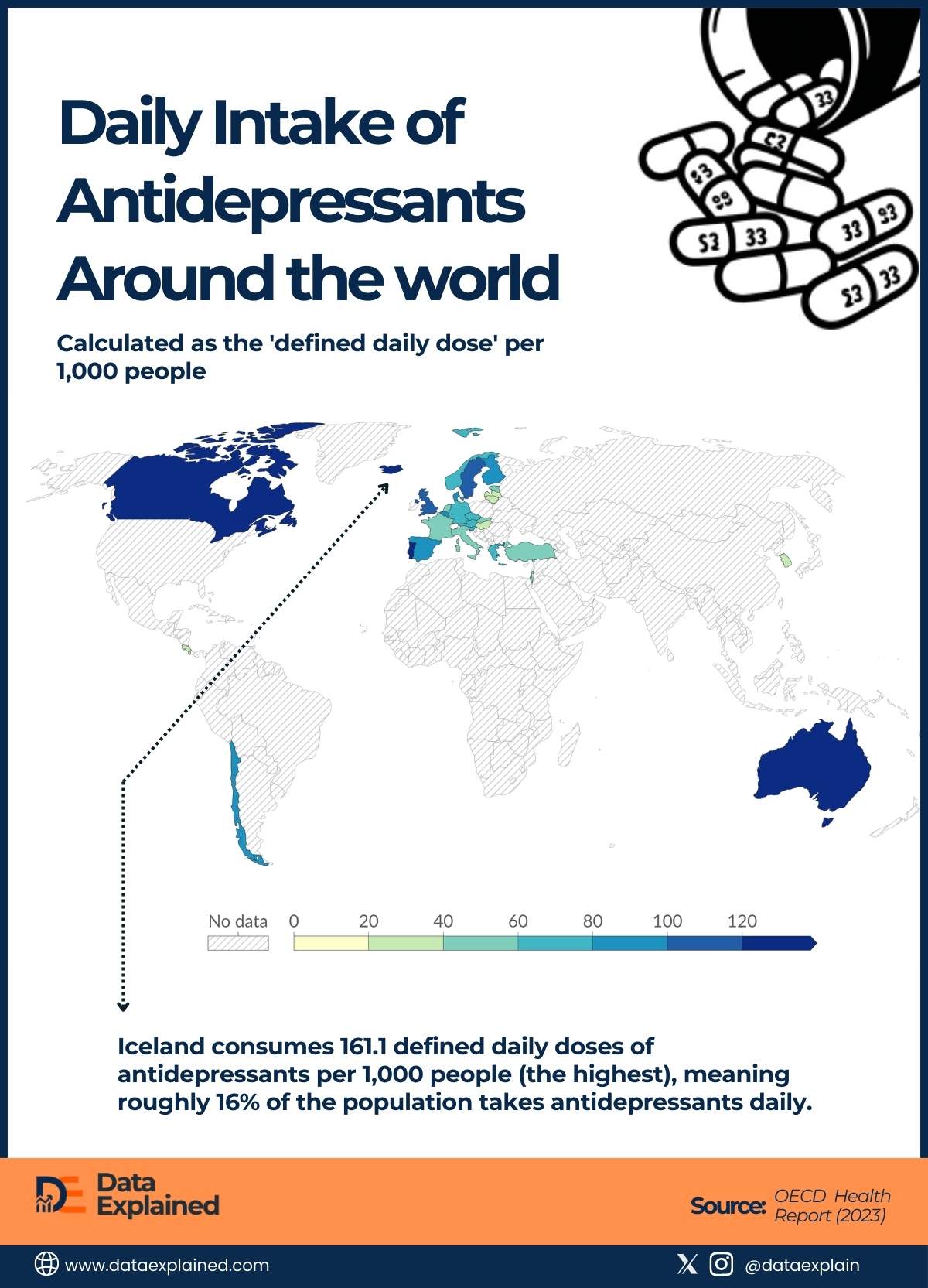
Iceland consumes 161.1 defined daily doses of antidepressants per 1,000 people, meaning roughly 16% of the population takes antidepressants daily.
This makes the country rank first globally and 7.5 times higher than Latvia’s 21.5, the lowest rate among OECD countries.
The data comes from OECD 2023 report.
It reflects antidepressant consumption measured in defined daily doses per 1,000 people.
There’s a bigger picture, though.
It reveals enormous global disparities in mental health treatment driven more by cultural stigma and healthcare access than actual depression prevalence.
TL;DR
- Iceland has the highest antidepressant use of 161.1 in the OECD, about 7.5 times higher than in Latvia.
- Anglo-Nordic countries dominate the top ranks.
- Eastern European and low-use countries show lower consumption.
Ranked: Antidepressant Consumption by Country
| wdt_ID | wdt_created_by | wdt_created_at | wdt_last_edited_by | wdt_last_edited_at | Entity | Antidepressants per 1,000 persons daily |
|---|---|---|---|---|---|---|
| 1 | emmanuel-ashemiriogwa | 19/03/2026 09:39 AM | emmanuel-ashemiriogwa | 19/03/2026 09:39 AM | Iceland | 161.10 |
| 2 | emmanuel-ashemiriogwa | 19/03/2026 09:39 AM | emmanuel-ashemiriogwa | 19/03/2026 09:39 AM | Portugal | 139.60 |
| 3 | emmanuel-ashemiriogwa | 19/03/2026 09:39 AM | emmanuel-ashemiriogwa | 19/03/2026 09:39 AM | Canada | 130.40 |
| 4 | emmanuel-ashemiriogwa | 19/03/2026 09:39 AM | emmanuel-ashemiriogwa | 19/03/2026 09:39 AM | Australia | 122.20 |
| 5 | emmanuel-ashemiriogwa | 19/03/2026 09:39 AM | emmanuel-ashemiriogwa | 19/03/2026 09:39 AM | Sweden | 108.90 |
| 6 | emmanuel-ashemiriogwa | 19/03/2026 09:39 AM | emmanuel-ashemiriogwa | 19/03/2026 09:39 AM | United Kingdom | 107.90 |
| 7 | emmanuel-ashemiriogwa | 19/03/2026 09:39 AM | emmanuel-ashemiriogwa | 19/03/2026 09:39 AM | Spain | 92.00 |
| 8 | emmanuel-ashemiriogwa | 19/03/2026 09:39 AM | emmanuel-ashemiriogwa | 19/03/2026 09:39 AM | Chile | 90.70 |
| 9 | emmanuel-ashemiriogwa | 19/03/2026 09:39 AM | emmanuel-ashemiriogwa | 19/03/2026 09:39 AM | Denmark | 84.60 |
| 10 | emmanuel-ashemiriogwa | 19/03/2026 09:39 AM | emmanuel-ashemiriogwa | 19/03/2026 09:39 AM | Belgium | 83.80 |
Iceland’s Stunning 161.1 Rate
Iceland records about 161.1 defined daily doses per 1,000 people, the highest in the OECD and roughly 7.5× higher than Latvia (~20). This metric reflects total volume distributed across the population.
In practical terms, this could translate to roughly 10–15 out of every 100 people actively using antidepressants at a given time in Iceland, compared to perhaps 2–3 per 100 in Latvia.
Geography plays a measurable role. Iceland experiences very limited daylight in winter, sometimes as little as 4–5 hours, which can disrupt sleep-wake cycles and mood regulation.
This is closely associated with Seasonal Affective Disorder, where repeated seasonal depressive episodes increase both clinical recognition and long-term treatment rates.
Colder climates and relative isolation can also reduce outdoor activity and social interaction, compounding these effects.
Lower-stigma environments also mean more people seek help.
By contrast, lower-use countries like Latvia may have underdiagnosis or limited access, which keeps recorded consumption low even when need exists.
Anglo + Nordic Countries Lead
That pattern becomes clearer when you move beyond Iceland and look at similar countries shaping the top ranks.
Many are either Nordic or English-speaking nations like the United Kingdom, Canada, Australia, Sweden, Denmark, and Finland, where antidepressant use consistently exceeds 100 defined daily doses per 1,000 people in several cases.
Long winters, limited daylight, and in some regions geographic isolation can contribute to mood disorders, making mental health challenges more visible and more openly discussed.
Across much of the OECD, these nations operate well-funded public healthcare systems in which mental health screening is routine, and treatment is integrated into primary care.
Eastern Europe Dramatically Lower
In stark contrast to Iceland and Anglo-Nordic nations, several Eastern European countries report dramatically lower antidepressant consumption.
For instance, Latvia registers only 21.5 defined daily doses per 1,000 people, South Korea sits at 27.4, and Hungary at 29.8.
These figures are roughly one-sixth to one-quarter of the levels seen in Iceland or the United Kingdom, highlighting a clear regional disparity in treatment uptake rather than necessarily lower prevalence of depression.
Structural factors also play a significant role.
Healthcare systems in these countries are often under-resourced or unevenly distributed, limiting access to trained mental health professionals and evidence-based treatment.
What This Data Actually Measures
It’s easy to assume that higher antidepressant use in countries like Iceland or the United Kingdom automatically means higher levels of depression, but that’s not what this data is designed to show.
Instead, figures from the OECD reflect how widely treatment is accessed and prescribed, not how many people are actually experiencing depression.
In other words, this is less about prevalence and more about response—how societies diagnose, manage, and treat mental health conditions.
Across many Anglo-Nordic countries, antidepressant use is shaped by structured healthcare systems and policy decisions.
In places like France and Canada, mental health care is integrated into public health services, meaning patients can access consultations, follow-ups, and prescriptions at relatively low cost.
Clinical guidelines also standardize how and when antidepressants are prescribed, reducing informal or inconsistent use.
Rather than over-the-counter reliance, treatment typically follows regulated medical pathways, often supported by insurance or government funding.
Cultural context matters just as much.
In countries such as Sweden and Australia, mental health is more openly discussed, reducing stigma and encouraging early intervention.
ELI5
Some countries like Iceland and the UK use a lot of antidepressants, mostly because they have easy access, strong healthcare, and less stigma, not necessarily more depression. Eastern Europe and countries like Latvia use far less, largely due to historical stigma, underdiagnosis, and limited treatment access. Cold, dark winters and isolation can increase need, but access drives usage.
Sources: