During the 40-day period from February 2 to March 13, 2026, China’s National Development and Reform Commission (NDRC) projects a record 9.5 billion interregional passenger trips.
It’s for the Chinese New Year or Spring Festival. However, one notable finding is that self-driving has nearly doubled in volume over the last few years, now accounting for 80% of all holiday movement as more families own private vehicles.
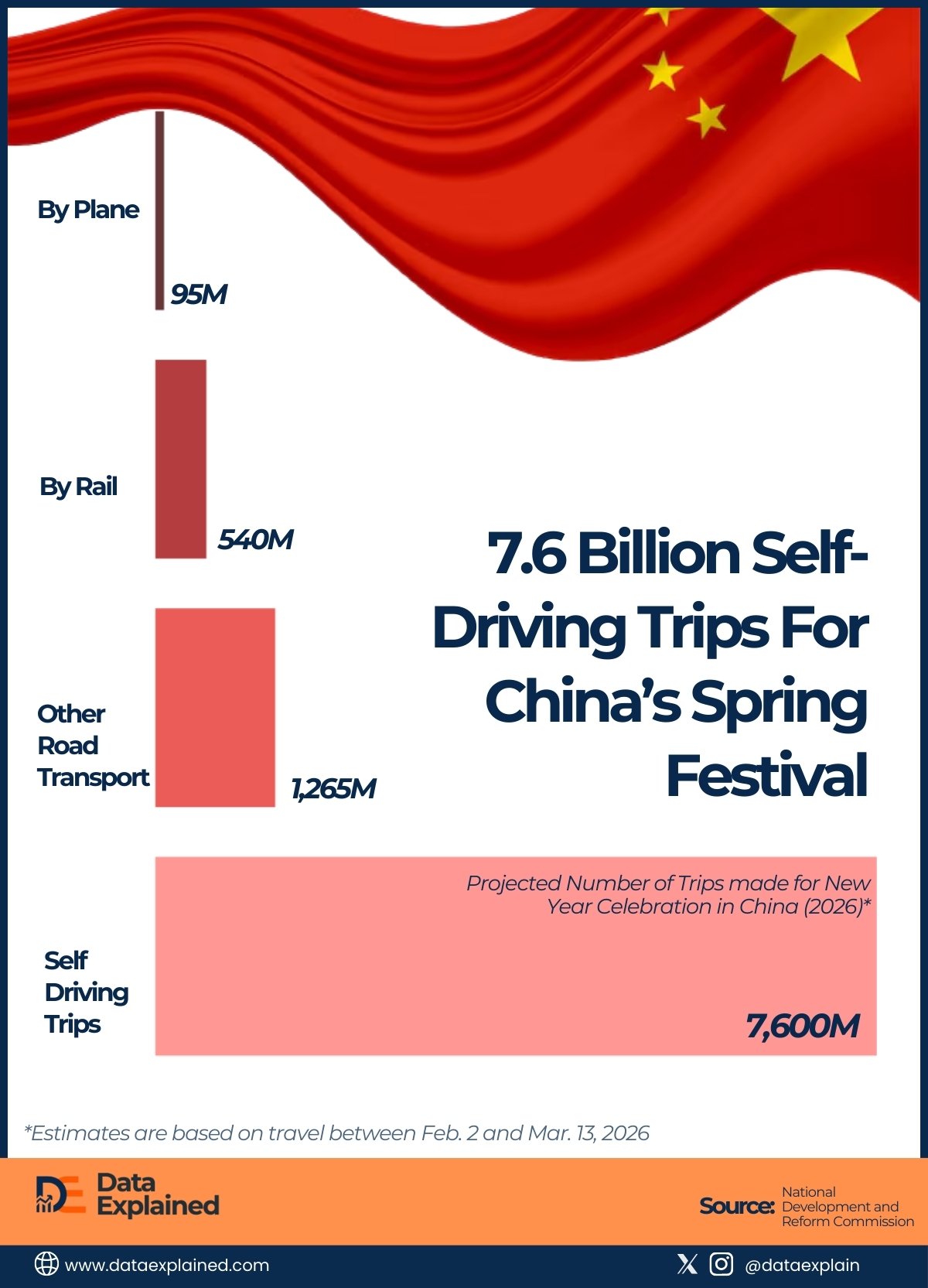
The visualization above shows that 7,600 million people will travel by road in cars, a mode that dominates all others.
It’s based on NDRC data.
TL;DR
- Self-driving vehicles dominated China’s transportation during the New Year celebration, with 7.6 million road trips by car.
- The total number of privately owned motor vehicles in China reached 309.89 million in 2024.
- China’s aircraft is also playing a significant role by operating all 14 of its C919 jets in commercial service during this period.
Projected Number of Trips for New Year Celebration in China
| wdt_ID | wdt_created_by | wdt_created_at | wdt_last_edited_by | wdt_last_edited_at | Travel type | Projected Number of Trips (in millions) |
|---|---|---|---|---|---|---|
| 1 | emmanuel-ashemiriogwa | 18/02/2026 02:28 PM | emmanuel-ashemiriogwa | 18/02/2026 02:28 PM | By plane | 95 |
| 2 | emmanuel-ashemiriogwa | 18/02/2026 02:28 PM | emmanuel-ashemiriogwa | 18/02/2026 02:28 PM | By rail | 540 |
| 3 | emmanuel-ashemiriogwa | 18/02/2026 02:28 PM | emmanuel-ashemiriogwa | 18/02/2026 02:28 PM | Other road transport | 1,265 |
| 4 | emmanuel-ashemiriogwa | 18/02/2026 02:28 PM | emmanuel-ashemiriogwa | 18/02/2026 02:28 PM | Self-driving trips | 7,600 |
Why the Surge in Self-Driving?
China’s Spring Festival New Year travel projections show a dominance in self-driving trips, with about 7,600 million road journeys expected to be made by car.
This is quite higher than rail (540 million) or air travel (95 million) during the holiday period.
It shows that private car travel has become the preferred option for most Chinese families during major holidays, when millions of people return home or travel across the country.
The surge in self-driving is related to the quick growth in car ownership across China.
Many people now own private vehicles.
By 2020, private car ownership had reached 194 per 1,000 population, a level comparable to that in the U.S. in the 1920s. The total privately owned motor vehicles reached 309.89 million by 2024.
Some projections estimate that China’s car ownership could exceed 400 per 1,000 population by 2040.
This trend is driven by rising incomes, the expansion of expressways and road infrastructure, and improved rural connectivity, which make long-distance driving more practical and convenient.
285 Million “Day One” Sprint
On February 15, 2026, the first official day of China’s nine-day Spring Festival holiday.
Chinese transport authorities predicted that approximately 285 million interregional passenger trips would occur in 24 hours nationwide.
This single-day figure is equivalent to moving almost the entire population of Indonesia.
This sudden surge doesn’t occur in isolation.
It’s part of China’s annual “chunyun” travel period, the world’s largest recurrent human migration, where millions of people return home or go on holiday, due to family reunions and cultural traditions.
The fact that road travel alone accounted for most of those trips indicates how deeply private car use and autonomous driving have become entrenched in China’s travel habits.
Domestic Tech at the Core
For the first time during China’s massive Spring Festival “chunyun” travel rush, domestically developed C919 passenger aircraft are playing a huge role in moving holiday travelers.
Global Times reported that China Eastern Airlines is operating all 14 of its C919 jets in commercial service during the 2026 travel period.
These operate an average of 19,400 daily flights.
This is a quick increase of over 50% compared with last year’s Spring Festival deployment.
The expanded use of the C919, China’s domestically developed large passenger jet, highlights a broader shift toward reliance on domestic aerospace technology to support one of the world’s largest annual human migrations.
It combines locally built aircraft with expanded rail and road capacity.
ELI5
In China, most people now choose to drive when traveling during the New Year holiday, with projections indicating approximately 7.6 billion car trips, more than on trains or airplanes.
It shows how owning a private car has become the norm for many families, and that driving offers greater flexibility when millions are trying to move at the same time.
Also, the scale of movement is large.
Approximately 285 million long-distance trips are expected to occur across the country in the opening days of the celebration, making it one of the largest annual waves of human travel worldwide.
Source:
NDRC | Xinhua | Global times