The global economy is expected to lose momentum in 2026, but not enough to slip into recession.
According to the International Monetary Fund’s (IMF) latest World Economic Outlook Update, global real GDP growth is projected to slow from 3.5% in 2025 to 3.0% in 2026, before picking up slightly to 3.4% in 2027.
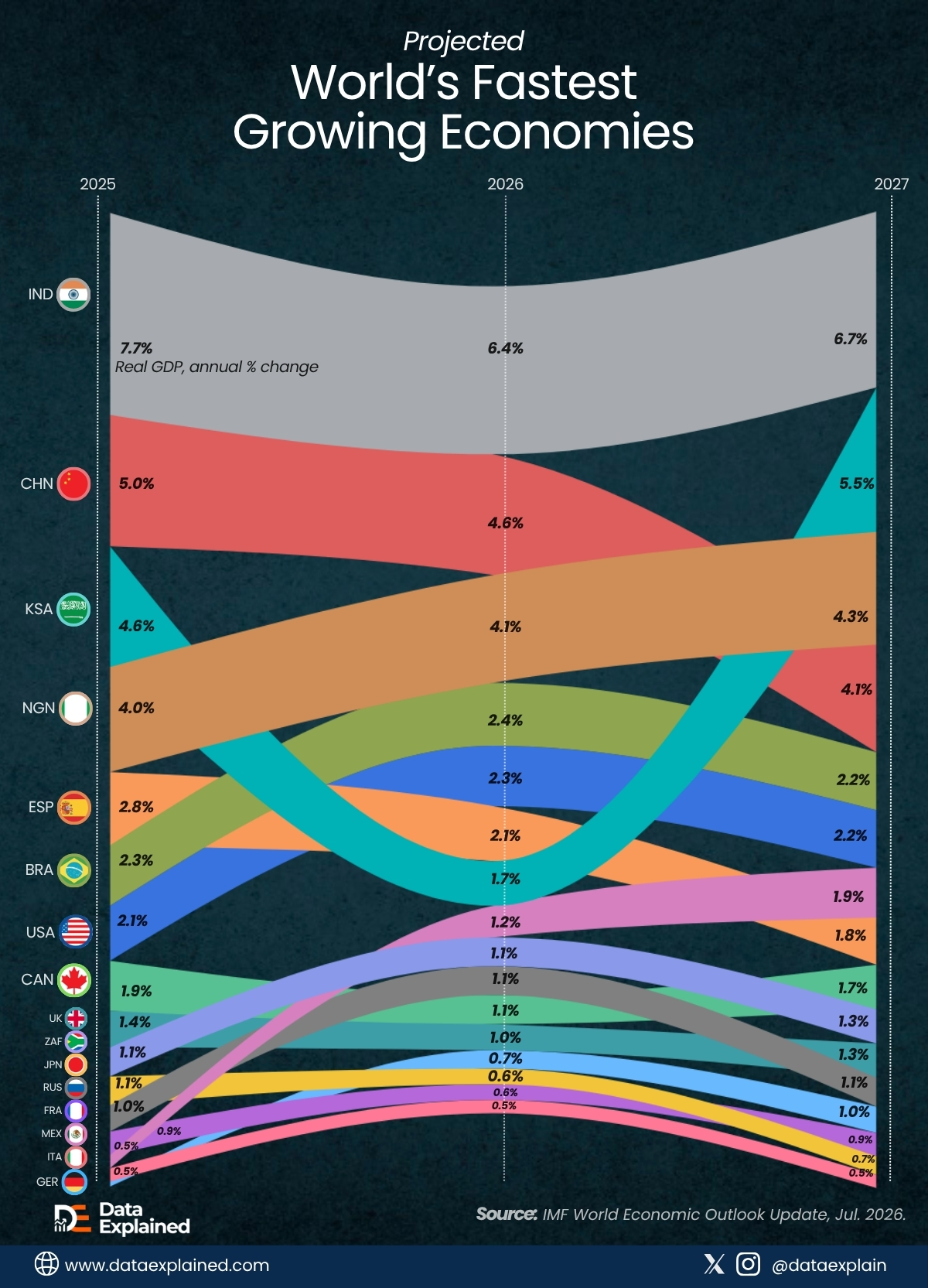
The visualization above shows the projected real GDP of key economies worldwide.
TL;DR
- The IMF expects global economic growth to slow from 3.5% in 2025 to 3.0% in 2026.
- Emerging economies are still projected to grow more than twice as fast as advanced economies.
- India remains the fastest-growing major economy, while Europe is expected to post some of the weakest growth.
The projections come at a time when the economic fallout from conflict in the Middle East, shifting trade policies and the rapid expansion of artificial intelligence (AI) investment are dominating global economic discussions.
Rather than pointing to a broad-based downturn, the data paints a picture of uneven growth, with some regions slowing sharply while others continue to expand at a healthy pace.
ALSO READ: Ranked: Largest Sectors of the Global Economy in 2026
| wdt_ID | wdt_created_by | wdt_created_at | wdt_last_edited_by | wdt_last_edited_at | Economy / Region | 2025 | 2026 | 2027 |
|---|---|---|---|---|---|---|---|---|
| 1 | emmanuel-ashemiriogwa | 13/07/2026 03:17 AM | emmanuel-ashemiriogwa | 13/07/2026 03:17 AM | World Output | 3.5 | 3.0 | 3.4 |
| 2 | emmanuel-ashemiriogwa | 13/07/2026 03:17 AM | emmanuel-ashemiriogwa | 13/07/2026 03:17 AM | Advanced Economies | 1.9 | 1.7 | 1.8 |
| 3 | emmanuel-ashemiriogwa | 13/07/2026 03:17 AM | emmanuel-ashemiriogwa | 13/07/2026 03:17 AM | United States | 2.1 | 2.3 | 2.2 |
| 4 | emmanuel-ashemiriogwa | 13/07/2026 03:17 AM | emmanuel-ashemiriogwa | 13/07/2026 03:17 AM | Euro Area | 1.4 | 0.9 | 1.2 |
| 5 | emmanuel-ashemiriogwa | 13/07/2026 03:17 AM | emmanuel-ashemiriogwa | 13/07/2026 03:17 AM | Germany | 0.2 | 0.7 | 1.0 |
| 6 | emmanuel-ashemiriogwa | 13/07/2026 03:17 AM | emmanuel-ashemiriogwa | 13/07/2026 03:17 AM | France | 0.9 | 0.6 | 0.9 |
| 7 | emmanuel-ashemiriogwa | 13/07/2026 03:17 AM | emmanuel-ashemiriogwa | 13/07/2026 03:17 AM | Italy | 0.5 | 0.5 | 0.5 |
| 8 | emmanuel-ashemiriogwa | 13/07/2026 03:17 AM | emmanuel-ashemiriogwa | 13/07/2026 03:17 AM | Spain | 2.8 | 2.1 | 1.8 |
| 9 | emmanuel-ashemiriogwa | 13/07/2026 03:17 AM | emmanuel-ashemiriogwa | 13/07/2026 03:17 AM | Japan | 1.1 | 0.6 | 0.7 |
| 10 | emmanuel-ashemiriogwa | 13/07/2026 03:17 AM | emmanuel-ashemiriogwa | 13/07/2026 03:17 AM | United Kingdom | 1.4 | 1.0 | 1.3 |
Global Economy is Slowing, Not Shrinking
A projected 3.0% global growth rate is lower than the previous year, yet it still signals continued expansion of the world economy.
The IMF also expects growth to strengthen modestly in 2027, suggesting the slowdown is likely to be temporary rather than the start of a prolonged global downturn.
That distinction matters.
Slower growth means economies are expanding at a reduced pace (not necessarily contracting).
ALSO READ: Visualized: World’s Fastest-Growing Major Economy in 2026
Emerging Economies Continue to Drive Global Growth
One of the clearest patterns in the data is the widening gap between advanced economies and developing ones.
The IMF projects advanced economies to grow by 1.7% in 2026, compared with 3.8% for emerging market and developing economies.
That means developing economies are expected to grow at more than twice the pace of wealthier nations, continuing a trend that has shaped the global economy for years.
India remains the standout performer.
The IMF forecasts the country will grow by 6.4% in 2026, making it the fastest-growing major economy in the table.
Although that represents a slowdown from 7.7% in 2025, India’s projected growth remains comfortably ahead of China, the United States and every major advanced economy.
China, meanwhile, is expected to continue its gradual slowdown. Growth is projected to ease from 5.0% in 2025 to 4.6% in 2026, before slowing further to 4.1% in 2027.
Europe Lags While the U.S. Outperforms its Peers
Among advanced economies, Europe remains one of the weakest-performing regions.
The Euro Area is expected to grow by just 0.9% in 2026. Germany is forecast to expand by 0.7%, France by 0.6%, and Italy by only 0.5%.
The United States presents a different picture.
The IMF projects U.S. growth of 2.3% in 2026, comfortably above the 1.7% average for advanced economies.
While the IMF does not attribute its forecasts to a single factor, continued business investment (including spending on AI infrastructure) and resilient domestic demand have helped support expectations of stronger U.S. growth than many of its developed peers.
The Middle East shows the biggest swing
Perhaps the most striking movement in the table comes from the Middle East and Central Asia.
The region is forecast to slow from 3.7% growth in 2025 to just 0.7% in 2026, before rebounding sharply to 6.5% in 2027.
Saudi Arabia follows a similar path, with growth projected at 1.7% in 2026 after 4.6% in 2025, before recovering to 5.5% the following year.
The forecasts reflect how geopolitical events can temporarily weigh on economic activity before conditions improve.
Sub-Saharan Africa, by contrast, is expected to remain relatively resilient.
The region is projected to grow by 4.3% in 2026, while Nigeria’s economy is forecast to expand by 4.1%, reinforcing Africa’s position as one of the faster-growing regions globally.
ELI5
The world economy is still growing, just more slowly than before. Rich countries are expected to grow at a modest pace, while many developing countries continue to expand much faster.
India remains a global growth leader, Europe is slowing, and conflict and uncertainty are affecting some regions more than others.
Source:
International Monetary Fund (IMF), World Economic Outlook Update, July 2026.