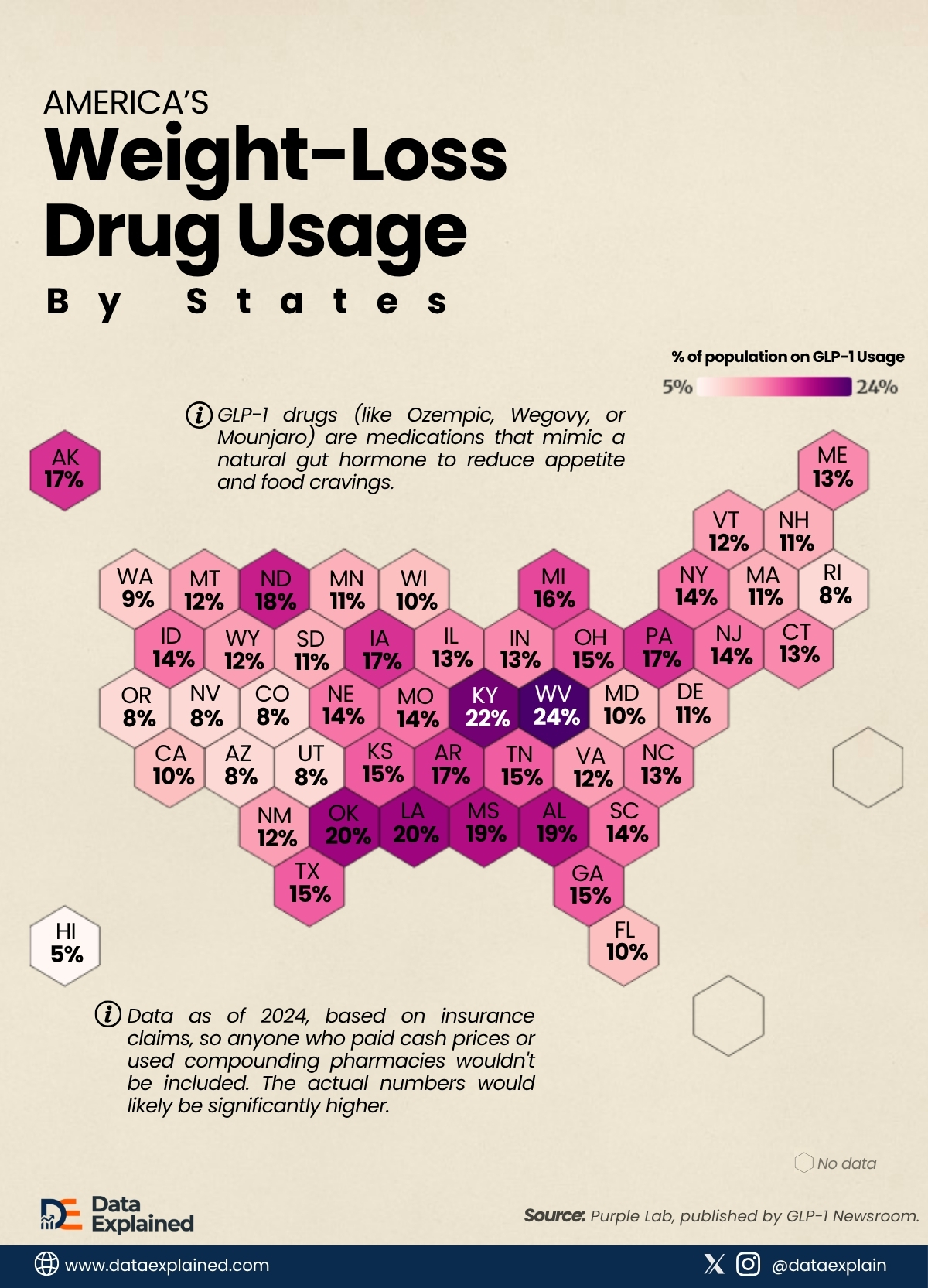
West Virginia has been ranked as the state with the highest GLP-1 drug usage rate in the United States.
The data is as of 2024, comes from the health analytics company Purple Lab, and was published by GLP-1 Newsroom.
It was compiled from insurance claims, so anyone who paid out of pocket or used compounding pharmacies wouldn’t be included. The actual numbers would likely be significantly higher.
In 2024, 24% of West Virginia’s population was on a prescription for a drug like Ozempic or Wegovy. In Hawaii, the figure was 5%.
The 19-percentage-point gap between those two states is the clearest illustration of just how unevenly America’s weight-loss drug boom is playing out.
TL;DR
- Nearly one in four West Virginians was on a GLP-1 drug as of 2024, the highest rate in the country, while Hawaii had the lowest at just 5%.
- The states with the highest usage rates are mostly in the South and Appalachia, where obesity and diabetes rates are also the highest.
- The real numbers are likely much higher, as the data only counts people with insurance and excludes cash payers, compounding pharmacy users, and the uninsured.
| wdt_ID | wdt_created_by | wdt_created_at | wdt_last_edited_by | wdt_last_edited_at | State | Prescriptions (2024) | Statewide GLP-1 Usage (%) |
|---|---|---|---|---|---|---|---|
| 1 | emmanuel-ashemiriogwa | 09/07/2026 11:09 AM | emmanuel-ashemiriogwa | 09/07/2026 11:09 AM | Alabama | 993,406 | 19 |
| 2 | emmanuel-ashemiriogwa | 09/07/2026 11:09 AM | emmanuel-ashemiriogwa | 09/07/2026 11:09 AM | Alaska | 128,658 | 17 |
| 3 | emmanuel-ashemiriogwa | 09/07/2026 11:09 AM | emmanuel-ashemiriogwa | 09/07/2026 11:09 AM | Arizona | 614,174 | 8 |
| 4 | emmanuel-ashemiriogwa | 09/07/2026 11:09 AM | emmanuel-ashemiriogwa | 09/07/2026 11:09 AM | Arkansas | 535,706 | 17 |
| 5 | emmanuel-ashemiriogwa | 09/07/2026 11:09 AM | emmanuel-ashemiriogwa | 09/07/2026 11:09 AM | California | 3,731,277 | 10 |
| 6 | emmanuel-ashemiriogwa | 09/07/2026 11:09 AM | emmanuel-ashemiriogwa | 09/07/2026 11:09 AM | Colorado | 464,404 | 8 |
| 7 | emmanuel-ashemiriogwa | 09/07/2026 11:09 AM | emmanuel-ashemiriogwa | 09/07/2026 11:09 AM | Connecticut | 482,518 | 13 |
| 8 | emmanuel-ashemiriogwa | 09/07/2026 11:09 AM | emmanuel-ashemiriogwa | 09/07/2026 11:09 AM | Delaware | 114,101 | 11 |
| 9 | emmanuel-ashemiriogwa | 09/07/2026 11:09 AM | emmanuel-ashemiriogwa | 09/07/2026 11:09 AM | Florida | 2,428,469 | 10 |
| 10 | emmanuel-ashemiriogwa | 09/07/2026 11:09 AM | emmanuel-ashemiriogwa | 09/07/2026 11:09 AM | Georgia | 1,705,031 | 15 |
ALSO READ: Eli Lilly Nears $1 Trillion Valuation on Weight-Loss Drug Dominance
The South Leads, Reasons Not Hard to Find
The states with the highest GLP-1 usage rates cluster tightly in the South and Appalachia.
Kentucky came in at 22%, Louisiana and Oklahoma at 20% each, and Alabama and Mississippi at 19% each, per Purple Lab data published by GLP-1 Newsroom.
These are not states known for early adoption of expensive new medications.
They are, however, states that consistently rank among the highest in the country for obesity and Type 2 diabetes rates.
The drugs are most prevalent where the medical need is greatest.
The West sits at the other end
Arizona, Colorado, Nevada, Oregon, and Utah all recorded 8% usage rates in 2024, and Hawaii came in at 5%, the lowest in the dataset.
Western states generally have lower obesity prevalence and younger population profiles than Southern and Appalachian states, which likely explains a significant portion of the gap.
Rhode Island, at 8%, is the notable geographic outlier on the low end, sitting well below the usage rates of the Northeastern states around it.
Volume and penetration do not tally
Texas recorded the highest raw prescription count in the entire dataset at 4,664,860 in 2024, edging out California’s 3,731,277, according to Purple Lab data published by GLP-1 Newsroom.
But Texas sits at only 15% usage and California at 10%. Neither figure reflects poor access or low demand. Both reflect population size.
A state of 30 million people can generate enormous prescription volumes while still having a usage rate well below the national average.
North Dakota makes the opposite point: just 142,108 prescriptions in 2024, yet an 18% usage rate, because its total population sits just above 770,000.
ALSO READ: Cost of Gym Membership in Major Cities
There’s a Caveat
The prescription records were drawn from commercial and government insurance claims only.
People who paid cash, used compounding pharmacies, accessed GLP-1 drugs through telehealth-only providers, or had no insurance are entirely absent from the numbers.
Purple Lab and GLP-1 Newsroom note that the actual figures are likely significantly higher.
In states like Texas and Florida, which have some of the highest uninsured rates in the country, the gap between reported and actual usage is probably wider than the national average.
ELI5
Weight-loss and diabetes drugs like Ozempic are now being taken by millions of Americans, but some states use them far more than others.
States with the most sick people, such as West Virginia and Kentucky, have the highest usage rates. States like Hawaii and Colorado have the lowest.
And because the data only counts people with insurance, the real numbers across every state are almost certainly even higher.
Source:
Purple Lab, published by GLP-1 Newsroom.