
AI is transforming the way people work, from offices to factories.
It automates routine tasks and speeds up decision-making. But the key question remains: is it really making us more productive or just busier in smarter ways?
TL;DR
- AI-intensive sectors saw 27% productivity growth between 2018 and 2024.
- Sectors and industries such as finance, technology, and professional services lead the gains, with revenue per worker rising at three times the rate of low-AI industries.
- Workers skilled in AI now earn an average wage premium of 56%, reflecting growing demand for technical and analytical expertise.
Data for this visualization comes from PwC’s AI Jobs Barometer 2025. The report analyzes job ads and financial data to examine the impact of AI on jobs, wages, skills, and productivity worldwide.
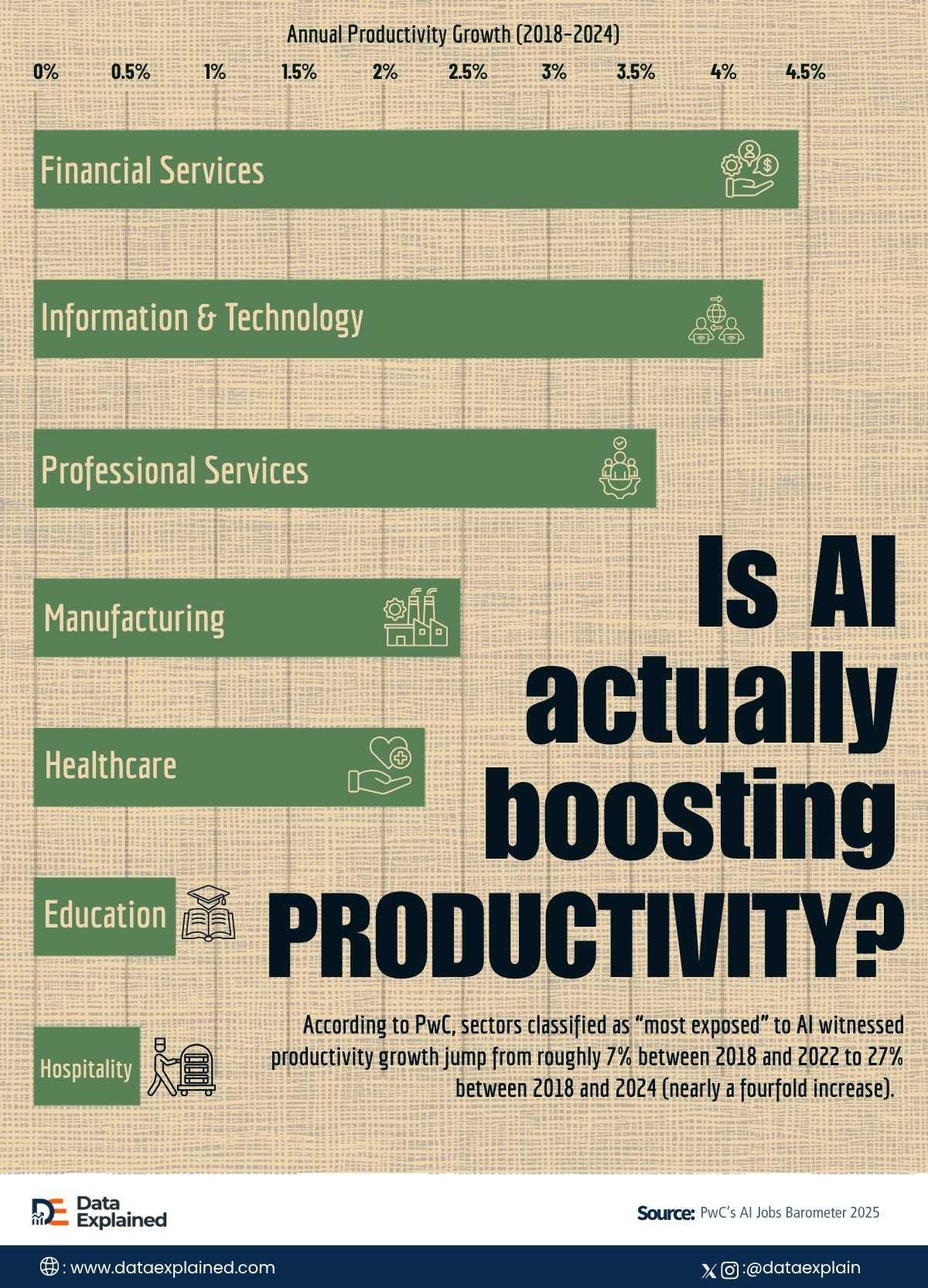
AI Influence On Productivity by Industry
| wdt_ID | wdt_created_by | wdt_created_at | wdt_last_edited_by | wdt_last_edited_at | Industry | AI Adoption Level | Productivity Growth (2018–2024) |
|---|---|---|---|---|---|---|---|
| 1 | Monica Ebunoluwa | 08/07/2026 03:03 PM | Monica Ebunoluwa | 08/07/2026 03:05 PM | Financial Services | High | +4.3% |
| 2 | Monica Ebunoluwa | 08/07/2026 03:03 PM | Monica Ebunoluwa | 08/07/2026 03:05 PM | Information & Technology | High | +4.1% |
| 3 | Monica Ebunoluwa | 08/07/2026 03:03 PM | Monica Ebunoluwa | 08/07/2026 03:05 PM | Professional Services | Moderate–High | +3.5% |
| 4 | Monica Ebunoluwa | 08/07/2026 03:03 PM | Monica Ebunoluwa | 08/07/2026 03:06 PM | Manufacturing | Moderate | +2.4% |
| 5 | Monica Ebunoluwa | 08/07/2026 03:03 PM | Monica Ebunoluwa | 08/07/2026 03:06 PM | Healthcare | Moderate | +2.2% |
| 6 | Monica Ebunoluwa | 08/07/2026 03:03 PM | Monica Ebunoluwa | 08/07/2026 03:06 PM | Education | Low | +0.8% |
| 7 | Monica Ebunoluwa | 08/07/2026 03:03 PM | Monica Ebunoluwa | 08/07/2026 03:07 PM | Hospitality | Low | +0.6% |
Industries that have fully embraced AI are seeing notable increases in productivity.
According to PwC, sectors classified as “most exposed” to AI witnessed productivity growth jump from roughly 7% between 2018 and 2022 to 27% between 2018 and 2024 (nearly a fourfold increase).
In contrast, industries least exposed to AI saw their productivity edge shrink from 10% to 9% in the same period.
In high-AI sectors such as financial services, software, and IT, workers and machines are operating in tandem.
AI handles routine or data-heavy tasks, freeing human talent to focus on strategy, creativity, and oversight. The result is teams that accomplish more, faster.
Meanwhile, in low-AI sectors such as hospitality, mining, or traditional retail, modest productivity growth reflects slower adoption of machine-assisted work and weaker data infrastructure.
What the Numbers Mean for Workers and Economies
Workers using AI now earn a 56% global wage premium, up from 25% the previous year, indicating that skill divides are widening.
Sectors that lag in adoption, like hospitality, education, and low-tech services, risk slower wage growth and stagnant productivity.
On the one hand, AI augments human potential; on the other, it struggles to keep pace with the digital acceleration reshaping modern work.
ELI5
AI enables some workers to work faster and more effectively, mainly when tasks rely on data or analysis.
That’s why people in finance or tech earn more and produce more.
Jobs that depend on human interaction, such as teaching or hospitality, haven’t gained as much traction yet.
The big lesson? AI boosts productivity but only where people and machines learn to work together.
Sources: