The global economy is often associated with flashy technology companies, artificial intelligence, and social media giants.
But when it comes to sheer revenue, a different set of industries sits atop the mountain.
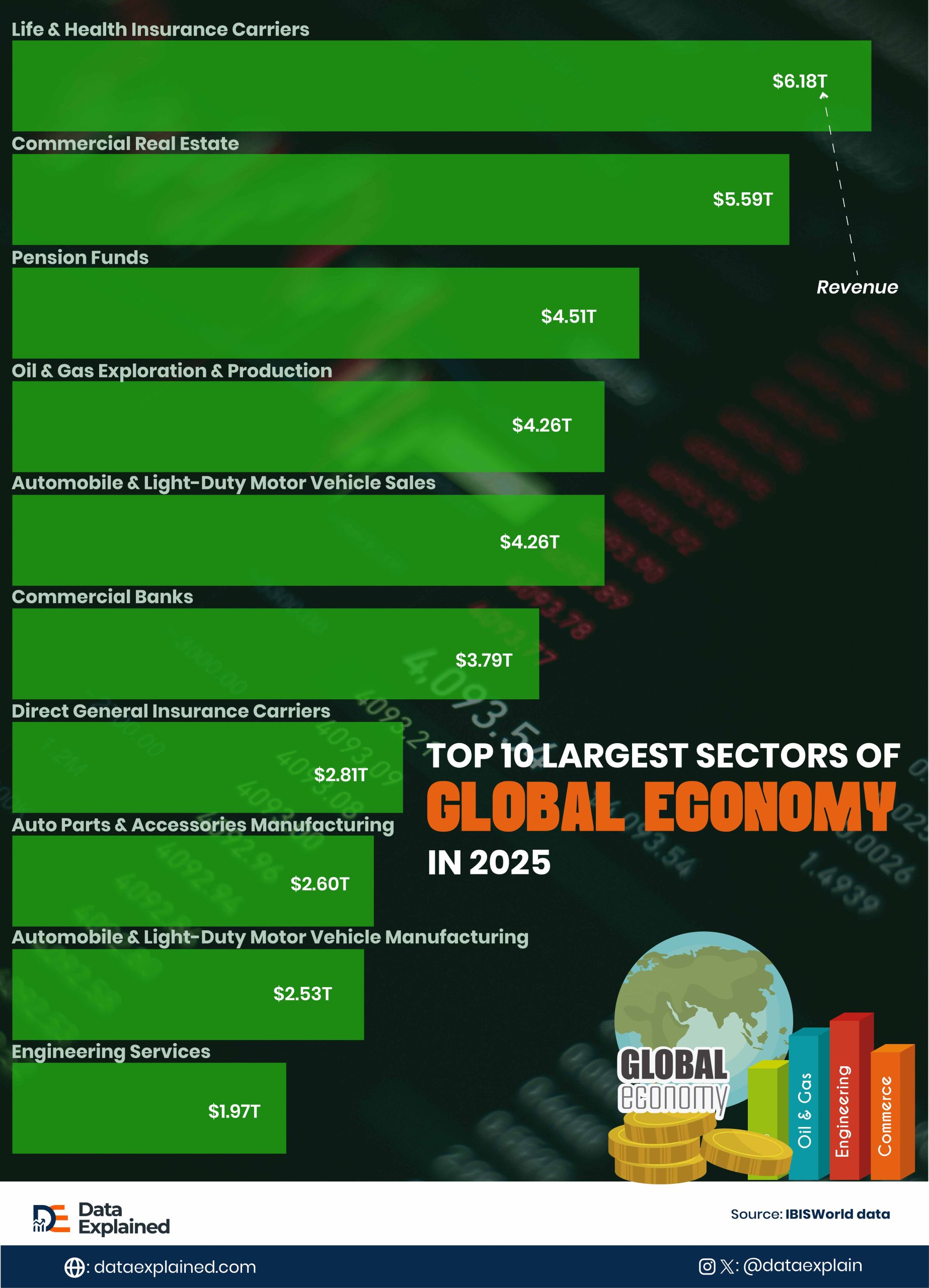
According to IBISWorld’s 2026 industry revenue rankings, the world’s largest industry is Life & Health Insurance, generating an estimated $6.18 trillion in annual revenue.
The visual above tells the story of the industries that quietly manage people’s money, assets, and risks, yet generate far more revenue than those that attract the most public attention.
TL;DR
- Insurance, commercial real estate, and pension funds are the world’s three biggest industries by revenue in 2026, each generating trillions of dollars annually by managing risk, assets, and retirement savings.
- Traditional sectors still dominate the global economy. Banking, oil and gas, and the automotive industry remain far larger by revenue than many of today’s most talked-about technology sectors.
| wdt_ID | wdt_created_by | wdt_created_at | wdt_last_edited_by | wdt_last_edited_at | Rank | Industry | Revenue ($trn) |
|---|---|---|---|---|---|---|---|
| 1 | Monica Ebunoluwa | 30/06/2026 10:08 AM | Monica Ebunoluwa | 30/06/2026 10:08 AM | 1 | Life & Health Insurance Carriers | 6.18 |
| 2 | Monica Ebunoluwa | 30/06/2026 10:08 AM | Monica Ebunoluwa | 30/06/2026 10:08 AM | 2 | Commercial Real Estate | 5.59 |
| 3 | Monica Ebunoluwa | 30/06/2026 10:08 AM | Monica Ebunoluwa | 30/06/2026 10:08 AM | 3 | Pension Funds | 4.51 |
| 4 | Monica Ebunoluwa | 30/06/2026 10:08 AM | Monica Ebunoluwa | 30/06/2026 10:08 AM | 4 | Oil & Gas Exploration & Production | 4.26 |
| 5 | Monica Ebunoluwa | 30/06/2026 10:08 AM | Monica Ebunoluwa | 30/06/2026 10:08 AM | 5 | Automobile & Light-Duty Motor Vehicle Sales | 4.26 |
| 6 | Monica Ebunoluwa | 30/06/2026 10:08 AM | Monica Ebunoluwa | 30/06/2026 10:08 AM | 6 | Commercial Banks | 3.79 |
| 7 | Monica Ebunoluwa | 30/06/2026 10:08 AM | Monica Ebunoluwa | 30/06/2026 10:08 AM | 7 | Direct General Insurance Carriers | 2.81 |
| 8 | Monica Ebunoluwa | 30/06/2026 10:08 AM | Monica Ebunoluwa | 30/06/2026 10:08 AM | 8 | Auto Parts & Accessories Manufacturing | 2.60 |
| 9 | Monica Ebunoluwa | 30/06/2026 10:08 AM | Monica Ebunoluwa | 30/06/2026 10:08 AM | 9 | Automobile & Light-Duty Motor Vehicle Manufacturing | 2.53 |
| 10 | Monica Ebunoluwa | 30/06/2026 10:08 AM | Monica Ebunoluwa | 30/06/2026 10:08 AM | 10 | Engineering Services | 1.97 |
Insurance Comes Out on Top
At first glance, it may seem surprising that Life & Health Insurance is the world’s largest industry.
However, the explanation is straightforward.
Insurance companies collect premiums from hundreds of millions of individuals and businesses worldwide.
As populations age and healthcare costs continue to rise, more people are purchasing health, life, and retirement-related insurance products.
The industry’s size also reflects a broader trend: uncertainty is becoming more expensive.
Whether it’s health risks, natural disasters, or economic instability, people and businesses are increasingly willing to pay for financial protection.
Insurance appears twice in the top 10 list, with Direct General Insurance Carriers also ranking seventh at $2.81 trillion, showing just how much money flows through risk-management services globally.
Real Estate Remains an Economic Giant
The second-largest industry, Commercial Real Estate, generated nearly $5.6 trillion in revenue.
Despite concerns about remote work and changing office demand, commercial property remains a massive business.
Warehouses, logistics hubs, shopping centers, industrial facilities, hotels, and office buildings continue to underpin global commerce.
The rise of e-commerce has also increased demand for industrial real estate and distribution centers, helping offset weakness in some traditional office markets.
Real estate’s position near the top highlights a fundamental truth: every economy needs physical space to operate.
Retirement Money Is Becoming Big Business
Ranking third are Pension Funds, with more than $4.5 trillion in revenue.
This reflects a major demographic shift occurring across many countries. Populations in developed economies are aging, while workers and employers continue contributing large sums to retirement systems.
Pension funds are among the largest investors in global markets, holding stocks, bonds, real estate, and infrastructure assets.
Their growing size means retirement savings are increasingly shaping financial markets and corporate decision-making worldwide.
Cars Dominate Multiple Spots
The automotive sector appears three separate times in the top 10:
- Automobile & Light-Duty Vehicle Sales (#5)
- Auto Parts & Accessories Manufacturing (#8)
- Automobile Manufacturing (#9)
Combined, these industries generate more than $9.3 trillion in revenue.
The automotive ecosystem extends far beyond vehicle sales. It includes factories, suppliers, parts manufacturers, dealerships, and maintenance networks spread across thousands of companies worldwide.
Even as electric vehicles gain market share, the industry’s scale shows that transportation remains one of the largest economic activities on Earth.
What the Rankings Really Tell Us
A striking pattern emerges from the list.
Most of the world’s largest industries are not built around innovation or consumer trends. Instead, they revolve around four basic economic needs:
- Managing money (banks, pension funds, insurance)
- Providing space (real estate)
- Supplying energy (oil and gas)
- Moving people and goods (automobiles)
Together, these foundational sectors form the backbone of the global economy.
They may not generate as much excitement as artificial intelligence or social media, but they handle trillions of dollars because modern societies cannot function without them.
In many ways, the rankings are a reminder that beneath every technological breakthrough lies a vast network of industries that ensure finance, power, and physical support for economic activity.
ELI5 (Explain Like I’m 5)
Imagine the world is a giant city. To make the city work, people need:
- A place to live and work (real estate)
- Money kept safe and borrowed when needed (banks)
- Protection when bad things happen (insurance)
- Fuel to power cars, planes, and factories (oil and gas)
- Vehicles to move around (automobiles)
These things are so important that people spend trillions of dollars on them every year.
Sources: