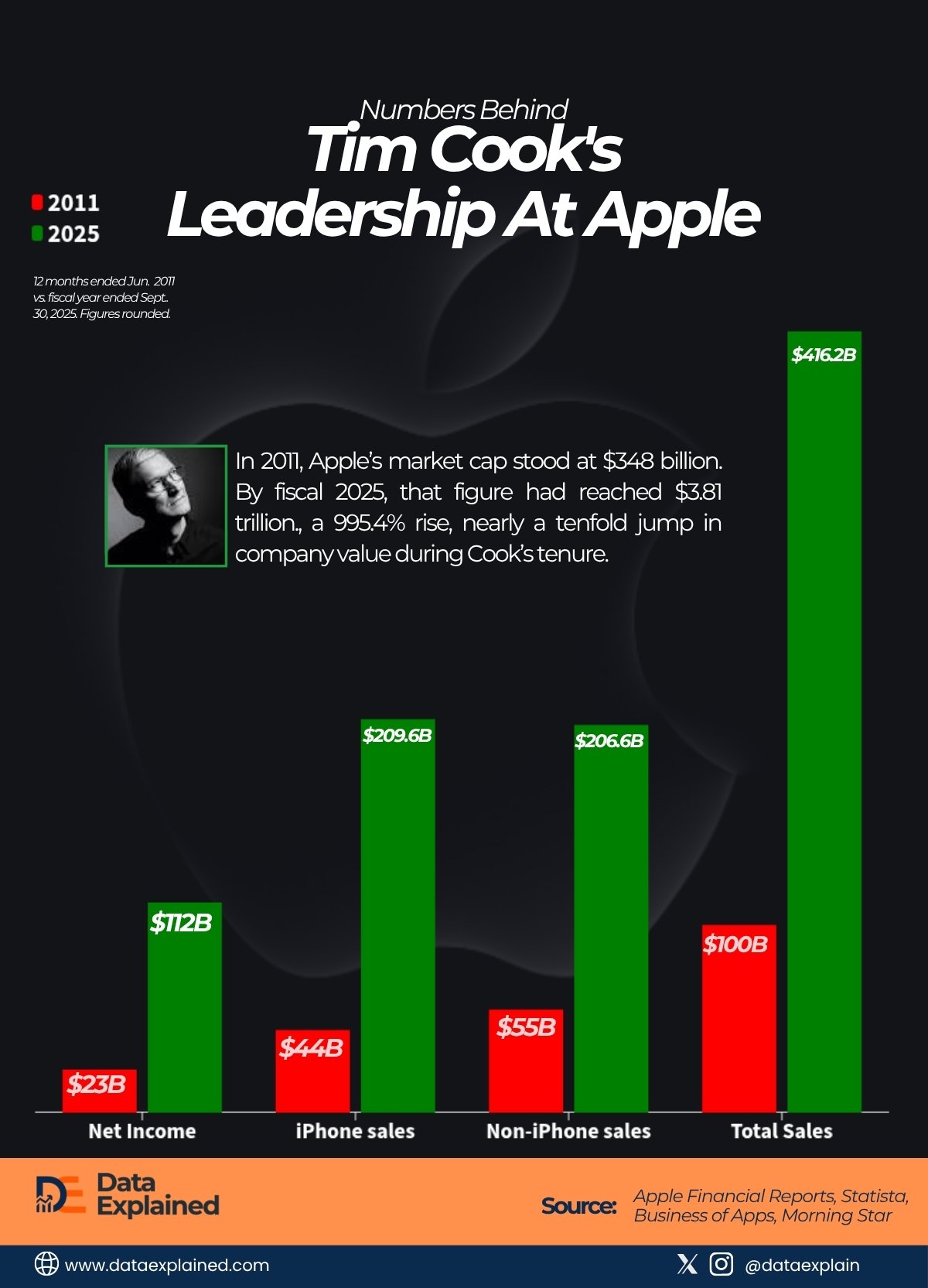
When Tim Cook took over the leadership of Apple Inc. in 2011, he inherited one of the most successful companies in the world.
Annual sales stood at about $100 billion, and the company was already valued at approximately $348 billion.
Fourteen years later, as Cook prepares to hand over the chief executive role to hardware specialist John Ternus while remaining executive chairman, we show the growth in numbers.
The data used for today’s infographic is compiled from Apple’s official filings and industry aggregators, including Morningstar, Statista, and Business of Apps.
It compares two points in time: the 12 months ended June 2011 (roughly when Cook assumed leadership following Steve Jobs) and the fiscal year ended September 30, 2025, his final full year as CEO.
TL;DR
- In 2011, Apple’s market cap stood at $348 billion. By fiscal 2025, that figure had reached $3.81 trillion.
- Following Tim Cook’s leadership, Augmented reality devices and artificial intelligence-driven hardware could define Apple’s next chapter.
| wdt_ID | wdt_created_by | wdt_created_at | wdt_last_edited_by | wdt_last_edited_at | Year | 2011 ($bn) | 2025 ($bn) |
|---|---|---|---|---|---|---|---|
| 1 | emmanuel-ashemiriogwa | 21/04/2026 10:58 AM | emmanuel-ashemiriogwa | 21/04/2026 10:58 AM | Total Sales | 100.0 | 416.2 |
| 2 | emmanuel-ashemiriogwa | 21/04/2026 10:58 AM | emmanuel-ashemiriogwa | 21/04/2026 10:58 AM | iPhone sales | 44.0 | 209.6 |
| 3 | emmanuel-ashemiriogwa | 21/04/2026 10:58 AM | emmanuel-ashemiriogwa | 21/04/2026 10:58 AM | Non-iPhone sales | 55.0 | 206.6 |
| 4 | emmanuel-ashemiriogwa | 21/04/2026 10:58 AM | emmanuel-ashemiriogwa | 21/04/2026 10:58 AM | Net Income | 23.0 | 112.0 |
| 5 | emmanuel-ashemiriogwa | 21/04/2026 10:58 AM | emmanuel-ashemiriogwa | 21/04/2026 10:58 AM | Market Cap | 348.0 | 3,810.0 |
Perhaps the most striking number in the dataset is Apple’s market capitalization. It means the total value investors assign to the company.
In 2011, Apple’s market cap stood at $348 billion. By fiscal 2025, that figure had reached $3.81 trillion.
The increase of $3.462 trillion represents a 995.4% rise, nearly a tenfold jump in company value during Cook’s tenure.
Profit Growth Outpaced Revenue
Revenue expansion alone rarely defines corporate success. Profitability, which is how much of each dollar becomes earnings, often matters more.
Apple’s net income rose from $23 billion in 2011 to $112 billion in 2025, representing a 387% increase.
That growth outpaced revenue expansion, meaning Apple became more profitable as it grew.
In 2011, Apple generated about 23 cents of profit for every dollar in revenue.
By 2025, that figure had climbed to roughly 27 cents per dollar.
For a company already operating globally, improving margins while quadrupling revenue signals operational discipline and pricing power.
The Rise of the Non-iPhone Business
One of the most overlooked developments during Cook’s tenure is the expansion of Apple’s non-iPhone revenue streams.
In 2011, non-iPhone sales generated $55 billion annually. It includes products like:
- Mac computers
- iPads
- Wearables
- Accessories
- Emerging services
By 2025, that figure had climbed to $206.6 billion, representing a 275.6% increase.
The growth effectively created a second business inside Apple. If separated, it would rank among the largest technology companies globally.
Much of that expansion came from Apple’s services ecosystem, including the App Store, Apple Music, iCloud, and Apple Pay.
A Company Re-Rated by Investors
Another revealing shift lies in how investors valued Apple relative to its revenue.
In 2011, Apple’s market cap was roughly 3.48 times its annual revenue. By 2025, that ratio had climbed to about 9.15 times revenue (more than doubling over the period).
Such a shift reflects investor confidence in the durability of Apple’s business model, particularly the rise of subscription-based services that produce recurring income.
Recurring revenue is often valued more highly than one-time hardware sales because it provides predictable cash flow.
That’s a key factor behind Apple’s expanding valuation multiple.
The Transition to John Ternus
The leadership shift to Ternus arrives at a moment when Apple’s financial engine is running at full strength but faces new strategic questions.
Ternus, long associated with Apple’s hardware development, takes control of a company that generates $416.2 billion in annual revenue, $112 billion in net income, and has a $3.81 trillion market valuation.
Emerging technologies such as augmented reality devices and artificial intelligence-driven hardware could define Apple’s next chapter.
ELI5
Today’s visualization simply shows a financial record of Cook’s leadership at Apple as CEO.
Total sales increased by more than 300%. Net income grew even faster. Market value multiplied nearly tenfold. And Apple built a second revenue engine that now rivals the iPhone in size.
Source:
Apple Financial Reports | Statista | Business of Apps | Morning Star