There are about 1.53 billion people worldwide who speak English, either as their first or second language.
While many continue to argue that colonial history has influenced how English is used globally, there’s a bigger picture.
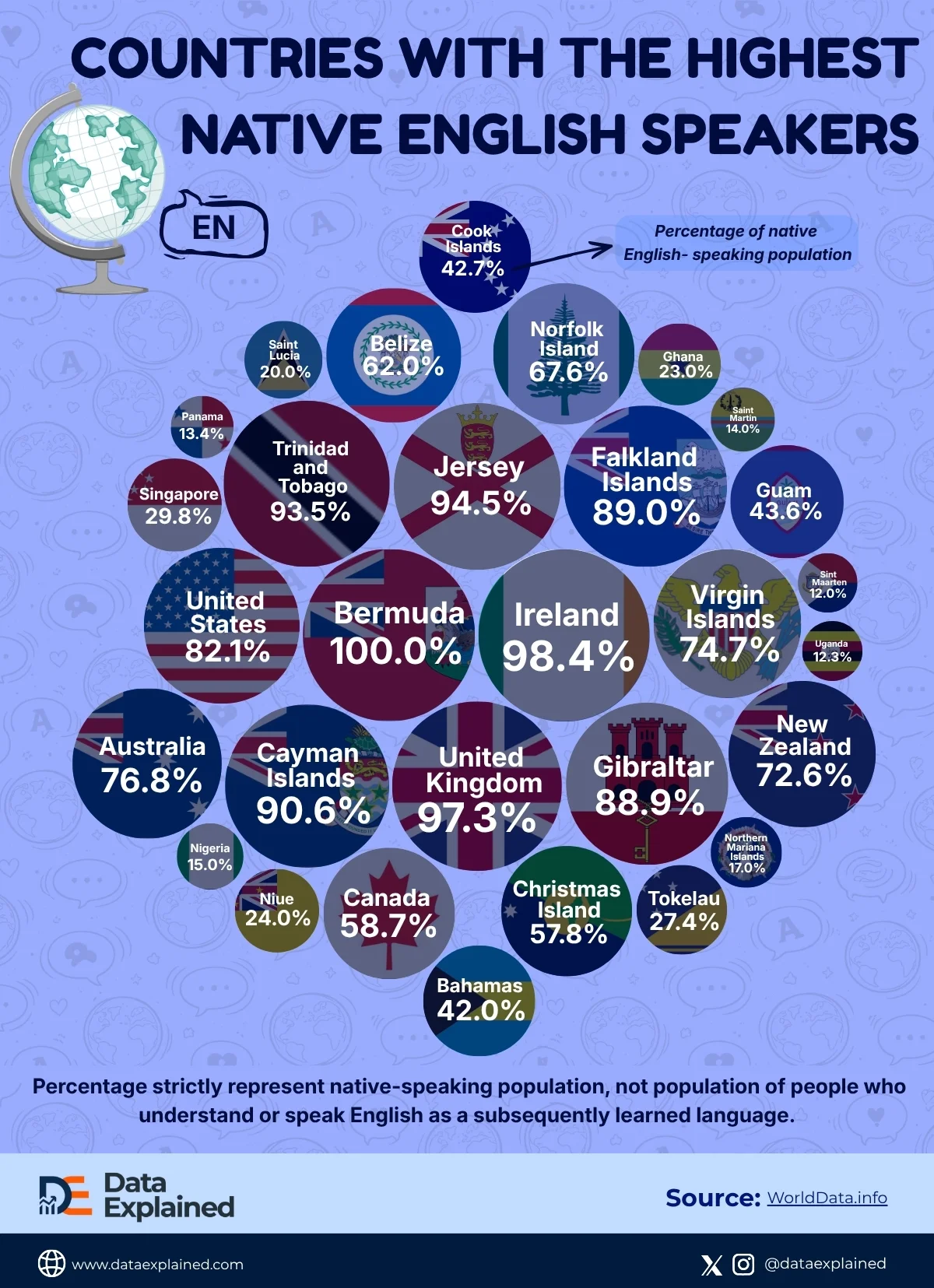
This visualization shows the percentage of native English speakers in each country, based on data from World Data Info.
TL;DR
- Bermuda’s small population is 100% native English speakers.
- Northern Europe (the UK at 97.3%) and the Caribbean (Trinidad at 93.5%) have high native rates.
- Highly proficient regions, such as North America, gain economic advantages, while low-penetration nations, like Japan (0.1%), face barriers partly due to the wide linguistic distance between English and their native languages.
Countries with the Highest Percentage of Native English Speakers
| wdt_ID | wdt_created_by | wdt_created_at | wdt_last_edited_by | wdt_last_edited_at | Rank | Country | Region | Native Speakers (%) | Native Speakers (number) |
|---|---|---|---|---|---|---|---|---|---|
| 1 | Monica Ebunoluwa | 17/04/2026 03:14 PM | Monica Ebunoluwa | 17/04/2026 03:14 PM | 1 | Bermuda | North America | 100.0 | 65,000 |
| 2 | Monica Ebunoluwa | 17/04/2026 03:14 PM | Monica Ebunoluwa | 17/04/2026 03:14 PM | 2 | Ireland | Northern Europe | 98.4 | 5,294,000 |
| 3 | Monica Ebunoluwa | 17/04/2026 03:14 PM | Monica Ebunoluwa | 17/04/2026 03:14 PM | 3 | United Kingdom | Northern Europe | 97.3 | 67,357,000 |
| 4 | Monica Ebunoluwa | 17/04/2026 03:14 PM | Monica Ebunoluwa | 17/04/2026 03:14 PM | 4 | Jersey | Northern Europe | 94.5 | 98,000 |
| 5 | Monica Ebunoluwa | 17/04/2026 03:14 PM | Monica Ebunoluwa | 17/04/2026 03:14 PM | 5 | Trinidad and Tobago | Caribbean | 93.5 | 1,279,000 |
| 6 | Monica Ebunoluwa | 17/04/2026 03:14 PM | Monica Ebunoluwa | 17/04/2026 03:14 PM | 6 | Cayman Islands | Caribbean | 90.6 | 67,000 |
| 7 | Monica Ebunoluwa | 17/04/2026 03:14 PM | Monica Ebunoluwa | 17/04/2026 03:14 PM | 7 | Falkland Islands | South America | 89.0 | 3,000 |
| 8 | Monica Ebunoluwa | 17/04/2026 03:14 PM | Monica Ebunoluwa | 17/04/2026 03:14 PM | 8 | Gibraltar | Southern Europe | 88.9 | 35,000 |
| 9 | Monica Ebunoluwa | 17/04/2026 03:14 PM | Monica Ebunoluwa | 17/04/2026 03:24 PM | 9 | United States | North America | 82.1 | 279,231,000 |
| 10 | Monica Ebunoluwa | 17/04/2026 03:14 PM | Monica Ebunoluwa | 17/04/2026 03:14 PM | 10 | Australia | Australia/New Zealand | 76.8 | 20,893,000 |
Percentages fall significantly beyond the top 19, with Singapore at 29.8%.
Total native speaker numbers range from 500 in Tokelau to 279 million in the U.S., illustrating the comparison between small and large populations.
Small places often have high percentages but fewer people; for example, the Falkland Islands have an 89% population of 3,000.
Larger countries, such as Nigeria, have lower percentages (15%) but many more speakers (35 million).
What Does This Mean?
English continues to be an influential language for business, education, diplomacy, and global mobility. But the countries with the largest English-speaking populations are not necessarily the ones where English originated.
Instead, demographic strength, education systems, and historical influences have shaped a very different global ranking.
ELI5
Imagine every country in the world is a classroom.
In some classrooms, almost everyone speaks English as their first language, as in the United States, the United Kingdom, or tiny Bermuda, where literally everyone does.
In other classrooms, only a few kids speak English at home, as in Nigeria or Singapore, even though many people there learn it later in school.
This list counts people who grew up speaking English from the start, not those who learned it later.
That is why some really big countries have small percentages, and some really small places have huge ones.
Sources: