Apple is testing four different smart glasses designs, according to Bloomberg’s Mark Gurman, with a potential unveiling in late 2026 ahead of a 2027 commercial launch.
The product would put Apple in direct competition with Meta’s Ray-Ban Display glasses.
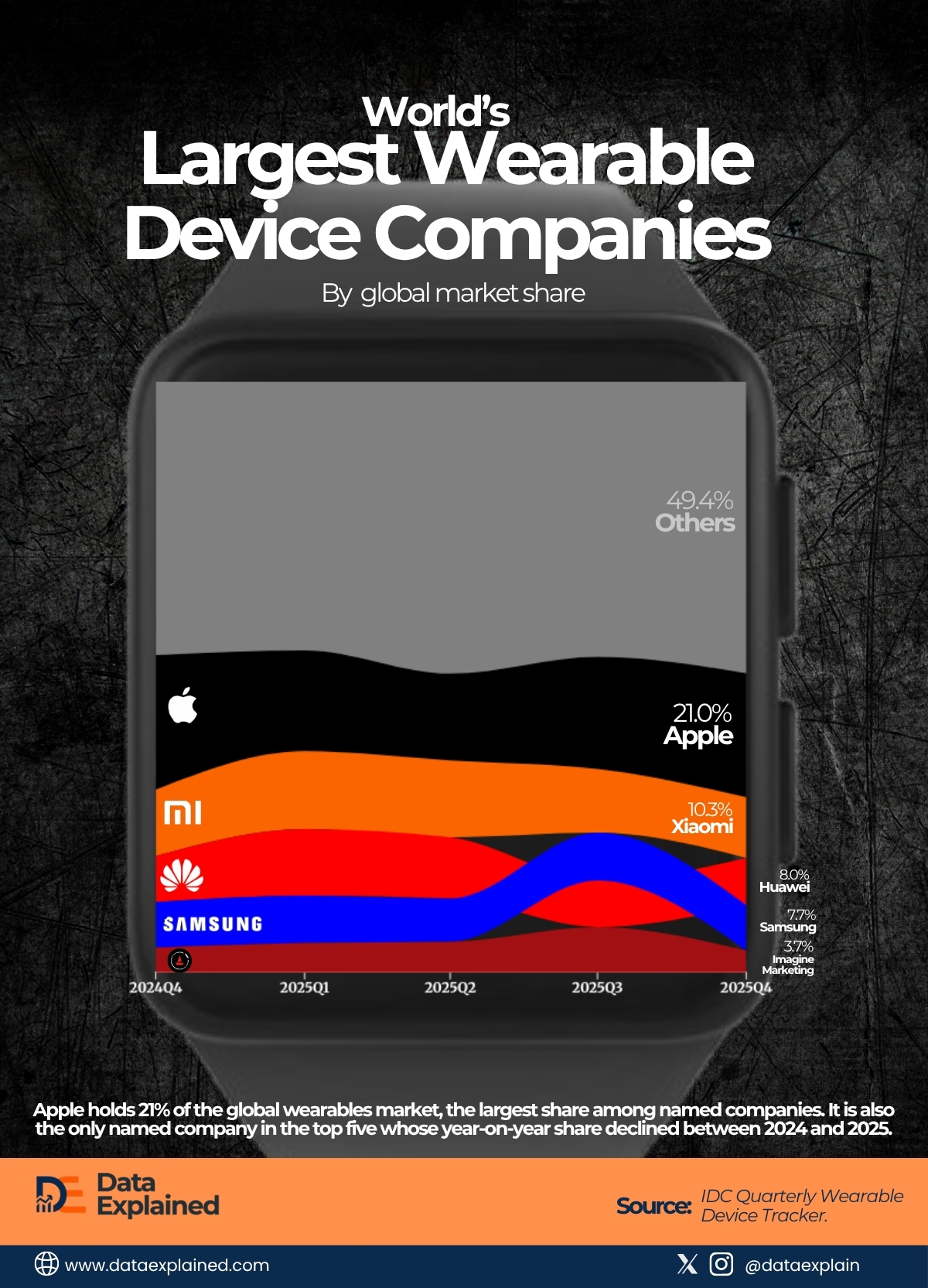
In that light, today’s data infographic shows the largest players in the global wearables market.
The data comes from The IDC Quarterly Wearable Device Tracker.
It shows why the timing of Apple’s products carries urgency.
TL;DR
- In the fourth quarter of 2025, Apple held 21.0% of the global wearables market (the largest share among named companies).
- While Apple is the market leader, it is also the only named company in the top five whose year-on-year share declined between 2024 and 2025.
Trend of Global Wearable Device Market Share by Companies
| wdt_ID | wdt_created_by | wdt_created_at | wdt_last_edited_by | wdt_last_edited_at | Company | 2024Q4 | 2025Q1 | 2025Q2 | 2025Q3 | 2025Q4 |
|---|---|---|---|---|---|---|---|---|---|---|
| 1 | emmanuel-ashemiriogwa | 16/04/2026 11:11 AM | emmanuel-ashemiriogwa | 16/04/2026 11:11 AM | Apple | 22.8% | 17.1% | 14.7% | 19.0% | 21.0% |
| 2 | emmanuel-ashemiriogwa | 16/04/2026 11:11 AM | emmanuel-ashemiriogwa | 16/04/2026 11:11 AM | Xiaomi | 11.2% | 13.2% | 13.0% | 10.8% | 10.3% |
| 3 | emmanuel-ashemiriogwa | 16/04/2026 11:11 AM | emmanuel-ashemiriogwa | 16/04/2026 11:11 AM | Huawei | 7.8% | 11.3% | 10.4% | 7.9% | 8.0% |
| 4 | emmanuel-ashemiriogwa | 16/04/2026 11:11 AM | emmanuel-ashemiriogwa | 16/04/2026 11:11 AM | Samsung | 7.7% | 8.0% | 7.3% | 8.1% | 7.7% |
| 5 | emmanuel-ashemiriogwa | 16/04/2026 11:11 AM | emmanuel-ashemiriogwa | 16/04/2026 11:11 AM | Imagine Marketing | 4.2% | 5.0% | 5.2% | 7.7% | 3.7% |
| 6 | emmanuel-ashemiriogwa | 16/04/2026 11:11 AM | emmanuel-ashemiriogwa | 16/04/2026 11:11 AM | Others | 46.2% | 45.5% | 49.4% | 46.6% | 49.4% |
| 7 | emmanuel-ashemiriogwa | 16/04/2026 11:11 AM | emmanuel-ashemiriogwa | 16/04/2026 11:11 AM | Total | 100.0% | 100.0% | 100.0% | 100.0% | 100.0% |
The year-on-year comparison understates the pressure Apple faced in 2025.
In the second quarter of the year, Apple’s wearables market share collapsed to 14.7%, the lowest figure in the entire five-quarter IDC dataset, an 8.1-percentage-point drop from its Q4 2024 position.
Of all the wearable device companies named in the tracker, none experienced a swing of that magnitude in a single direction across any comparable period.
Apple recovered sharply (19.0% in Q3 2025, 21.0% in Q4), driven by the Apple Watch and AirPods product launch cycle that reliably concentrates sales in the second half of the calendar year.
But here’s what it means:
Apple’s dominance in wearables is structurally seasonal.
When the launch cycle is not providing a tailwind, the company’s share position is considerably more vulnerable than its brand leadership implies.
The Market Nobody Controls
The most important number in the IDC dataset is the 49.4% sitting in the “Others” category in Q4 2025.
These are companies not large enough to appear as named entries in the quarterly tracker.
Nearly half the global wearables market belongs to a fragmented field of smaller players that collectively outsize every named competitor on the table.
Meta’s Ray-Ban smart glasses are somewhere inside that 49.4%.
For all the coverage Meta’s wearable has received as a category-defining device, it has not achieved the market share required to register as a named entry in IDC’s global tracker.
The Rest of the Field
Xiaomi sits at 10.3% in Q4 2025, down from 13.2% in Q1. That’s four consecutive quarters of share decline in a growing market.
Huawei holds 8.0% and operates under U.S. technology export controls that have been in place since 2019.
Its sustained top-three position despite those restrictions is a specific finding about the limits of technology containment in consumer hardware.
Samsung sits at 7.7% in Q4 2025, trading between 7.3% and 8.1% across all five quarters.
That’s the flattest trajectory in the dataset for the world’s largest smartphone manufacturer.
Samsung helped create the modern smartwatch category with the Galaxy Gear in 2013.
A decade later, its global wearables share has not meaningfully grown in five quarters of IDC tracking.
Something Special about India’s boAt
The Indian company behind the boAt brand, Imagine Marketing, tells the most dramatic story in the dataset.
Market share of wearables climbed from 4.2% in Q4 2024 to 7.7% in Q3 2025, temporarily making it the world’s fourth-largest wearables company.
It then fell to 3.7% by the end of 2025.
The spike and collapse maps almost exactly overlap India’s festive season.
Navratri and Diwali concentrate consumer electronics sales in Q3 each year. boAt’s trajectory is less a competitive story than a calendar story.
ELI5
The IDC data show a wearables market in which named companies collectively lost share from Q4 2024 to Q4 2025, “Others” grew to nearly half the market, and Apple’s own position (despite its leadership) declined year-on-year.
The smart glasses bet is coming from a market leader that knows the category it built is fragmenting around it, and that its next move needs to do what AirPods did a decade ago: create a new column in the table that only Apple can fill.
Source:
IDC Quarterly Wearable Device Tracker, Final Historical 2025