Luxury goods were supposed to be the sector that crises could not touch. Ultra-wealthy clients continue to spend regardless of geopolitical conditions.
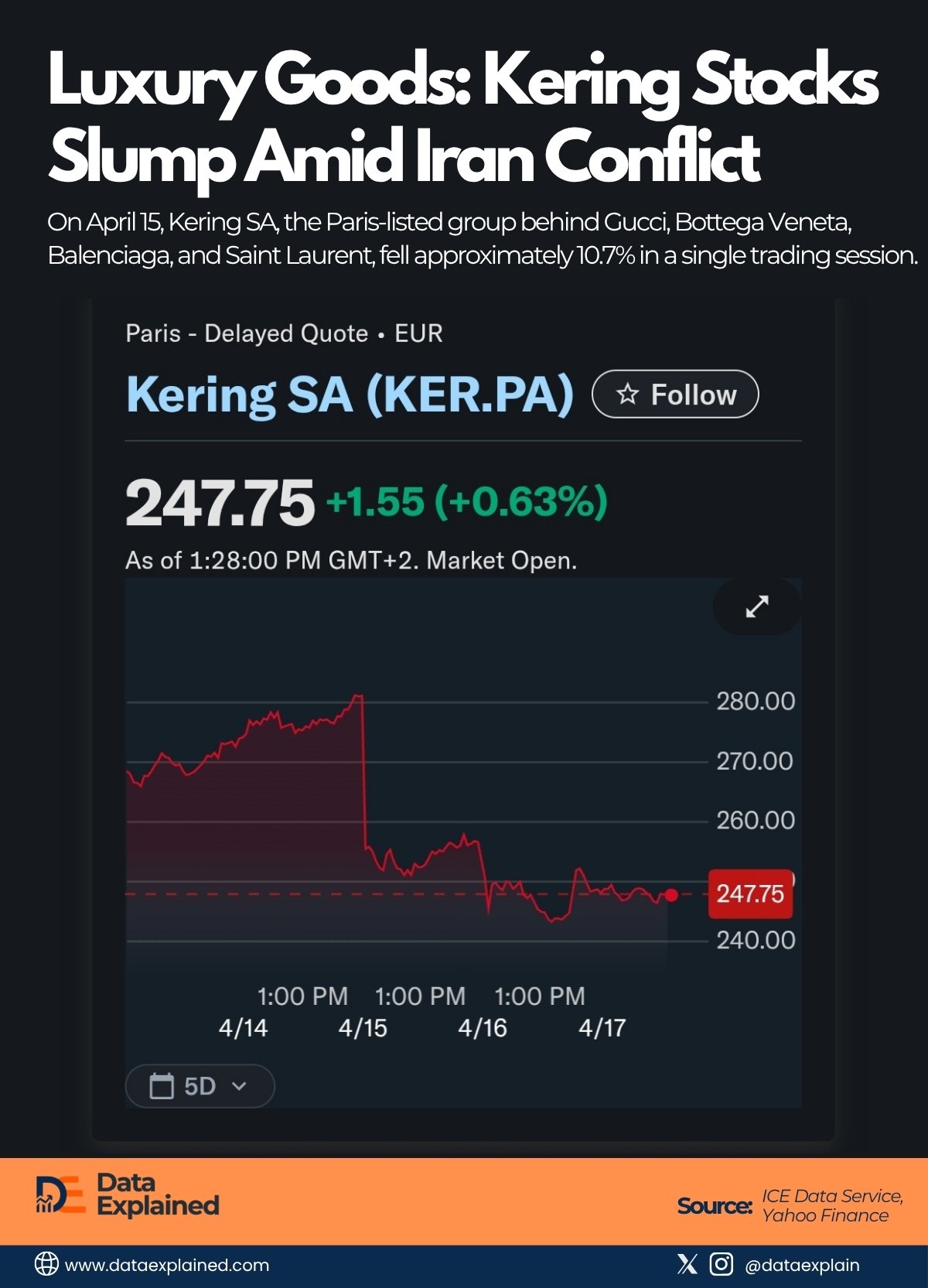
The US-Israeli war with Iran, which began in late February 2026, is testing that thesis directly, and Kering’s five-day stock chart is the evidence.
TL;DR
- Kering SA, the Paris-listed group behind Gucci, Bottega Veneta, Balenciaga, and Saint Laurent, opened on April 14 at approximately €265 on Euronext Paris.
- By April 14’s close, it had climbed to approximately €280 (as investors bought into the company’s scheduled quarterly earnings release with cautious optimism).
- Then the results arrived on April 15.
- The stock fell approximately 10.7% in a single trading session, dropping from approximately €280 to near €250 in what the five-day chart shows as a near-vertical single-day collapse.
- By April 17, Kering was trading at €247.75, approximately 11.5% below its four-day peak.
The Number That Moved the Price
The earnings disclosure that triggered the sell-off contained a specific figure.
Retail revenue in the Middle East fell 11% in the first quarter of 2026.
The region had shown growth in January and February.
The Iran conflict, which began in late February, reversed that positive trajectory within a single month.
The Middle East represents approximately 5% of Kering’s total retail revenue.
An 11% decline in a region generating 5% of total revenue is a manageable direct financial impact in isolation.
The second quarter of 2026 will be the first full three-month period reflecting the impact of the Iran conflict on Kering’s Middle East operations, with no January or February growth to cushion the result.
The Crisis Unit
Alongside the revenue figure, Kering disclosed that it had activated a crisis unit to monitor its 1,100 employees and 79 stores across the Middle East in real time.
Crisis units are an emergency operational infrastructure. They are not standard earnings-cycle disclosures.
Kering’s management considered the situation serious enough to build an emergency monitoring capability for a workforce and store network spread across the UAE, Saudi Arabia, Qatar, and other Gulf markets.
The disclosure amplified the market’s reaction.
A company activating crisis infrastructure is signaling operational uncertainty that goes beyond a single percentage point of revenue.
The Sector Behind the Chart
The global luxury goods market, valued at approximately $400 billion, is being hit by the Iran conflict through three simultaneous channels:
- Direct disruption to Middle East retail
- Reduced travel by Gulf-based luxury clients who typically shop in European capitals
- Rising logistics and materials costs stemming from regional supply chain disruption
Gulf-based luxury clients, particularly from the UAE, Saudi Arabia, and Qatar, are among the highest-spending segments for European luxury stores.
A client who buys in Dubai and also spends heavily during annual trips to Paris and Milan is absent from both channels when conflict restricts travel.
Kering’s 79 Middle East stores are the visible part of its regional exposure.
The travel retail impact (European stores losing Gulf clientele who are no longer flying) is the less visible and harder-to-quantify second hit.
The Chart’s Second Story
After April 15’s initial collapse from approximately €280 to approximately €250, Kering appeared to be finding a floor. Buyers stepped in on April 15-16, stabilizing the price between approximately €250 and €258.
Then the stock fell again, in a second leg down to approximately €242-243 on April 16-17, before a modest recovery to €247.75.
A failed recovery followed by a second leg lower is a technically significant pattern.
It suggests the initial drop was not an overreaction that buyers corrected. It suggests the market continues to find reasons to sell at each level of stabilization.
So, What?
Two data releases will determine whether Kering’s current level represents fair value or the beginning of a deeper repricing.
The first is any update on the trajectory of the Iran conflict.
For example, a ceasefire or de-escalation that restored Gulf travel and consumer confidence would materially change the forward revenue assumption the market is currently using.
The second is Kering’s Q2 2026 results, which will be the first full-quarter measurement of conflict impact without the January-February cushion that softened the Q1 figure to 11%.
If Q2 Middle East revenue declines at a rate reflecting the full weight of a conflict that has been running since late February (without the pre-war growth months offsetting it), the 11% figure reported on April 15 will look modest by comparison.
The $400 billion luxury sector found a vulnerability it did not know it had.
Source:
Kering SA (KER.PA), Euronext Paris | Kering Q1 2026 earnings release