Australia’s labor market produced one of its strongest monthly results in March 2026.
Full-time employment surged by 52,500 jobs. The unemployment rate held steady at 4.3%.
By the headline measures, the Australian jobs market is in good health.
Data Explained therefore looked into the seasonally adjusted underemployment data from the Australian Bureau of Statistics (ABS).
It tracks the share of employed people who want more hours than they are getting.
The data showed that female underemployment sits at 7.1% in March 2026, nearly double the headline unemployment figure.
For Australian women, the labor market problem is not whether they have a job. It is whether the job they have is enough.
TL;DR
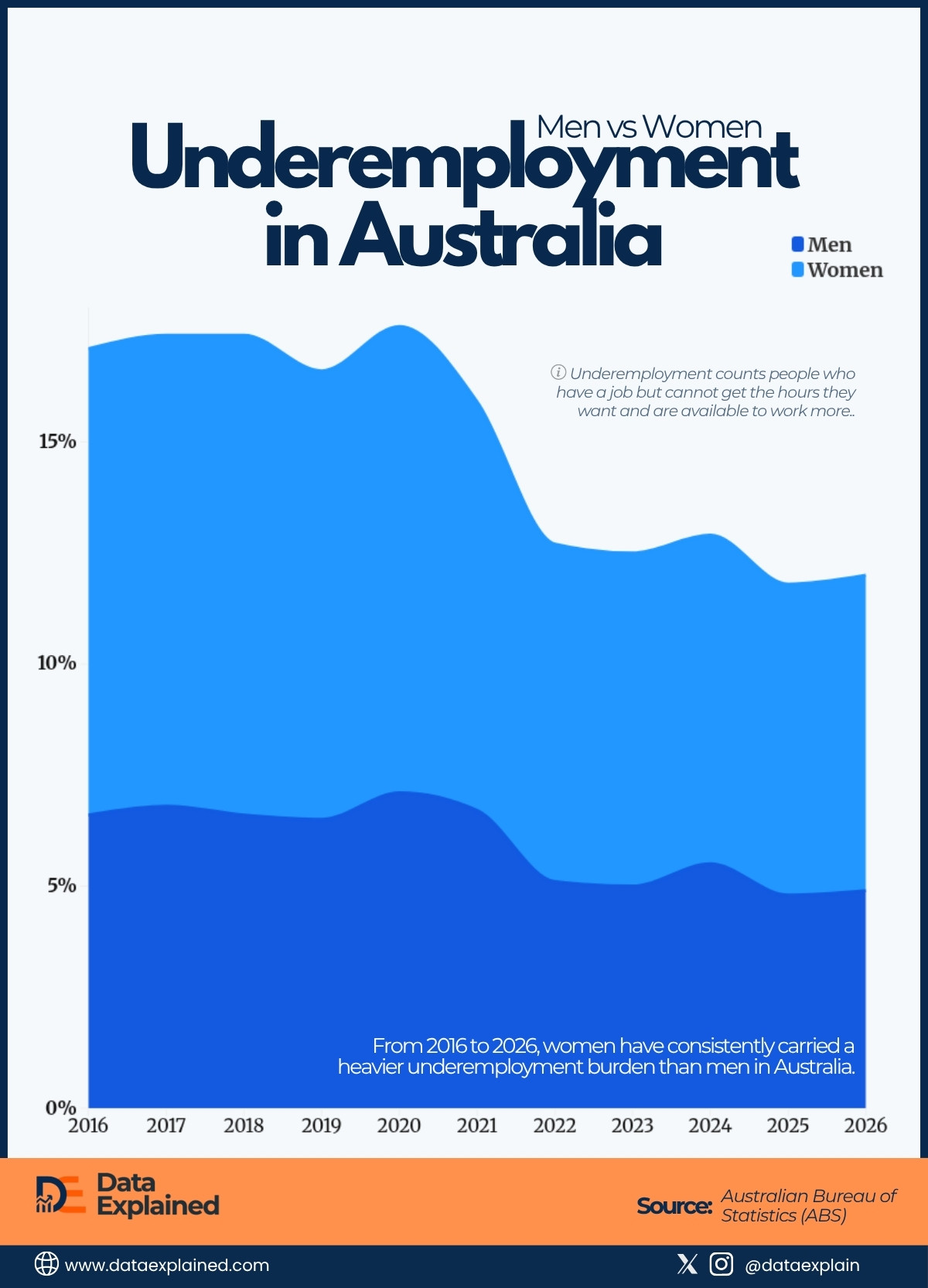
- From March 2016 to March 2026, women have consistently carried a heavier underemployment burden than men in Australia.
- The RBA began cutting interest rates in February 2026 after holding at restrictive levels through 2024. This may narrow down the gap.
Underemployment Rate Between Men and Women in Australia (2016-2026)
| wdt_ID | wdt_created_by | wdt_created_at | wdt_last_edited_by | wdt_last_edited_at | Year | Males (%) | Females (%) |
|---|---|---|---|---|---|---|---|
| 1 | emmanuel-ashemiriogwa | 17/04/2026 08:56 AM | emmanuel-ashemiriogwa | 17/04/2026 08:56 AM | 2016 | 6.60 | 10.50 |
| 2 | emmanuel-ashemiriogwa | 17/04/2026 08:56 AM | emmanuel-ashemiriogwa | 17/04/2026 08:56 AM | 2017 | 6.80 | 10.60 |
| 3 | emmanuel-ashemiriogwa | 17/04/2026 08:56 AM | emmanuel-ashemiriogwa | 17/04/2026 08:56 AM | 2018 | 6.60 | 10.80 |
| 4 | emmanuel-ashemiriogwa | 17/04/2026 08:56 AM | emmanuel-ashemiriogwa | 17/04/2026 08:56 AM | 2019 | 6.50 | 10.10 |
| 5 | emmanuel-ashemiriogwa | 17/04/2026 08:56 AM | emmanuel-ashemiriogwa | 17/04/2026 08:56 AM | 2020 | 7.10 | 10.50 |
| 6 | emmanuel-ashemiriogwa | 17/04/2026 08:56 AM | emmanuel-ashemiriogwa | 17/04/2026 08:56 AM | 2021 | 6.70 | 9.20 |
| 7 | emmanuel-ashemiriogwa | 17/04/2026 08:56 AM | emmanuel-ashemiriogwa | 17/04/2026 08:56 AM | 2022 | 5.10 | 7.60 |
| 8 | emmanuel-ashemiriogwa | 17/04/2026 08:56 AM | emmanuel-ashemiriogwa | 17/04/2026 08:56 AM | 2023 | 5.00 | 7.50 |
| 9 | emmanuel-ashemiriogwa | 17/04/2026 08:56 AM | emmanuel-ashemiriogwa | 17/04/2026 08:56 AM | 2024 | 5.50 | 7.40 |
| 10 | emmanuel-ashemiriogwa | 17/04/2026 08:56 AM | emmanuel-ashemiriogwa | 17/04/2026 08:56 AM | 2025 | 4.80 | 7.00 |
What Underemployment Actually Measures
Unemployment counts people who have no job and are actively looking for one.
Underemployment counts people who have a job but cannot get the hours they want and are available to work more.
For example:
- A part-time retail worker seeking full-time hours.
- A casual healthcare worker who applied for additional shifts was turned away.
- A hospitality employee rostered for 12 hours a week who needs 30.
These workers are employed by official definition. They are not fully absorbed by the labor market in any meaningful economic sense.
The ABS underemployment rate is the metric that captures them.
And across a full decade of ABS data, from March 2016 to March 2026, that metric has consistently shown women carrying a heavier underemployment burden than men.
A Persistent Gap
In March 2026, male underemployment sits at approximately 5%. Female underemployment sits at approximately 7%.
The 2-percentage-point gap between them is the narrowest in the ten-year ABS dataset.
It is also the continuation of a structural pattern that has never been closed.
Before COVID arrived, the gap was considerably wider.
From March 2016 through 2019, female underemployment ranged from 10.5% to 10.1%, while male underemployment ranged from 6.6% to 6.5%.
One in ten employed Australian women wanted more work and could not get it during a period of sustained national prosperity.
The strong economy did not solve the problem of underemployment for women. It managed it at a structurally elevated level and held it there.
The Recovery Was Not Equal
Male underemployment fell from its COVID peak of approximately 12% to below 5% by late 2021, a recovery of more than 7 percentage points in under two years.
Female underemployment remained above 8% at the same point.
Men’s underemployment recovered at nearly twice the speed of women’s.
The sectors that recovered fastest (construction, manufacturing, mining) are male-dominated.
The Reserve Bank of Australia (RBA)’s interest rate hiking cycle from May 2022 to November 2023 added a further headwind specifically to female underemployment.
Recall that the rate raised the cash rate from 0.1% to 4.35% to address post-COVID inflation.
Consumer-facing sectors, cooled by higher borrowing costs and reduced household spending, are the sectors where women’s employment is concentrated.
The ABS data shows female underemployment stabilizing and briefly rising during 2023 before resuming its decline.
What Comes Next
The RBA began cutting interest rates in February 2026 after holding at restrictive levels through 2024.
Rate cuts that stimulate consumer spending flow directly into hospitality, retail, and care sectors.
These are industries where female underemployment is concentrated.
If the rate-cut cycle restores hours in those sectors, the gap between male and female underemployment should continue to narrow.
The second signal is the gender breakdown of full-time employment creation in Q2 2026.
A labor market that adds tens of thousands of full-time jobs every month but concentrates them in male-dominated industries will produce strong unemployment headlines alongside a persistent female underemployment gap.
Source:
Australian Bureau of Statistics