American aerospace company SpaceX hoped to break records with a staggering 175 to 180 launches in 2025, and that was just for the Falcon family.
It was to be the biggest year yet for the Elon Musk-founded Starship, and by the end of it, it would be operational.
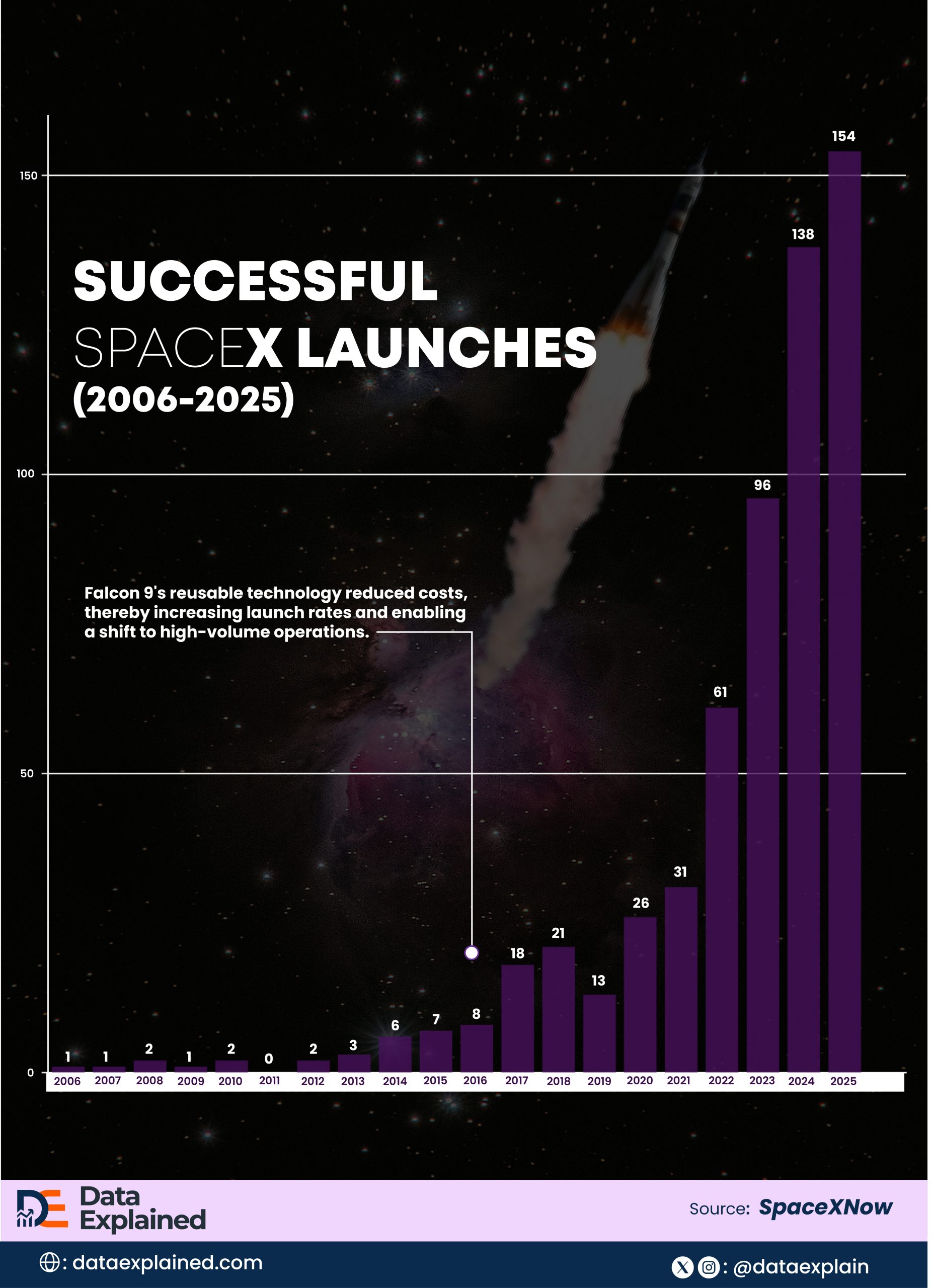
Using SpaceXNow data, this visualization shows SpaceX’s successful launches to date.
TL;DR
- SpaceX launched 134 rockets in 2024 and 154 in 2025, the most since 2020, thanks to Falcon 9 reuse and increasing Starlink demand.
- Falcon Series continues to demonstrate its reliability with a 99% success rate, while Starship’s arrival in 2024-2025 suggests a reusable, heavy-lift future.
Successful SpaceX Launches (2006-2025)
| wdt_ID | wdt_created_by | wdt_created_at | wdt_last_edited_by | wdt_last_edited_at | Year | Successful Launches |
|---|---|---|---|---|---|---|
| 1 | dataexplained.4re | 19/01/2026 12:12 PM | dataexplained.4re | 19/01/2026 12:12 PM | 2006 | 1 |
| 2 | dataexplained.4re | 19/01/2026 12:12 PM | dataexplained.4re | 19/01/2026 12:12 PM | 2007 | 1 |
| 3 | dataexplained.4re | 19/01/2026 12:12 PM | dataexplained.4re | 19/01/2026 12:12 PM | 2008 | 2 |
| 4 | dataexplained.4re | 19/01/2026 12:12 PM | dataexplained.4re | 19/01/2026 12:12 PM | 2009 | 1 |
| 5 | dataexplained.4re | 19/01/2026 12:12 PM | dataexplained.4re | 19/01/2026 12:12 PM | 2010 | 2 |
| 6 | dataexplained.4re | 19/01/2026 12:12 PM | dataexplained.4re | 19/01/2026 12:12 PM | 2011 | 0 |
| 7 | dataexplained.4re | 19/01/2026 12:12 PM | dataexplained.4re | 19/01/2026 12:12 PM | 2012 | 2 |
| 8 | dataexplained.4re | 19/01/2026 12:12 PM | dataexplained.4re | 19/01/2026 12:12 PM | 2013 | 3 |
| 9 | dataexplained.4re | 19/01/2026 12:12 PM | dataexplained.4re | 19/01/2026 12:12 PM | 2014 | 6 |
| 10 | dataexplained.4re | 19/01/2026 12:12 PM | dataexplained.4re | 19/01/2026 12:12 PM | 2015 | 7 |
SpaceX’s launch history shows a steep uphill movement. There’s slow growth at first, then rapid increases as technology and markets expand.
Over 10 years (2006-2016), they averaged fewer than five launches annually, primarily due to Falcon 1 failures and early setbacks, and experienced a complete pause in 2011 due to production issues.
After 2016, Falcon 9’s reusable technology reduced costs, thereby increasing launch rates and enabling a shift to high-volume operations.
What’s Special About 2025 Record?
In 2025, SpaceX conducted 167 launches as of December, up from 134 in 2024.
They reused boosters more than 450 times, enabling near-weekly missions and maintaining industry leadership.
While Starship’s orbital tests played a minor role, most launches utilised Falcon rockets, maintaining SpaceX’s global leadership.
Approximately 134 launches in 2024 are SpaceX’s highest number of launches in a year, surpassing the 98 launches in 2023.
That is 40+ launches in 2024, driven by increased manufacturing at Starbase and Hawthorne.
This growth aligned with surging Starlink user requests for constant satellite launches, strengthened by U.S. government contracts and post-COVID supply chain improvements.
As expected, this launch history reflects on SpaceX’s revenue.
It grew from $1.45 billion in 2019 to $8.7 billion in 2023, then $13–14 billion in 2024, and is expected to reach $15.5 billion in 2025. Starlink dominated, accounting for over 60% of earnings by 2024, supported by NASA and commercial pacts.
This direct link between launch volume and income fuels ambitious plans, such as a Mars settlement, amid a $350 billion valuation.
Breakdown by Rocket Family
Falcon 9:
Falcon 9 launched for the first time in 2010, achieving two flawless launches, establishing SpaceX’s reusable rocket technology after early issues with the Falcon 1.
It took off around 2015, achieving an 85.7% success rate with six launches, then jumped to 18 in 2017 as reusability improved and Starlink expanded. By 2020–2025, it dominated with 136 launches in 2024 and 154 in 2025, achieving an overall reliability of 99.47% based on 567 wins.
Dubbed the King of Space Travel, it has the main advantage of cutting costs by reusing boosters, enabling faster launches and market leadership.
Falcon Heavy:
Falcon Heavy made its first launch in 2018 with a perfect debut, boosting payload capacity for complex missions.
Between 2019 and 2023, it had 11 flawless launches, primarily for high-stakes payloads, including military satellites.
It’s used about 1-2 times a year and is primarily for heavy-lift tasks, with Falcon 9 handling most routine flights.
Starship:
Starship became a big deal in 2024 with test launches from Starbase, hitting five successes out of 11, even as it went through lots of quick upgrades.
In 2025, it sped up, with fewer flight delays of about a month, and aimed for full reusability. However, its success rate is around 45%, showing it’s still in development compared to Falcon’s more mature stage.
Overall, it’s a sign that SpaceX is dreaming bigger, aiming for interplanetary travel and massive payloads that could surpass previous rockets.
What Does High Launch Volumes Really Mean?
Now, why should you care?
SpaceX’s rapid launch schedule makes spaceflight more accessible and affordable, reducing costs from $67 million per Falcon 9 in 2010 to under $30 million in 2025.
More frequent launches mean routine deliveries to orbit, opening the door to tourism and research.
This busy schedule breaks down old barriers, letting startups send payloads cheaply.
High launch rates also accelerate satellite deployment, with Starlink adding over 2,500 satellites in 2025 through grouped launches. These mega-constellations expand the global internet, especially in remote areas.
However, the increased number of satellites also means more falling debris, which raises concerns about pollution and safety.
In the market, SpaceX’s 52% share in 2024 puts pressure on companies like Blue Origin to improve reusability. Their dominance drives industry growth, setting new records in 2025 and generating new revenue streams.
While new niches are emerging, it’s becoming increasingly complex for newcomers to compete due to the scale and advancements of established players.
ELI5: SpaceX Launches by Year
SpaceX rocket launches have become more frequent over the years, with 134 launches in 2024 and over 160 in 2025.
The reuse of Falcon 9 rocket parts and the need for Starlink internet inspire this growth.
Falcon rockets are more reliable, succeeding 99% of the time, much like trusty bikes.
However, testing of Starship rockets is underway to haul more and reuse everything.
All these launches make space trips more affordable, build satellite networks for the global internet faster, and help SpaceX surpass other space companies.
Sources:
Sacra | PayloadSpace | NewSpaceNexus | ApplyingAI | MarketWatch