It may surprise you to know that, on average, people spend 6 hours and 40 minutes per day on screens.
From phones and laptops to TVs and tablets, screens now dominate modern life, but not everywhere.
Exploring countries by average daily screen time reveals where people spend the most time and how digital habits differ across nations.
TL;DR
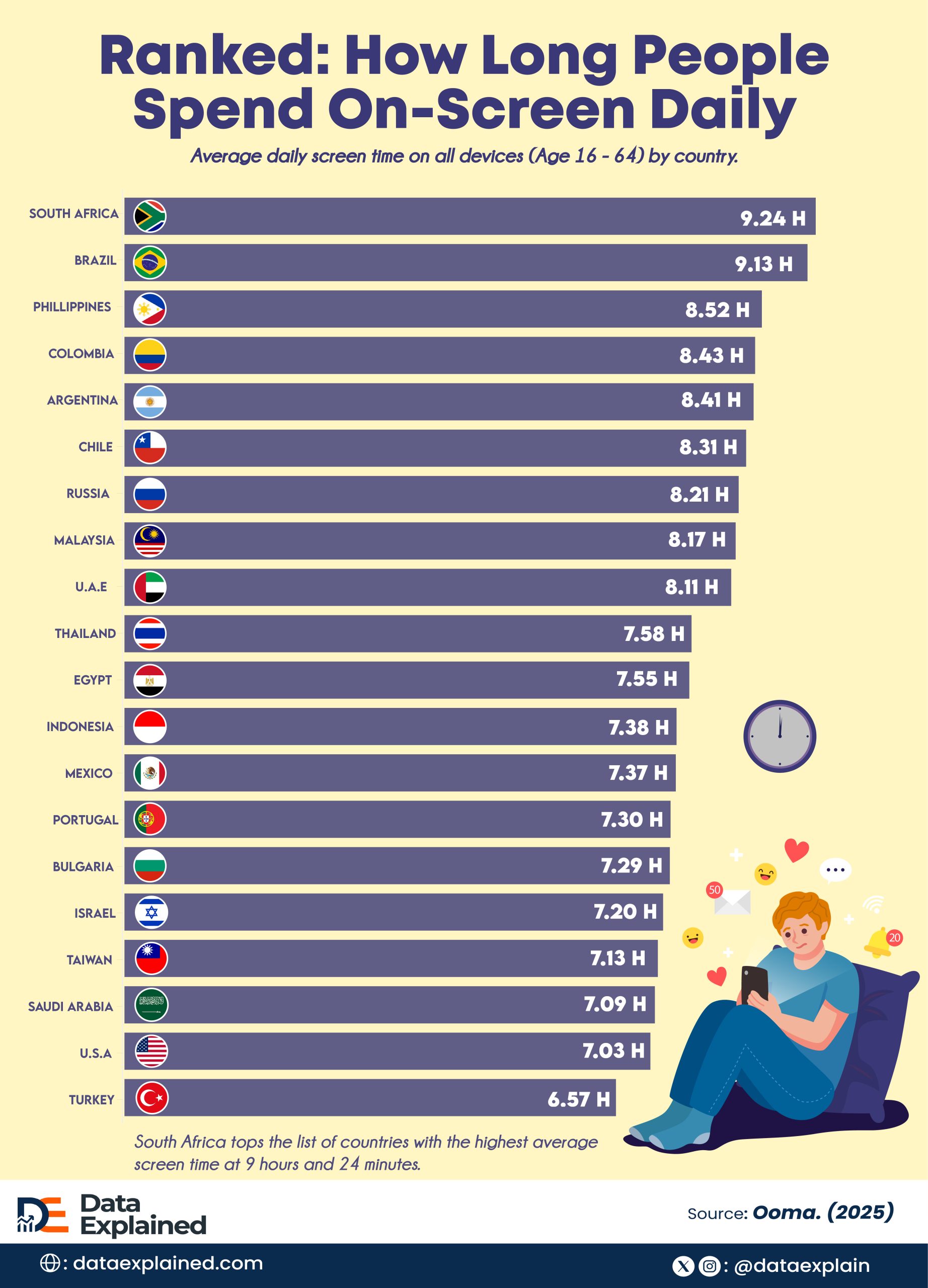
- South Africa tops the list of countries with the highest average screen time at 9 hours and 24 minutes.
- On average, the younger generation (under 20s) spends 5 more hours on screen than older adults daily.
The data used in this graphic and explainer comes from Ooma.
Countries Ranked by Average Daily Screen Time
| wdt_ID | wdt_created_by | wdt_created_at | wdt_last_edited_by | wdt_last_edited_at | Rank | Country | Average Daily Screen Time (16-64yrs) |
|---|---|---|---|---|---|---|---|
| 1 | emmanuel-ashemiriogwa | 10/03/2026 01:07 PM | emmanuel-ashemiriogwa | 10/03/2026 01:07 PM | 1 | South Africa | 9.24 hrs |
| 2 | emmanuel-ashemiriogwa | 10/03/2026 01:07 PM | emmanuel-ashemiriogwa | 10/03/2026 01:07 PM | 2 | Brazil | 9.13 hrs |
| 3 | emmanuel-ashemiriogwa | 10/03/2026 01:07 PM | emmanuel-ashemiriogwa | 10/03/2026 01:07 PM | 3 | Philippines | 8.52 hrs |
| 4 | emmanuel-ashemiriogwa | 10/03/2026 01:07 PM | emmanuel-ashemiriogwa | 10/03/2026 01:07 PM | 4 | Colombia | 8.43 hrs |
| 5 | emmanuel-ashemiriogwa | 10/03/2026 01:07 PM | emmanuel-ashemiriogwa | 10/03/2026 01:07 PM | 5 | Argentina | 8.41 hrs |
| 6 | emmanuel-ashemiriogwa | 10/03/2026 01:07 PM | emmanuel-ashemiriogwa | 10/03/2026 01:07 PM | 6 | Chile | 8.31 hrs |
| 7 | emmanuel-ashemiriogwa | 10/03/2026 01:07 PM | emmanuel-ashemiriogwa | 10/03/2026 01:07 PM | 7 | Russia | 8.21 hrs |
| 8 | emmanuel-ashemiriogwa | 10/03/2026 01:07 PM | emmanuel-ashemiriogwa | 10/03/2026 01:07 PM | 8 | Malaysia | 8.17 hrs |
| 9 | emmanuel-ashemiriogwa | 10/03/2026 01:07 PM | emmanuel-ashemiriogwa | 10/03/2026 01:07 PM | 9 | U.A.E | 8.11 hrs |
| 10 | emmanuel-ashemiriogwa | 10/03/2026 01:07 PM | emmanuel-ashemiriogwa | 10/03/2026 01:07 PM | 10 | Thailand | 7.58 hrs |
What seems odd about this ranking is that South Africa is at the top of the list, even ahead of countries often considered more digital.
Having more than 9 hours of daily screen time puts it far above the global average.
Another noticeable pattern is the strong presence of Latin American countries close to the top.
Countries such as Brazil, Colombia, Argentina, and Chile rank high, indicating that social media, mobile internet use, and entertainment play significant roles in daily life across these nations.
We can also observe that some developing or middle-income countries rank higher than advanced economies.
Countries such as the U.S., Canada, and Australia rank closer to the middle of the list, despite having good access to devices and the internet.
Where People Spend Less Time on Screens
An odd pattern is how Nordic and Western European countries rank low.
Countries like Norway, Denmark, Sweden, and the Netherlands are known for strong digital infrastructure. Yet, their screen time is below the global average.
Japan also stands out the most at the bottom of the list, with less than 4 hours of daily screen time.
This is unexpected, given Japan’s advanced technology culture.
Though, this may reflect long working hours, offline communication habits, or less social media use compared to other nations.
Screen Time By Age
Younger age groups tend to spend more time on screens than older ones, with Gen Z (teens and early 20s) averaging around 9 hours daily.
This is above the global average of about 6 hours and 40 minutes.
Younger adults (aged 16–24) also spend more time on screens, usually more than 7 hours daily, while screen time slowly declines with age for older adults.
Older adults usually spend less screen time, about 4–5 hours daily, showing lower digital engagement than the younger generations.
The age trend shows that screens dominate the lives of teens and young adults, primarily through social media, entertainment, education, and online communication.
Impact Of Screen Time
Excessive screen time is related to several health and developmental concerns.
A July 2025 CDC report (using data from 2021-2023) highlighted that U.S teenagers with four or more hours of daily non-school screen time were more likely to report multiple adverse outcomes.
Also, high screen time has been associated with social and attentional issues in young children, such as difficulties with focus and language skills.
ELI5
South Africa topping the screen-time list is surprising, given that it’s ahead of countries seen as more digitally advanced.
This means that screen use isn’t just about technology, but also about lifestyle.
Things like heavy social media use and long hours spent online for entertainment and communication also matter.
Age also plays a role. Younger people naturally spend more time on screens due to social media, streaming, and gaming.