
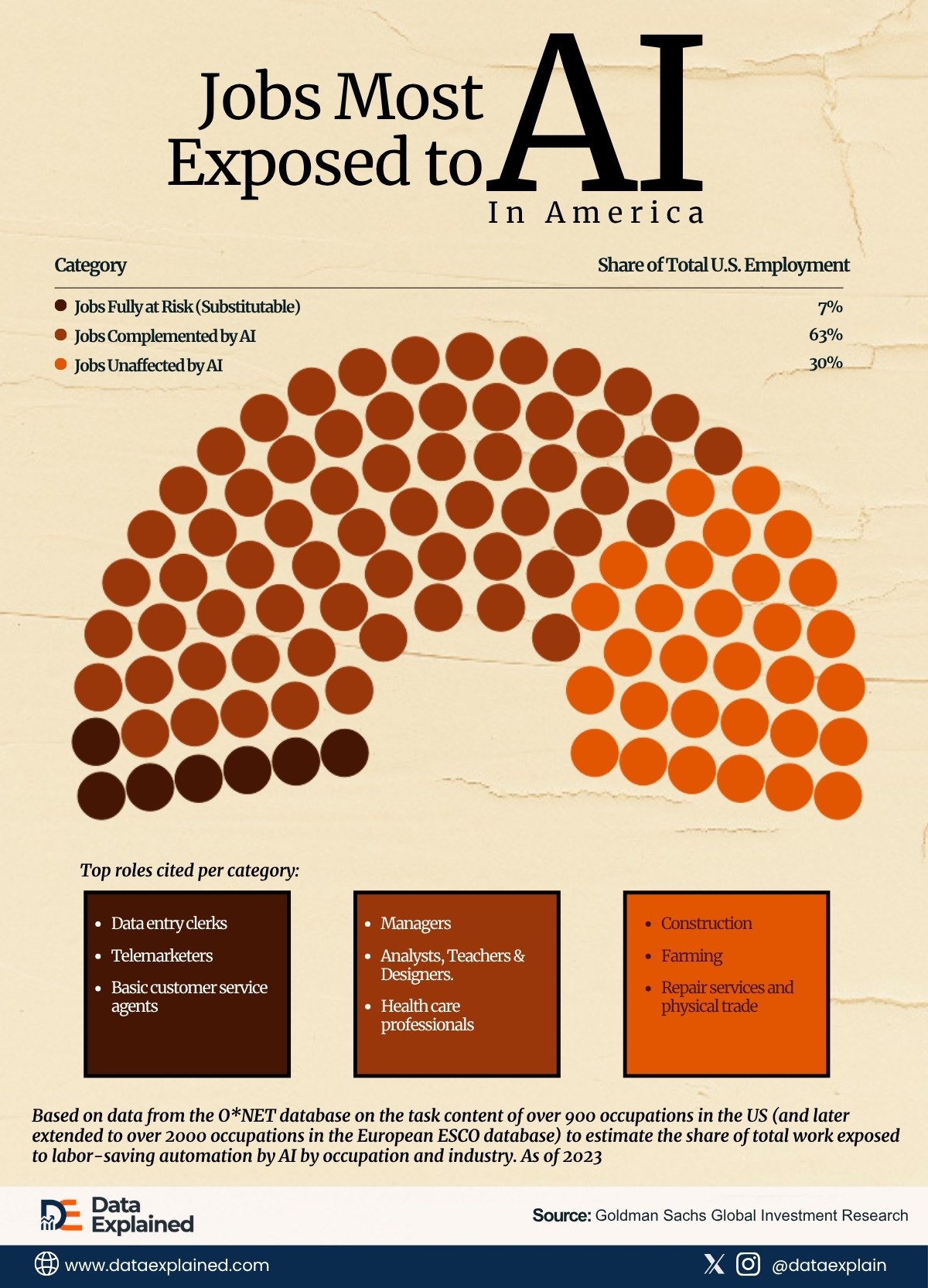
Out of all the tasks Americans perform in paid work, one-quarter could feasibly be done by AI tools without human input.
But because most jobs blend automatable and non-automatable tasks, only about 7% of actual jobs would be fully replaced.
Data gathered from Goldman Sachs Global Investment Research revealed that AI is likely to change how most people work, rather than immediately throwing most people out of work.
TL;DR
- Roughly two-thirds of job roles are exposed to some degree of AI automation.
- 7% of current U.S. employment is substituted by AI, 63% complemented, and 30% unaffected.
| wdt_ID | wdt_created_by | wdt_created_at | wdt_last_edited_by | wdt_last_edited_at | Category | % Share of Total U.S. Employment | Examples of Tasks/Jobs Affected |
|---|---|---|---|---|---|---|---|
| 1 | Monica Ebunoluwa | 03/07/2026 03:27 PM | Monica Ebunoluwa | 03/07/2026 03:27 PM | Jobs Fully at Risk (Substitutable) | 7 | Data entry clerks, telemarketers, basic customer service agents. |
| 2 | Monica Ebunoluwa | 03/07/2026 03:27 PM | Monica Ebunoluwa | 03/07/2026 03:27 PM | Jobs Complemented by AI | 63 | Managers, analysts, teachers, designers, and healthcare professionals. |
| 3 | Monica Ebunoluwa | 03/07/2026 03:27 PM | Monica Ebunoluwa | 03/07/2026 03:27 PM | Jobs Unaffected by AI | 30 | Construction, farming, repair services, and physical trades. |
Top Jobs/Industries Most Exposed to AI in the U.S.
| wdt_ID | wdt_created_by | wdt_created_at | wdt_last_edited_by | wdt_last_edited_at | Rank | Industry | Share of Industry Employment Exposed (%) |
|---|---|---|---|---|---|---|---|
| 1 | Monica Ebunoluwa | 03/07/2026 03:18 PM | Monica Ebunoluwa | 03/07/2026 03:18 PM | 1 | Office & administrative support | 46% |
| 2 | Monica Ebunoluwa | 03/07/2026 03:18 PM | Monica Ebunoluwa | 03/07/2026 03:18 PM | 2 | Legal occupations | 44% |
| 3 | Monica Ebunoluwa | 03/07/2026 03:18 PM | Monica Ebunoluwa | 03/07/2026 03:18 PM | 3 | Architecture & engineering (professional/technical) | 37% |
| 4 | Monica Ebunoluwa | 03/07/2026 03:18 PM | Monica Ebunoluwa | 03/07/2026 03:18 PM | 4 | Life, physical & social science roles | 36% |
| 5 | Monica Ebunoluwa | 03/07/2026 03:18 PM | Monica Ebunoluwa | 03/07/2026 03:18 PM | 5 | Business & financial operations | 35% |
| 6 | Monica Ebunoluwa | 03/07/2026 03:18 PM | Monica Ebunoluwa | 03/07/2026 03:18 PM | 6 | Community & social services | 33% |
| 7 | Monica Ebunoluwa | 03/07/2026 03:18 PM | Monica Ebunoluwa | 03/07/2026 03:18 PM | 7 | Management | 32% |
| 8 | Monica Ebunoluwa | 03/07/2026 03:18 PM | Monica Ebunoluwa | 03/07/2026 03:18 PM | 8 | Sales & related occupations | 31% |
| 9 | Monica Ebunoluwa | 03/07/2026 03:18 PM | Monica Ebunoluwa | 03/07/2026 03:18 PM | 9 | Computer & mathematical roles | 29% |
Goldman Sachs Exhibit 5 — US, 2023
*Note: the report estimates exposure by mapping O*NET task-level data to occupations and weighting by importance and complexity. “Exposed” means AI could perform a material share of tasks in that occupation under Goldman Sachs’ baseline assumptions
The industry detail gives the picture teeth.
The work most exposed sits in the paperwork-heavy, language- and knowledge-dense side of the economy.
The Bigger Picture from a Global Perspective
Scaling the U.S. analysis worldwide, Goldman estimates 18% of work globally could be automated.
There’s a larger effect in developed markets, where office-based and knowledge work are a larger share of employment.
There’s a smaller near-term effect in many emerging economies with larger agricultural and manual workforces.
That means the macro gains (the productivity payoffs) are concentrated where tasks align with what AI can do.
Recent data from a YouGov survey shows that more than one in five (22%) people think that AI could perform some of their tasks.
According to the OECD paper “Who Will Be the Workers Most Affected by AI?”, some of the most AI-exposed jobs are held by science & engineering professionals, chief executives, managers, business professionals, and IT professionals.
PwC’s 2024 Global AI Jobs Barometer shows that sectors least exposed to AI tasks have experienced lower productivity growth than AI-exposed sectors.
What This Means for Workers
- Retraining is essential: Many jobs will be partially exposed rather than entirely replaced, indicating the need for workers to learn new skills to remain relevant. Workers whose routines are automated will need training in areas where human creativity still matters.
- Role adaptation becomes standard: Instead of roles dying completely, many jobs will evolve. AI will handle repetitive tasks while humans focus on oversight, decision-making, and complex activities.
- New job opportunities emerge: History shows that technology displaces some jobs while creating new ones. New occupations drive long-run employment growth after transitions.
- Productivity gains can benefit non-displaced workers. AI could boost human productivity by doing the heavy lifting on data, reports, and analysis.
- Short-term disruption, long-term opportunity: The transition won’t be smooth. Some workers may be displaced before new roles or skills that fit are available.
ELI5
AI will change most jobs, fully replace relatively few, and could raise productivity (but only if adoption, policy, and reskilling keep pace).
The real economic story will be written in the years after half of the firms actually adopt these tools.
Ditto to the choices societies make about who gets to benefit from the productivity they unlock.
Source:
Goldman Sachs Report | YouGov Survey | PwC’s 2024 Global AI Jobs Barometer | OECD paper “Who Will Be the Workers Most Affected by AI?”
Also Read:
The Rate of AI Job Automation: 20 Fastest Changing Occupations