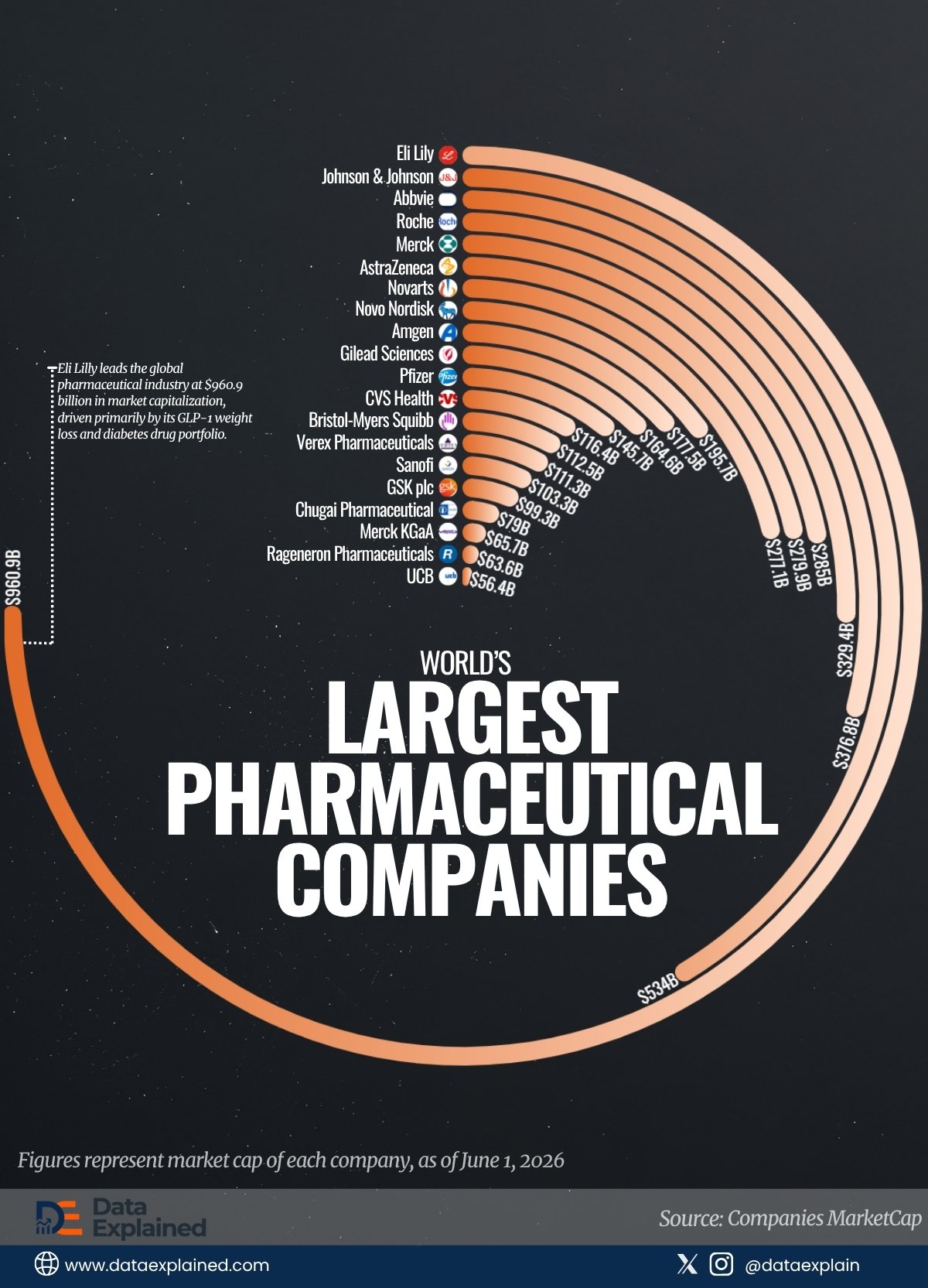
Eli Lilly now has a market capitalization of $960.9 billion, almost double Johnson & Johnson’s $534 billion. It is roughly driven by a single drug class that did not generate meaningful revenue five years ago.
The infographic above shows the top 20 largest pharma companies by market cap, as of June 1, 2026.
It comes from Companies MarketCap.
Market capitalization is the total dollar value of a company’s outstanding shares of stock. It is a quick and widely used metric to measure a company’s total size.
TL;DR
- Eli Lilly leads the global pharmaceutical industry at $960.9 billion in market capitalization, driven primarily by its GLP-1 weight loss and diabetes drug portfolio
- Pfizer has lost approximately half of its market value since its COVID vaccine peak, falling from roughly $300 billion to $145.7 billion, and now ranks 11th.
- 11 of the top 20 pharmaceutical companies are American
| wdt_ID | wdt_created_by | wdt_created_at | wdt_last_edited_by | wdt_last_edited_at | Company | Market Cap ($B) | Country |
|---|---|---|---|---|---|---|---|
| 1 | emmanuel-ashemiriogwa | 01/06/2026 04:13 PM | emmanuel-ashemiriogwa | 01/06/2026 04:13 PM | Eli Lily | 960.9 | USA |
| 2 | emmanuel-ashemiriogwa | 01/06/2026 04:13 PM | emmanuel-ashemiriogwa | 01/06/2026 04:13 PM | Johnson & Johnson | 534.0 | USA |
| 3 | emmanuel-ashemiriogwa | 01/06/2026 04:13 PM | emmanuel-ashemiriogwa | 01/06/2026 04:13 PM | Abbvie | 376.8 | USA |
| 4 | emmanuel-ashemiriogwa | 01/06/2026 04:13 PM | emmanuel-ashemiriogwa | 01/06/2026 04:13 PM | Roche | 329.4 | Switzerland |
| 5 | emmanuel-ashemiriogwa | 01/06/2026 04:13 PM | emmanuel-ashemiriogwa | 01/06/2026 04:13 PM | Merck | 285.0 | USA |
| 6 | emmanuel-ashemiriogwa | 01/06/2026 04:13 PM | emmanuel-ashemiriogwa | 01/06/2026 04:13 PM | AstraZeneca | 279.9 | UK |
| 7 | emmanuel-ashemiriogwa | 01/06/2026 04:13 PM | emmanuel-ashemiriogwa | 01/06/2026 04:13 PM | Novarts | 277.1 | Switzerland |
| 8 | emmanuel-ashemiriogwa | 01/06/2026 04:13 PM | emmanuel-ashemiriogwa | 01/06/2026 04:13 PM | Novo Nordisk | 195.7 | Denmark |
| 9 | emmanuel-ashemiriogwa | 01/06/2026 04:13 PM | emmanuel-ashemiriogwa | 01/06/2026 04:13 PM | Amgen | 177.5 | USA |
| 10 | emmanuel-ashemiriogwa | 01/06/2026 04:13 PM | emmanuel-ashemiriogwa | 01/06/2026 04:13 PM | Gilead Sciences | 164.6 | USA |
The Weight Loss Revolution
Tirzepatide, sold as Zepbound for obesity and Mounjaro for type 2 diabetes, is the primary engine behind Eli Lilly’s valuation.
GLP-1 drugs work by mimicking hormones that regulate blood sugar and appetite, producing sustained weight loss in clinical trials at rates that no previous drug class achieved.
Eli Lilly’s version and Novo Nordisk’s semaglutide (Ozempic, Wegovy) together define the category.
Novo Nordisk, the Danish company that pioneered insulin manufacturing in 1923, sits eighth in the table at $195.7 billion, a position driven by the same drug class.
What Happened to Pfizer?
Pfizer sits 11th at $145.7 billion.
During 2021 and 2022, as its COVID-19 vaccine generated unprecedented revenue, Pfizer’s market capitalization reached approximately $300 billion.
The company was briefly one of the most valuable corporations on earth.
Three years later, it is worth less than Amgen ($177.5 billion), Gilead Sciences ($164.6 billion), and Novo Nordisk, all of which were far less prominent during the pandemic period.
COVID vaccine revenue was extraordinary but non-recurring.
The pipeline of drugs that would justify a sustained $300 billion valuation did not materialize at the pace the market initially priced.
America’s pharma
Eleven of the top 20 pharmaceutical companies are American.
That includes Eli Lilly, Johnson and Johnson, AbbVie, Merck, Amgen, Gilead Sciences, Pfizer, CVS Health, Bristol-Myers Squibb, Vertex Pharmaceuticals, and Regeneron Pharmaceuticals.
That concentration of pharmaceutical value in American companies creates a specific policy context.
Robert F. Kennedy Jr., as the U.S. Department of Health and Human Services Secretary, oversees a regulatory environment that directly affects each of those 11 companies.
The Trump administration’s executive order targeting “most favored nation” drug pricing, which would tie U.S. drug prices to the lowest price paid by peer countries, would directly compress the revenue model that supports American pharmaceutical company valuations relative to European competitors, as shown in the chart.
The Absent Giants
China does not appear in the top 20 despite having the world’s second-largest pharmaceutical market by revenue and a population of 1.4 billion.
India does not appear despite producing approximately 20% of the world’s generic drug supply and approximately 40% of the U.S. generic drug demand.
China and India have built pharmaceutical industries on manufacturing—producing generic versions of other companies’ drugs at scale and at low cost.
Generic manufacturing generates volume without the patent protection, price premiums, and investor multiples that proprietary drug development produces.
A company that manufactures off-patent medicines for pennies per pill generates a fundamentally different market capitalization than one charging thousands of dollars per month for a drug it invented and holds a 20-year patent on.
ELI5
Eli Lilly makes a drug that helps people lose weight (Ozempic’s competitor), and it’s now almost worth $1 trillion, making it the most valuable drug company in the world. Pfizer, which made the famous COVID vaccine, is worth half as much as it used to be because sales of the vaccine have dropped. America dominates this list with 11 of the top 20 companies. China and India, despite being huge countries, aren’t on the list because they mainly copy drugs rather than invent new ones.
Source: