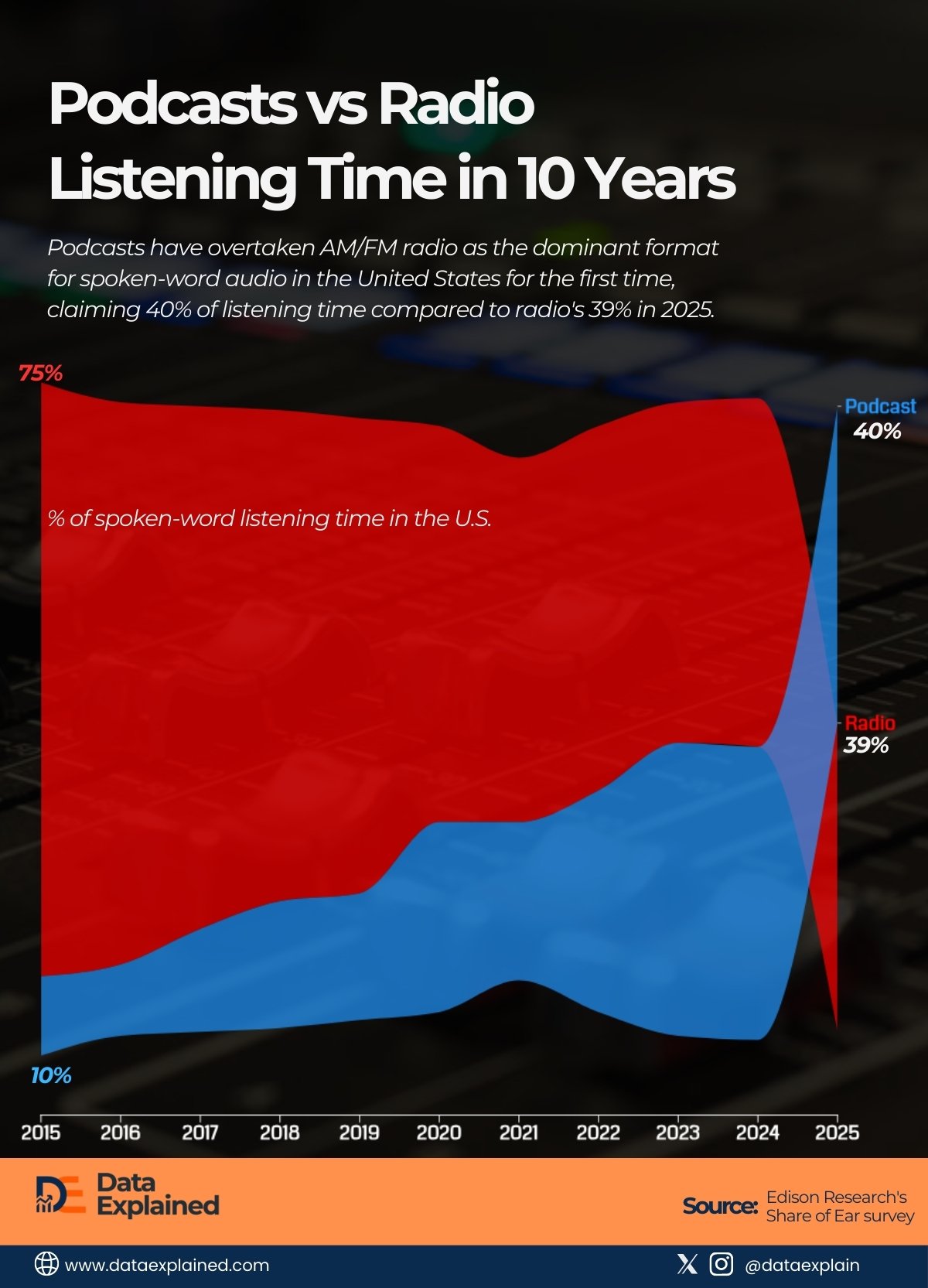
Podcasts have overtaken AM/FM radio as the dominant format for spoken-word audio in the United States for the first time, claiming 40% of listening time compared to radio’s 39% in 2025.
This data comes from Edison Research’s Share of Ear survey released on February 24.
The milestone caps a decade-long transformation visible in the data.
In 2015, radio commanded 75% of spoken-word listening, while podcasts held just 10%, a 7.5-to-1 ratio that has now flipped to near-parity, with radio losing 36 percentage points and podcasts gaining 30.
TL;DR
- Podcasts have officially surpassed AM/FM radio in the U.S., claiming 40% of spoken-word listening vs. radio’s 39% in 2025.
- Over the past 10 years, radio fell 36 points while podcasts rose 30 — almost mirror-image trends
Spoken-Word Listening Trends: Radio vs Podcasts (2015–2025)
| wdt_ID | wdt_created_by | wdt_created_at | wdt_last_edited_by | wdt_last_edited_at | Year | Radio (% of listening time) | Podcast (% of listening time) |
|---|---|---|---|---|---|---|---|
| 1 | emmanuel-ashemiriogwa | 27/02/2026 02:30 AM | emmanuel-ashemiriogwa | 27/02/2026 02:30 AM | 2015 | 75 | 10 |
| 2 | emmanuel-ashemiriogwa | 27/02/2026 02:30 AM | emmanuel-ashemiriogwa | 27/02/2026 02:30 AM | 2016 | 71 | 9 |
| 3 | emmanuel-ashemiriogwa | 27/02/2026 02:30 AM | emmanuel-ashemiriogwa | 27/02/2026 02:30 AM | 2017 | 66 | 13 |
| 4 | emmanuel-ashemiriogwa | 27/02/2026 02:30 AM | emmanuel-ashemiriogwa | 27/02/2026 02:30 AM | 2018 | 62 | 16 |
| 5 | emmanuel-ashemiriogwa | 27/02/2026 02:30 AM | emmanuel-ashemiriogwa | 27/02/2026 02:30 AM | 2019 | 60 | 16 |
| 6 | emmanuel-ashemiriogwa | 27/02/2026 02:30 AM | emmanuel-ashemiriogwa | 27/02/2026 02:30 AM | 2020 | 50 | 24 |
| 7 | emmanuel-ashemiriogwa | 27/02/2026 02:30 AM | emmanuel-ashemiriogwa | 27/02/2026 02:30 AM | 2021 | 46 | 20 |
| 8 | emmanuel-ashemiriogwa | 27/02/2026 02:30 AM | emmanuel-ashemiriogwa | 27/02/2026 02:30 AM | 2022 | 46 | 28 |
| 9 | emmanuel-ashemiriogwa | 27/02/2026 02:30 AM | emmanuel-ashemiriogwa | 27/02/2026 02:30 AM | 2023 | 43 | 37 |
| 10 | emmanuel-ashemiriogwa | 27/02/2026 02:30 AM | emmanuel-ashemiriogwa | 27/02/2026 02:30 AM | 2024 | 44 | 37 |
In 2025, podcasts account for 40% of spoken-word audio time in the U.S., edging past radio at 39%.
The margin is just one percentage point, but it ends a decade in which radio consistently led the category.
That 1% matters because of where the shift began.
In 2015, radio commanded 75% of spoken-word listening while podcasts held only 10%.
Over the years, radio’s share steadily declined as on-demand listening gained ground, accelerated by the pandemic and the rise of smartphones, smart speakers, and connected TVs.
Podcasts are no longer just audio downloads; they now include video versions distributed across platforms like Spotify and YouTube.
According to Roots Analysis, the global podcasting market size is projected to grow from $36.34 billion in 2025 to $432.04 billion by 2035.
It has a CAGR of 28.1% during the forecast period.
Even Netflix has begun striking deals with companies such as iHeartMedia and Barstool Sports to bring podcast-style programming to its streaming service.
The 10-Year War
What makes the crossover even more striking is how symmetrical the shift has been.
The climb was not perfectly smooth.
In 2021, both formats dipped following the pandemic disruption, but the broader trajectory did not change.
An early 2021 survey on radio news consumption, published by Statista, found that spending less time in a car was the main reason for listening to less AM/FM radio in the United States and Canada.
While 71% of respondents mentioned reduced car travel, more than 60% also listed lifestyle changes.
The past 10 years have seen a gradual shift in attention.
As listening shifted to on-demand, mobile, and multi-platform formats, time gradually moved from broadcast schedules to downloadable and streamable content until the balance finally tipped.
COVID Changed Everything
The 2019–2020 period marked the most dramatic shift in the past decade.
Radio’s share of spoken-word listening plunged from 60% to 50%, while podcasts jumped from 16% to 24%, an 18-point swing in just one year.
Commute radio, once a staple of daily life, collapsed as millions stayed home.
At the same time, podcast listening exploded as people sought entertainment, information, and new habits while working remotely or spending more time indoors.
Home became the new hub for spoken-word audio, and podcasts fit perfectly into the new rhythm.
Even in 2021, after the initial shock, radio continued to decline, dropping another four points, while podcasts held steady.
The pandemic helped redefine how Americans consume spoken-word audio, creating the conditions for podcasts to edge past radio in the years that followed.
ELI5
For the first time, more people are listening to podcasts than regular talk radio. Ten years ago, radio was way ahead. Now, podcasts slowly climbed while radio slid down.
COVID changed everything: people stayed home, so they swapped commuting radio for podcasts. Today, podcasts are available as video on apps like Spotify and YouTube. Simply put, the way we listen has flipped, and podcasts are winning the day.
Sources:
Share of Ear survey | Root Analysis | Statista Survey