China, one of the largest exporters of key fertilizers, is moving to restrict outbound shipments to protect its domestic market, according to multiple industry sources.
At the same time, rising geopolitical tensions linked to the U.S.-Israeli war on Iran are casting uncertainty over shipping routes from the Persian Gulf, a critical hub for fertilizer exports, particularly nitrogen-based products.
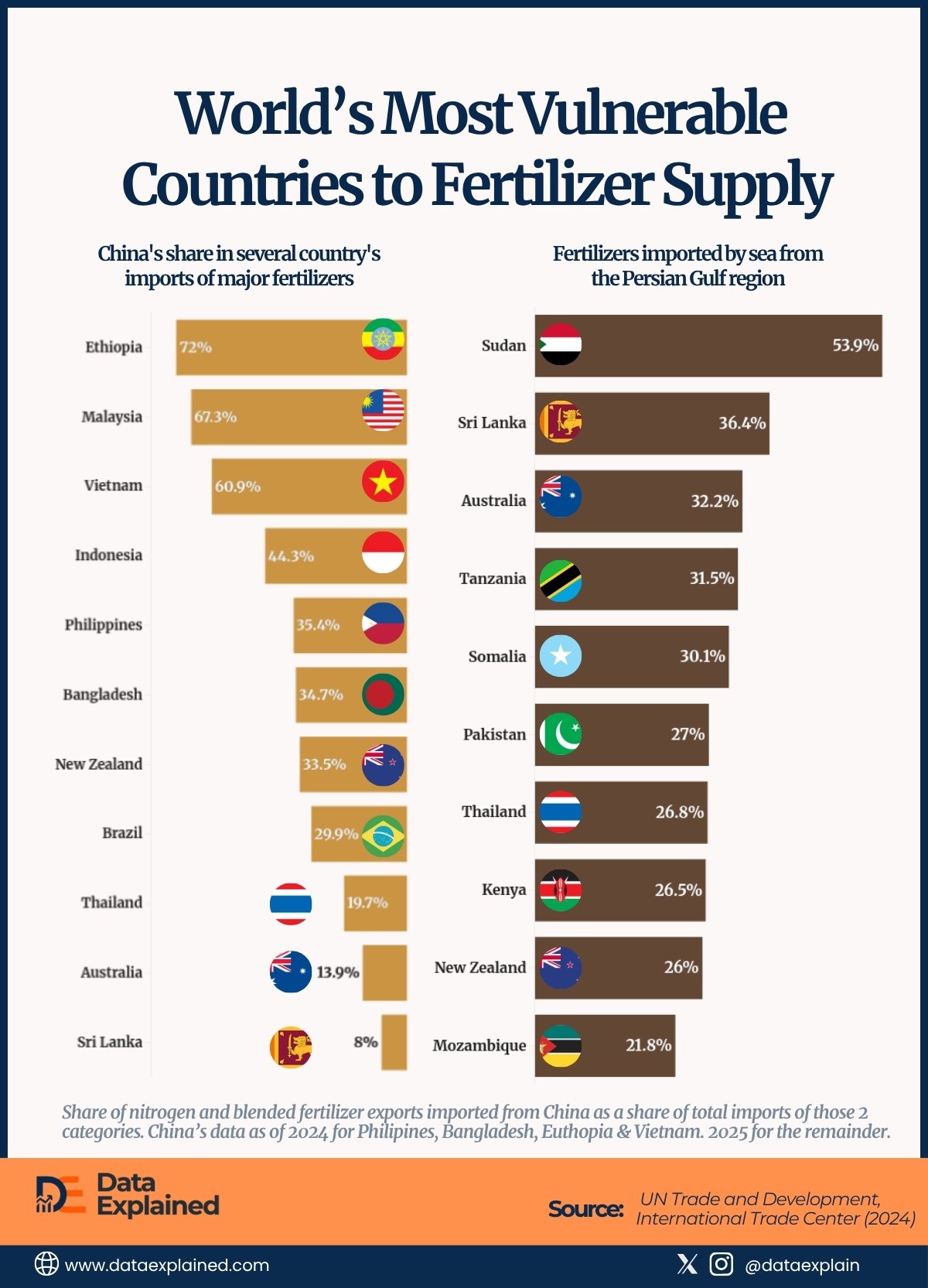
Today’s visualization shows the countries that are most vulnerable to these supply shocks.
This is because they depend on these two sources for their product imports.
TL;DR
- Ethiopia is the most vulnerable, with roughly 72% of its fertilizer imports coming from China.
- More than half of Sudan’s fertilizer imports by sea (about 54%) originated from the Gulf.
- Countries in Southeast Asia are more exposed to China’s export decisions. African nations (including Sudan, Tanzania, and Somalia) are more dependent on shipments from the Persian Gulf.
Data on fertiliser trade patterns were gathered from the UN Trade and Development and the International Trade Center.
It shows just how concentrated these dependencies are.
| wdt_ID | wdt_created_by | wdt_created_at | wdt_last_edited_by | wdt_last_edited_at | Economy | Share of ferterlizer import (%) | Vulnerability source |
|---|---|---|---|---|---|---|---|
| 1 | emmanuel-ashemiriogwa | 22/03/2026 08:14 PM | emmanuel-ashemiriogwa | 22/03/2026 08:14 PM | Sudan | 53.90 | Persian Gulf region |
| 2 | emmanuel-ashemiriogwa | 22/03/2026 08:14 PM | emmanuel-ashemiriogwa | 22/03/2026 08:14 PM | Sri Lanka | 36.40 | Persian Gulf region |
| 3 | emmanuel-ashemiriogwa | 22/03/2026 08:14 PM | emmanuel-ashemiriogwa | 22/03/2026 08:14 PM | Australia | 32.20 | Persian Gulf region |
| 4 | emmanuel-ashemiriogwa | 22/03/2026 08:14 PM | emmanuel-ashemiriogwa | 22/03/2026 08:14 PM | United Republic of Tanzania | 31.50 | Persian Gulf region |
| 5 | emmanuel-ashemiriogwa | 22/03/2026 08:14 PM | emmanuel-ashemiriogwa | 22/03/2026 08:14 PM | Somalia | 30.10 | Persian Gulf region |
| 6 | emmanuel-ashemiriogwa | 22/03/2026 08:14 PM | emmanuel-ashemiriogwa | 22/03/2026 08:14 PM | Pakistan | 27.00 | Persian Gulf region |
| 7 | emmanuel-ashemiriogwa | 22/03/2026 08:14 PM | emmanuel-ashemiriogwa | 22/03/2026 08:14 PM | Thailand | 26.80 | Persian Gulf region |
| 8 | emmanuel-ashemiriogwa | 22/03/2026 08:14 PM | emmanuel-ashemiriogwa | 22/03/2026 08:14 PM | Kenya | 26.50 | Persian Gulf region |
| 9 | emmanuel-ashemiriogwa | 22/03/2026 08:14 PM | emmanuel-ashemiriogwa | 22/03/2026 08:14 PM | New Zealand | 26.00 | Persian Gulf region |
| 10 | emmanuel-ashemiriogwa | 22/03/2026 08:14 PM | emmanuel-ashemiriogwa | 22/03/2026 08:14 PM | Mozambique | 21.80 | Persian Gulf region |
Dependants on China’s fertilizers
Several countries rely overwhelmingly on China for their fertilizer imports.
Ethiopia stands out the most, with roughly 72% of its fertilizer imports coming from China.
Malaysia follows at about 67%, while Vietnam and Indonesia import around 61% and 44%, respectively.
In each case, China is not just one supplier among many; it is the dominant source.
This level of reliance leaves little room to manoeuvre.
If Chinese exports slow or stop, these countries cannot easily switch to alternative suppliers without facing higher costs or delays.
For agricultural economies, especially those with limited domestic production capacity, this can quickly translate into supply shortages at the farm level.
Sudan’s most vulnerable
In 2024, more than half of Sudan’s fertilizer imports by sea (about 54%) originated from the Gulf.
Tanzania sourced around 31% of its imports from the region, while Somalia and Mozambique each relied on it for roughly 30% and 22% of their imports.
Here, the risk is not about production but about movement.
Even if fertilizer is available globally, disruptions to shipping routes (particularly through strategic chokepoints like the Strait of Hormuz) can delay or reduce supply.
For countries that depend heavily on maritime imports from the Gulf, that creates a different kind of exposure, one tied to logistics and geopolitics rather than manufacturing capacity.
Put side by side, the two datasets reveal a global fertilizer system with multiple pressure points.
Vulnerability is not evenly distributed
One of the clearest patterns is that vulnerability is not evenly distributed.
Countries in Southeast Asia, such as Vietnam, Malaysia, and Indonesia, are more exposed to China’s export decisions.
Meanwhile, several African nations (including Sudan, Tanzania, and Somalia) are more dependent on shipments from the Persian Gulf.
This geographic split matters.
It means that disruptions in different parts of the supply chain affect different regions in different ways. There is no single global fallback option.
A country heavily reliant on China cannot simply replace that supply with shipments from the Gulf, especially if logistics there are also under strain.
Some of the most striking cases involve extreme levels of dependence.
Ethiopia’s 72% reliance on China makes it one of the most exposed countries in the dataset. Sudan’s 54% dependence on Gulf-origin fertilizer shipped by sea places it in a similarly vulnerable position, albeit for different reasons.
In both cases, the margin for error is thin.
A disruption (whether from export restrictions or shipping delays) can have an outsized impact.
Least vulnerable countries
By contrast, more developed or diversified economies appear relatively less exposed.
Countries such as Australia and New Zealand still import fertilizers from both China and the Gulf, but their shares are lower and more balanced. Australia, for instance, sources around a third of its fertilizer imports from the Gulf and a much smaller portion from China.
That kind of diversification does not eliminate risk, but it reduces the likelihood of a severe supply shock.
What next?
In the short term, markets are likely to react through higher prices and increased volatility. In the longer term, countries may look to diversify their supply sources, invest in domestic production, or build strategic reserves. But those adjustments take time, and they do not eliminate the underlying constraints.
For now, the immediate reality is clear: the global fertiliser market is facing pressure from two sides at once. And as the data shows, some countries are far more exposed than others.
If those pressures persist or intensify, the consequences will not be confined to trade flows or commodity markets. They will be felt in fields, in harvests, and ultimately, on dinner tables.
ELI5
When fertiliser supply tightens, the effects are rarely immediate but always far-reaching. A delayed shipment or a sudden export curb does not just affect traders; it shows up months later in smaller harvests, tighter food supply, and higher prices.
That chain reaction is now at risk of being triggered again, as two of the world’s most important fertiliser supply channels come under pressure at the same time.
Sources: