United States Defense Secretary Pete Hegseth faced a barrage of criticism on Capitol Hill last week Wednesday as he defended the spiraling costs of the ongoing war with Iran.
During a marathon hearing of the House Armed Services Committee, the Pentagon officially estimated the war’s cost at $25 billion, primarily citing munitions, equipment maintenance, and operational support.
However, independent analysis paints a much more expensive picture of modern warfare
TL;DR
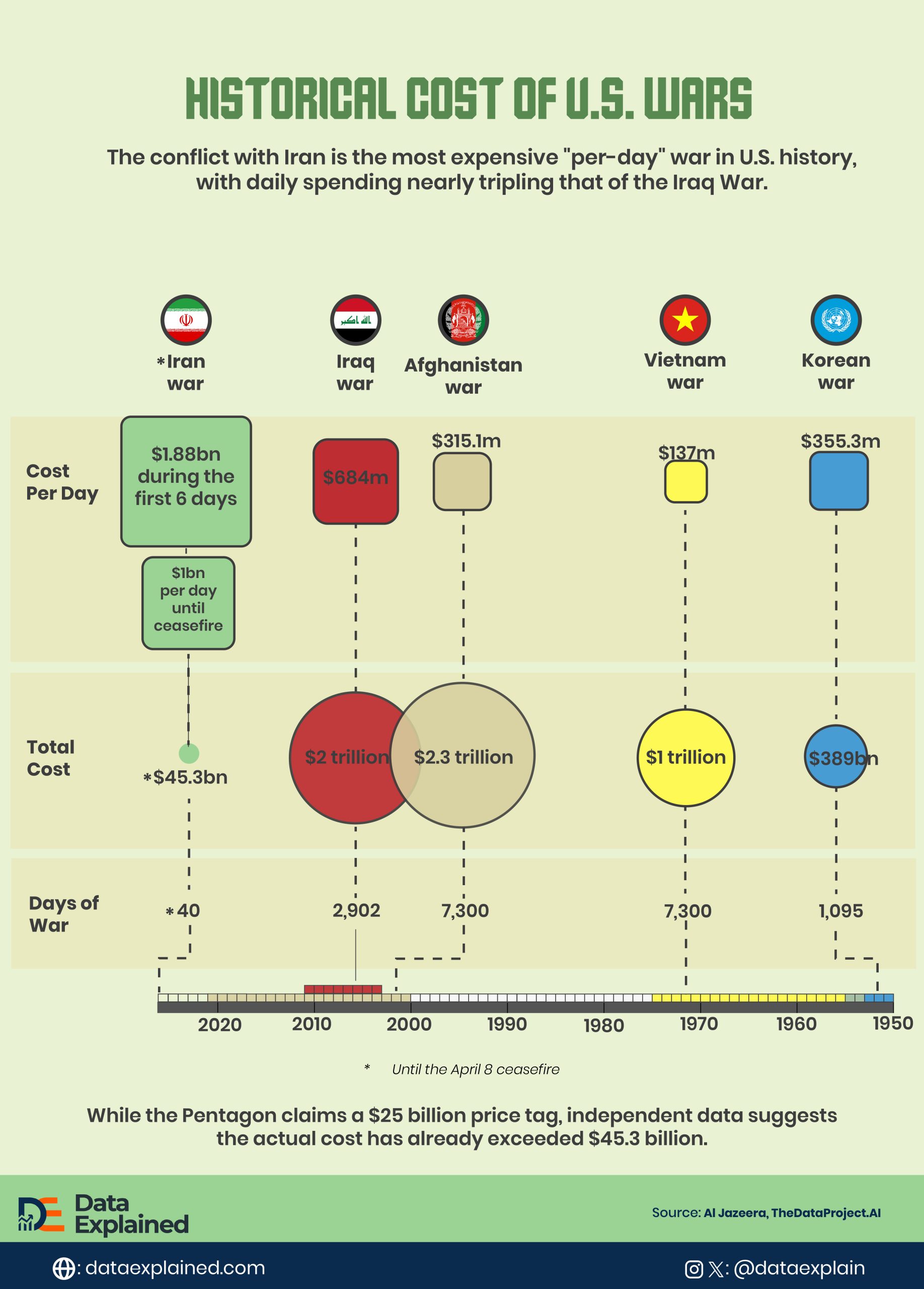
- The conflict with Iran is the most expensive “per-day” war in U.S. history, with daily spending nearly tripling that of the Iraq War.
- While the Pentagon claims a $25 billion price tag, independent data suggests the actual cost has already exceeded $45.3 billion.
- Beyond the immediate munitions, the U.S. faces a $2.2 trillion bill for veterans’ healthcare over the next 30 years.
| wdt_ID | wdt_created_by | wdt_created_at | wdt_last_edited_by | wdt_last_edited_at | Metric | Iran war* | Iraq war | Afghanistan war | Vietnam war | Korean war |
|---|---|---|---|---|---|---|---|---|---|---|
| 1 | emmanuel-ashemiriogwa | 05/05/2026 03:47 PM | emmanuel-ashemiriogwa | 05/05/2026 03:47 PM | Cost per day | $1.88bn (first 6 days) / $1bn (until ceasefire) | $684m | $315.1m | $137m | $355.3m |
| 2 | emmanuel-ashemiriogwa | 05/05/2026 03:47 PM | emmanuel-ashemiriogwa | 05/05/2026 03:47 PM | Total Cost | *$45.3bn | $2 trillion | $2.3 trillion | $1 trillion | $389bn |
| 3 | emmanuel-ashemiriogwa | 05/05/2026 03:47 PM | emmanuel-ashemiriogwa | 05/05/2026 03:47 PM | Days of War | * 40 | 2,902.0 | 7,300.0 | 7,300.0 | 1,095.00 |
| 4 | emmanuel-ashemiriogwa | 05/05/2026 03:47 PM | emmanuel-ashemiriogwa | 05/05/2026 03:52 PM | Approximate Period | 2026 | 2003 - 2011 | 2001 - 2021 | 1965 - 1975 | 1950 - 1953 |
The Intensity of Modern Warfare
Data from Al Jazeera’s ThedataProject AI shows that the Iran conflict is breaking all historical spending records in terms of daily intensity.
During the first six days of “Operation Epic Fury,” the U.S. spent a staggering $1.88 billion per day.
To put that into perspective, the daily cost of the Iraq War averaged $684 million, while the 20-year deployment in Afghanistan cost roughly $315 million per day.
Even after the initial “shock and awe” phase, the Iran conflict maintained a burn rate of $1 billion per day until the April 8 ceasefire.
Analysts suggest this high cost is driven by the use of precision-guided munitions, such as Tomahawk missiles, which cost approximately $2.5 million each.
$20 Billion Discrepancy
One of the oddest insights from the current data is the massive gap between the Pentagon’s $25 billion claim and the $45.3 billion total documented by independent monitors.
This $20 billion discrepancy likely stems from what the government chooses to “count.”
While Secretary Hegseth focused on direct munitions and replacements, independent experts argue that combat losses, infrastructure damage, and the massive logistical support required for a naval blockade in the Strait of Hormuz add billions more to the real-world tab.
Furthermore, the economic damage isn’t confined to the defense budget.
The war has triggered a 40% increase in U.S. gasoline prices, rising from an average of $2.90 to $4.10 per gallon.
This “consumer burden” has cost American households an estimated $27.8 billion (roughly $200 per family) which remains absent from official Pentagon reporting.
A Long Tail of War
Secretary Hegseth’s hearing wasn’t just about the past; he used the session to request a historic $1.5 trillion military budget for 2027, arguing it accounts for the “true cost of American deterrence”.
However, lawmakers like Representative John Garamendi described the conflict as a “geopolitical calamity” and a “quagmire”.
They point to the fact that the financial echoes of this 40-day spike will last for decades.
According to the Costs of War Project, the U.S. is already on the hook for at least $2.2 trillion in veterans’ healthcare and disability obligations over the next 30 years.
As the 2026 conflict adds new thousands to the veteran rolls, that number is expected to climb even higher, ensuring that the “most expensive per-day war” stays on the books for a generation.
ELI5
Imagine a war that is very short but uses the most expensive “smart” bombs in the world. Instead of spending a little money over many years, the U.S. spent $1 billion every single day to fight Iran. Even though the fighting has slowed down, they still have to pay for the expensive missiles used and take care of the soldiers for the next 30 years.
Source:
Al Jazeera’s ThedataProject AI