
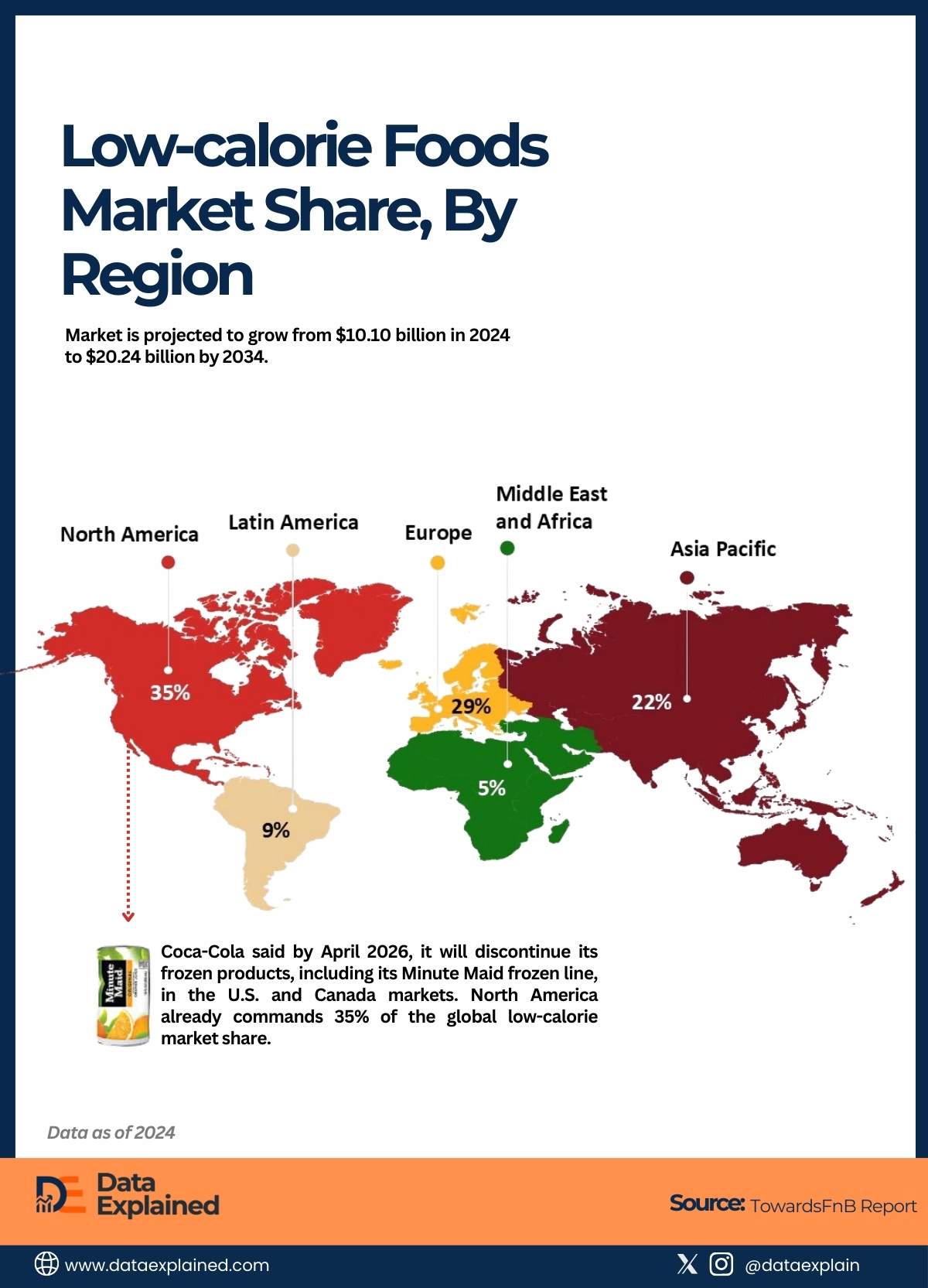
Last week, Coca-Cola said it is discontinuing its frozen products, including its Minute Maid frozen line, in the U.S. and Canadian markets as it seeks to adapt to shifting consumer tastes.
But there’s a bigger picture.
The global low-calorie foods market is projected to grow from $10.10 billion in 2024 to $20.24 billion by 2034. This effectively means the industry will double in size over the next decade.
Today’s visualization shows low-calorie market share by region, based on TowardsFnB data.
North America, home to the U.S. and Canada, remains a major player, commanding 35% of the global market share as of 2024.
TL;DR
- This sector will nearly double in size over the next 10 years, reflecting consumers’ continued preference for healthy alternatives.
- Coca-Cola is quietly withdrawing its frozen concentrate lines from the market, effectively inventory ghosting.
Low-Calorie Foods Market Size (2024-3034)
| wdt_ID | wdt_created_by | wdt_created_at | wdt_last_edited_by | wdt_last_edited_at | Year | Low-Calorie Market Size (USD Billion) |
|---|---|---|---|---|---|---|
| 1 | emmanuel-ashemiriogwa | 10/02/2026 10:58 PM | emmanuel-ashemiriogwa | 10/02/2026 10:58 PM | 2024 | 10.10 |
| 2 | emmanuel-ashemiriogwa | 10/02/2026 10:58 PM | emmanuel-ashemiriogwa | 10/02/2026 10:58 PM | 2025 | 10.83 |
| 3 | emmanuel-ashemiriogwa | 10/02/2026 10:58 PM | emmanuel-ashemiriogwa | 10/02/2026 10:58 PM | 2026 | 11.61 |
| 4 | emmanuel-ashemiriogwa | 10/02/2026 10:58 PM | emmanuel-ashemiriogwa | 10/02/2026 10:58 PM | 2027 | 12.44 |
| 5 | emmanuel-ashemiriogwa | 10/02/2026 10:58 PM | emmanuel-ashemiriogwa | 10/02/2026 10:58 PM | 2028 | 13.34 |
| 6 | emmanuel-ashemiriogwa | 10/02/2026 10:58 PM | emmanuel-ashemiriogwa | 10/02/2026 10:58 PM | 2029 | 14.30 |
| 7 | emmanuel-ashemiriogwa | 10/02/2026 10:58 PM | emmanuel-ashemiriogwa | 10/02/2026 10:58 PM | 2030 | 15.33 |
| 8 | emmanuel-ashemiriogwa | 10/02/2026 10:58 PM | emmanuel-ashemiriogwa | 10/02/2026 10:58 PM | 2031 | 16.43 |
| 9 | emmanuel-ashemiriogwa | 10/02/2026 10:58 PM | emmanuel-ashemiriogwa | 10/02/2026 10:58 PM | 2032 | 17.61 |
| 10 | emmanuel-ashemiriogwa | 10/02/2026 10:58 PM | emmanuel-ashemiriogwa | 10/02/2026 10:58 PM | 2033 | 18.88 |
The table shows a slow, steady increase, with the market expanding each year rather than in a sudden surge.
By the early 2030s, the industry is projected to exceed $17- $18 billion before reaching the $20 billion threshold.
The data indicate the sector will nearly double in size over the next decade, signaling strong growth for food and beverage companies as they move toward reduced-sugar and low-calorie offerings.
The Regional Gap
While the Asia-Pacific region is the fastest-growing in the low-calorie foods market, the combined share of Latin America and the Middle East & Africa is just over 14%.
This shows a clear imbalance in global adoption.
Growth is occurring, but primarily in regions with higher purchasing power and more health-conscious consumer bases.
This gap also indicates that low-calorie eating remains a lifestyle-driven trend, driven primarily in North America and Europe, where disposable income, product availability, and wellness culture are more established.
In most developing markets, affordability and access are key barriers, keeping demand comparatively lower while rising awareness.
End of an 80-Year Era
When Minute Maid popularized frozen juice concentrates in 1946, it created a household routine where families regularly “thawed” their orange juice before breakfast.
Its planned exit in 2026 marks the end of an 80-year chapter of prep-based consumption.
This shows that modern shoppers prefer ready-to-drink, no-prep, and lower-sugar options to traditional frozen formats.
This shift is also evident in the broader low-calorie market, where sugar substitutes such as Stevia and other natural sweeteners already account for approximately 55% of the category’s total share.
Meanwhile, Coca-Cola has been facing a tougher regulatory environment for packaged foods in the U.S. and is seeking to roll out a cane sugar version of its trademark soda in glass bottles.
Inventory Ghosting
Coca-Cola is not issuing a formal recall for its frozen concentrate lines.
Instead, the company is allowing existing inventory to sell through naturally until around April 2026. This strategy is seen as “inventory ghosting.”
This means there is no major announcement or clearance event; the products simply disappear from shelves as warehouses and retailers run out of stock.
For consumers, this creates a quiet but permanent shift: once the familiar cylinder cans vanish from local freezer aisles in Canada and the U.S., they may not likely return.
This approach reduces disruption for retailers while indicating a clean exit from the category without the publicity of a traditional product discontinuation.
ELI5
The low-calorie food and drink market is expected to nearly double over the next decade, as more people choose healthier, lower-sugar options over traditional sugary products.
The niche “diet” choice is becoming a mainstream preference, prompting companies to expand their healthy product lines.
This shift in taste is also why older formats, such as frozen juice concentrates, are fading. Instead of making drinks from frozen cans, shoppers now prefer ready-to-drink, low-sugar beverages that require no preparation.
Coca-Cola’s quiet decision to gradually remove its frozen concentrate products from shelves shows how major brands are adapting to this long-term shift.
Source:
TowardsFnB | CBS News | Reuters Report