For many people, launching a business today, the decision often comes down to sticking with e-commerce or pursuing physical retail.
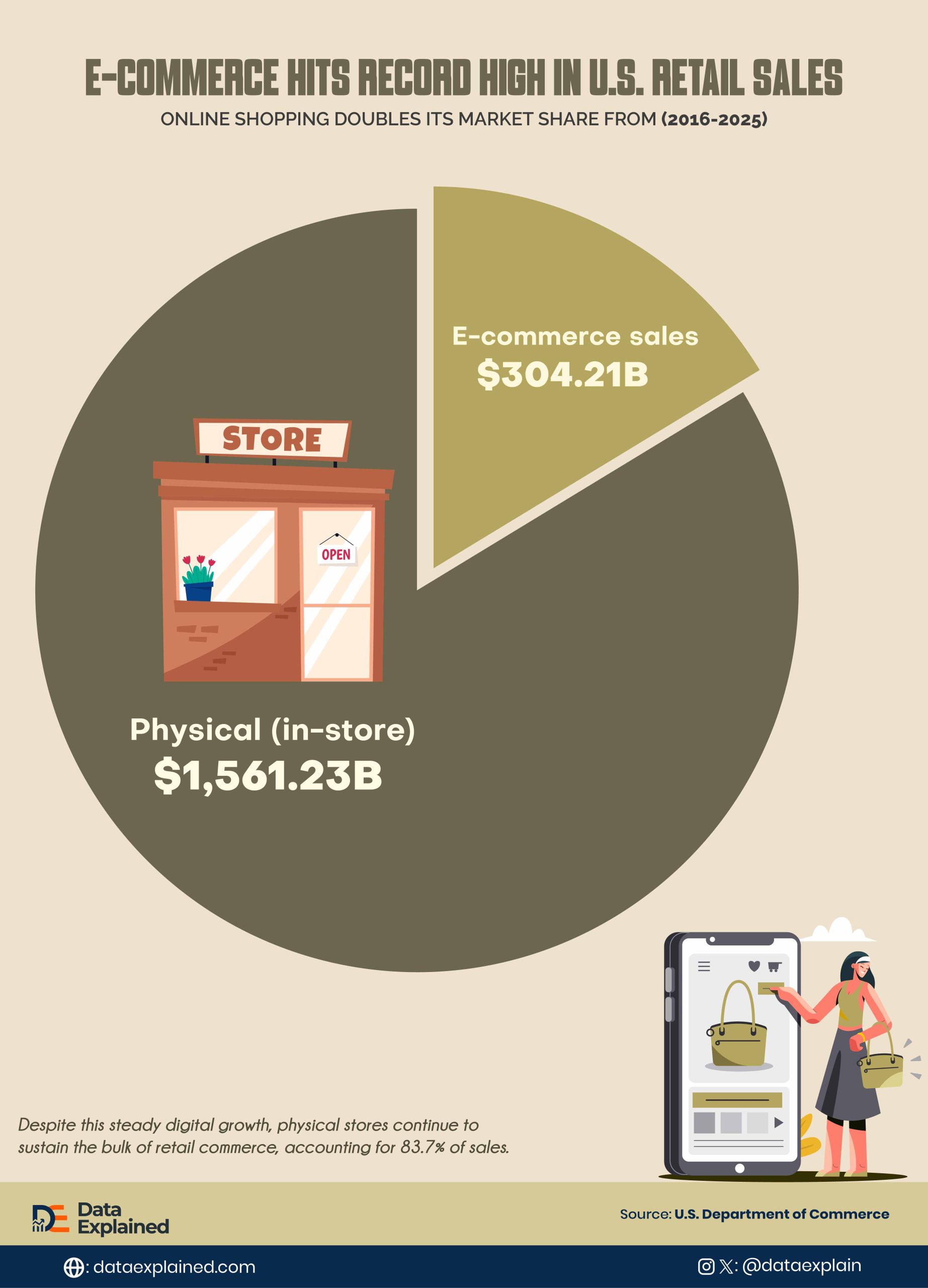
In the second quarter (Q2) of 2025, American shoppers bought $1.865 trillion worth of retail goods; online transactions accounted for $304.2 billion, or 16.3% of total retail sales (seasonally adjusted).
There is a continuing trend of online share creeping upward, up from around 15% a few years ago.
The data for this insight comes directly from the U.S. Department of Commerce and is dated as of the second quarter of 2025.
TL;DR
- In the U.S., e-commerce’s share of total retail has doubled from 8% to 16% over the last decade.
- 72% of in-store customers pull out their phones to compare prices while they shop.
Metric (Q2 2025, U.S.)
| wdt_ID | wdt_created_by | wdt_created_at | wdt_last_edited_by | wdt_last_edited_at | Metric (Q2 2025, U.S.) | Value |
|---|---|---|---|---|---|---|
| 1 | Monica Ebunoluwa | 25/06/2026 02:59 PM | Monica Ebunoluwa | 25/06/2026 02:59 PM | Total retail sales | $1,865.44 billion |
| 2 | Monica Ebunoluwa | 25/06/2026 02:59 PM | Monica Ebunoluwa | 25/06/2026 02:59 PM | E-commerce sales | $304.21 billion (16.3%) |
| 3 | Monica Ebunoluwa | 25/06/2026 02:59 PM | Monica Ebunoluwa | 25/06/2026 02:59 PM | Physical (in-store) sales | $1,561.23 billion (83.7%) |
Source: U.S. Department of Commerce
This means that for every $100 spent in U.S. retail during Q2 2025, about $16 was spent online and about $84 in physical stores.
That split matters because it frames how retailers should allocate their energy: digital growth is real and durable, but the bulk of revenue still flows through brick-and-mortar channels.
E-commerce’s share of total U.S. retail sales (2016-2025)
| wdt_ID | wdt_created_by | wdt_created_at | wdt_last_edited_by | wdt_last_edited_at | Year | E-Commerce Share of Total Retail (%) | Notes |
|---|---|---|---|---|---|---|---|
| 1 | Monica Ebunoluwa | 25/06/2026 03:09 PM | Monica Ebunoluwa | 25/06/2026 03:09 PM | 2016 (avg.) | 7.8 | Online retail is still in the early stages of mainstream growth. |
| 2 | Monica Ebunoluwa | 25/06/2026 03:09 PM | Monica Ebunoluwa | 25/06/2026 03:09 PM | 2017 (avg.) | 8.9 | Amazon’s expansion and mobile shopping push shares up. |
| 3 | Monica Ebunoluwa | 25/06/2026 03:09 PM | Monica Ebunoluwa | 25/06/2026 03:09 PM | 2018 (avg.) | 9.9 | Strong holiday e-commerce seasons lift share close to 10%. |
| 4 | Monica Ebunoluwa | 25/06/2026 03:09 PM | Monica Ebunoluwa | 25/06/2026 03:09 PM | 2019 (avg.) | 10.9 | Pre-pandemic baseline year. |
| 5 | Monica Ebunoluwa | 25/06/2026 03:09 PM | Monica Ebunoluwa | 25/06/2026 03:09 PM | 2020 (avg.) | 14.7 | COVID-19 lockdown surge (the peak quarters hit 16%). |
| 6 | Monica Ebunoluwa | 25/06/2026 03:09 PM | Monica Ebunoluwa | 25/06/2026 03:09 PM | 2021 (avg.) | 14.6 | Physical retail rebounds, e-commerce stabilizes. |
| 7 | Monica Ebunoluwa | 25/06/2026 03:09 PM | Monica Ebunoluwa | 25/06/2026 03:09 PM | 2022 (avg.) | 14.8 | Inflation year; spending shifts, but digital habits remain. |
| 8 | Monica Ebunoluwa | 25/06/2026 03:09 PM | Monica Ebunoluwa | 25/06/2026 03:09 PM | 2023 (avg.) | 15.6 | Steady growth resumes post-pandemic. |
| 9 | Monica Ebunoluwa | 25/06/2026 03:09 PM | Monica Ebunoluwa | 25/06/2026 03:09 PM | 2024 (avg.) | 15.9 | Incremental climb (online gains share from slower store growth). |
| 10 | Monica Ebunoluwa | 25/06/2026 03:09 PM | Monica Ebunoluwa | 25/06/2026 03:09 PM | 2025 (Q2) | 16.3 | The latest Census reading is the highest on record. |
Source: U.S. Department of Commerce
Over roughly a decade, e-commerce’s share of total U.S. retail has doubled, from under 8% in 2016 to over 16% by mid-2025.
Growth has slowed relative to the pandemic spike, but the trajectory remains clearly upward (about a 0.30-0.5 percentage-point gain per year recently).
That may sound modest, yet each half-point now equals roughly $9 billion to $10 billion in additional online sales per quarter.
Retail and E-commerce Complement Each Other
| wdt_ID | wdt_created_by | wdt_created_at | wdt_last_edited_by | wdt_last_edited_at | Retailer Type | Average Increase in Online Sales After Opening a Physical Store | Average Online Order Value Before Store Opening | Average Online Order Value After Store Opening |
|---|---|---|---|---|---|---|---|---|
| 1 | Monica Ebunoluwa | 25/06/2026 03:17 PM | Monica Ebunoluwa | 25/06/2026 03:34 PM | All Retailers (Overall) | +6.9% | - | - |
| 2 | Monica Ebunoluwa | 25/06/2026 03:17 PM | Monica Ebunoluwa | 25/06/2026 03:35 PM | Emerging Retailers | +14% | $111 | $120 |
| 3 | Monica Ebunoluwa | 25/06/2026 03:17 PM | Monica Ebunoluwa | 25/06/2026 03:37 PM | Established Retailers | +6.8% | $94 | $104 |
Source: ICSC, The Halo Effect III: Where the Halo Shines.
Research from the International Council of Shopping Centers (ICSC) reveals that online and physical retail don’t compete. They actually strengthen each other.
The study, known as The Halo Effect, found that when an online brand opens a physical store, its online sales typically rise by about 6.9%.
For younger, fast-growing retailers, the boost is even bigger (close to 14%) while established brands still enjoy around a 6.8% lift.
It’s not just about more orders, either.
The average order value also climbs once a retailer adds a storefront. Established brands see their online basket size grow from roughly $94 to $104, while emerging retailers jump from about $111 to $120 per purchase.
In other words, a physical presence can make digital shoppers spend more.
Backing that up, the U.S. Bureau of Labor Statistics reports a growing number of retail establishments.
In the second quarter of 2024, there were 1,083,811 private retail businesses, up from 1,079,629 in the first quarter of the same year.
So, that’s a clear sign that physical retail remains alive, expanding, and still vital to the U.S. economy.
Mobile Devices Are Influencing People’s Choice of Shopping Channel
Shoppers may love walking into stores, but their phones have become essential shopping companions.
A recent survey shows that 72% of in-store customers pull out their phones to compare prices while they shop.
The same study found that 69% read customer reviews, 52% look up detailed product information, and nearly three in ten research the brand’s reputation before heading to the checkout counter.
Mobile devices can also enhance the overall experience, especially when retailers offer their own apps.
Around 40% of shoppers say they use their smartphones every time or most of the time while shopping in person.
Interestingly, an equal share is willing to hand over personal data if it means getting a more tailored experience.
What drives them? Mostly, the promise of better prices.
ELI5
Retail versus e-commerce market share is all about the metrics that show how people buy and sell online and offline.
The trend reveals that brick-and-mortar still matters, but e-commerce is steadily taking a larger share of the retail pie.
If you’re a retailer, the practical translation of these stats is “don’t pick sides.”
Investments in both digital and in-store experience are high-ROI moves.
Digital increases reach and average order growth, while stores deliver instant gratification, handle returns, provide demos, and build loyalty.
Sources:
eMarketer: Physical Retail Importance | Quarterly Retail Market Survey U.S | SPAR 2024 Shopper Insights Survey | ICSC The Halo Effect research | US Bureau of Labor Statistics reports