On the eve of Thursday, June 4, Ukrainian President Volodymyr Zelenskyy posted an open letter to Russia’s Vladimir Putin.
He posted it three weeks before the third anniversary of the Wagner Group rebellion that briefly tore a hole in Putin’s military command structure.
Open letters from heads of state carry weight only when the sender’s position is strong enough to make the words credible.
The Kiel Institute for the World Economy has been tracking the cost of that position.
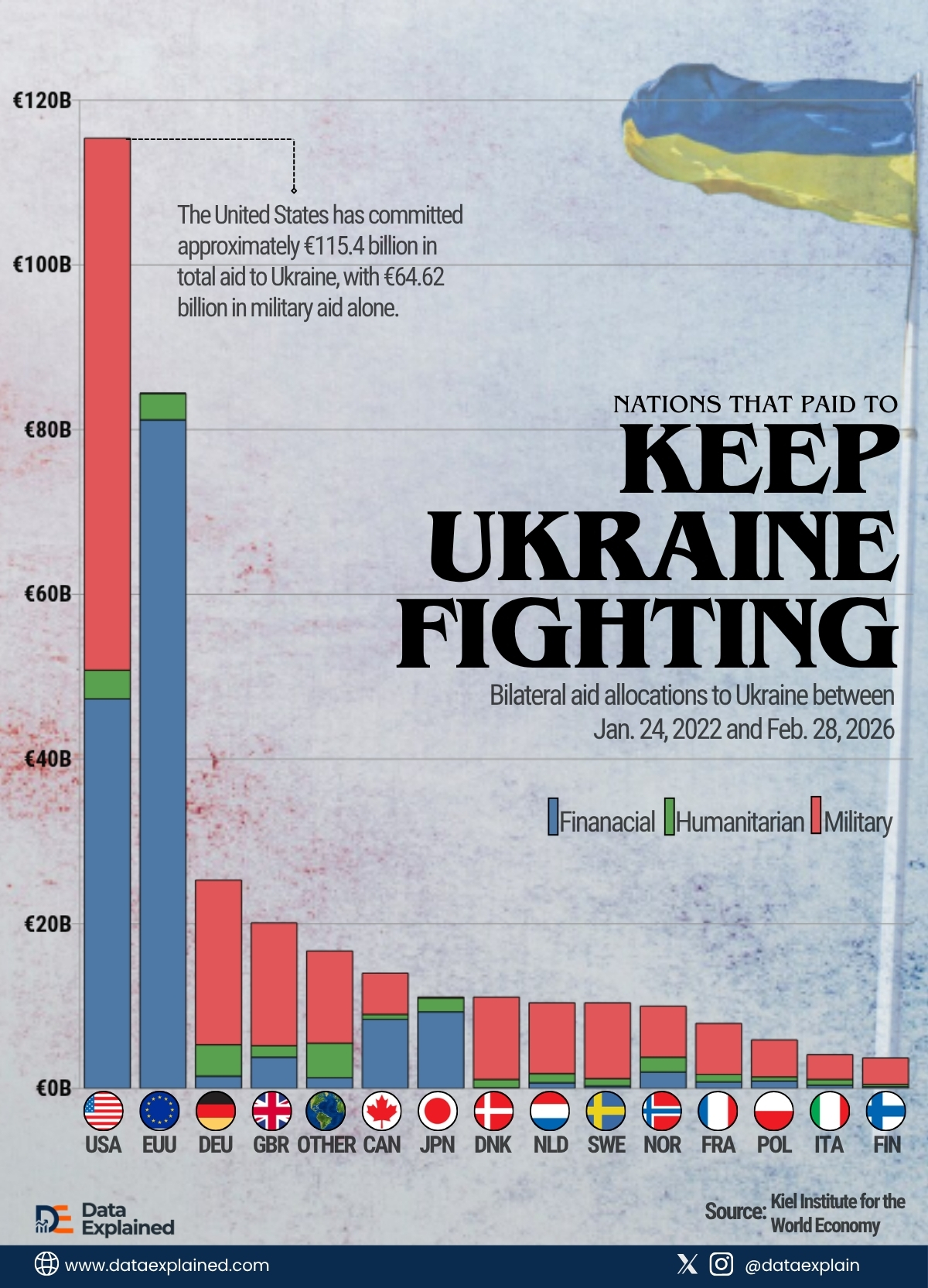
This episode’s visualization focuses on the bilateral aid commitments made to Ukraine from January 24, 2022, through February 28, 2026, documenting €415 billion in total support across 23 donors.
This is the fourth installment in a five-part data series on Russia’s war on Ukraine. The first three covered the dead, the displaced, and the military spending gap. This installment covers who stepped in to close that gap, and how.
TL;DR
- The United States has committed approximately €115.4 billion in total aid to Ukraine (more than any other donor), with €64.62 billion in military aid alone.
- The humanitarian section is the smallest across nearly every donor, in a war that has killed tens of thousands of civilians.
- The EU Commission and Council lead in financial aid at €81.21 billion, but have provided zero military support.
| wdt_ID | wdt_created_by | wdt_created_at | wdt_last_edited_by | wdt_last_edited_at | Country | Financial (€B) | Humanitarian (€B) | Military (€B) |
|---|---|---|---|---|---|---|---|---|
| 1 | emmanuel-ashemiriogwa | 08/06/2026 02:46 PM | emmanuel-ashemiriogwa | 08/06/2026 02:46 PM | United States | 47.3 | 3.5 | 64.6 |
| 2 | emmanuel-ashemiriogwa | 08/06/2026 02:46 PM | emmanuel-ashemiriogwa | 08/06/2026 02:46 PM | EU (Commission and Council) | 81.2 | 3.2 | 0.0 |
| 3 | emmanuel-ashemiriogwa | 08/06/2026 02:46 PM | emmanuel-ashemiriogwa | 08/06/2026 02:46 PM | Germany | 1.5 | 3.8 | 20.0 |
| 4 | emmanuel-ashemiriogwa | 08/06/2026 02:46 PM | emmanuel-ashemiriogwa | 08/06/2026 02:46 PM | United Kingdom | 3.8 | 1.4 | 14.9 |
| 5 | emmanuel-ashemiriogwa | 08/06/2026 02:46 PM | emmanuel-ashemiriogwa | 08/06/2026 02:46 PM | Canada | 8.4 | 0.6 | 5.0 |
| 6 | emmanuel-ashemiriogwa | 08/06/2026 02:46 PM | emmanuel-ashemiriogwa | 08/06/2026 02:46 PM | Japan | 9.3 | 1.7 | 0.1 |
| 7 | emmanuel-ashemiriogwa | 08/06/2026 02:46 PM | emmanuel-ashemiriogwa | 08/06/2026 02:46 PM | Denmark | 0.1 | 1.0 | 10.0 |
| 8 | emmanuel-ashemiriogwa | 08/06/2026 02:46 PM | emmanuel-ashemiriogwa | 08/06/2026 02:46 PM | Netherlands | 0.7 | 1.1 | 8.6 |
| 9 | emmanuel-ashemiriogwa | 08/06/2026 02:46 PM | emmanuel-ashemiriogwa | 08/06/2026 02:46 PM | Sweden | 0.3 | 0.9 | 9.2 |
| 10 | emmanuel-ashemiriogwa | 08/06/2026 02:46 PM | emmanuel-ashemiriogwa | 08/06/2026 02:46 PM | Norway | 2.0 | 1.8 | 6.2 |
ICYMI: The Recap
We started a five-part series of data investigation to capture the effect of the Russia-Ukraine war in numbers.
- Ukraine War in Data Part 1 confirmed approximately 19,225 civilian deaths in Ukraine.
- Ukraine War in Data Part 2 documented 5.35 million registered Ukrainian refugees and the countries hosting most of them across Europe and Asia.
- Ukraine War in Data Part 3 mapped a military spending gap between Russia and Ukraine that closed from 20-to-1 to 2-to-1 before widening again.
- Ukraine War in Data Part 4 tracked €415 billion in international aid commitments from 23 donors into Ukraine.
- Ukraine War in Data Part 5, the final installment, documents what four years of the war physically did to Ukraine at its center.
A Structural Split
The European Union’s institutions and the United States have divided Ukraine’s survival between them along a line that has never been formally agreed but is clearly visible in the data.
The EU Commission and Council have committed €81.21 billion in financial aid, the largest financial contribution from any single entity in the tracker.
It has exactly zero in military support.
On the other hand, the United States has committed €64.62 billion in military aid (the largest military contribution from any single entity).
It goes alongside €47.3 billion in financial aid.
Europe keeps Ukraine’s government and economy functioning. America keeps its military fighting.
The Military Numbers
America’s €64.62 billion in military support alone exceeds the combined military contributions of the next seven donors.
Denmark at €9.95 billion, Sweden at €9.15 billion, the Netherlands at €8.61 billion, Norway at €6.19 billion, and France at €6.23 billion.
Recall that Denmark, a country of 5.9 million people with an economy approximately one-tenth the size of France’s, has provided more military support to Ukraine than France.
France is a permanent UN Security Council member with a nuclear arsenal and 68 million people.
It’s €6.23 billion in military aid, which is not a small number in isolation.
Placed next to Denmark’s €9.95 billion, it is a specific measure of the gap between what France could provide and what it has chosen to provide.
Humanitarian Aid Allocations
Total humanitarian aid from the top 23 donors amounts to approximately €35 billion.
It is less than one-sixth of the military total and significantly below the financial total.
Ukraine is receiving vastly more support for its government and military than for the direct welfare of its civilian population.
The humanitarian section is the smallest across nearly every donor, in a war that has killed tens of thousands of civilians and produced Europe’s largest refugee crisis since World War II.
What It Adds Up To
The scale has no clear peacetime precedent for a single country.
The Marshall Plan disbursed roughly $13 billion between 1948 and 1952 to reconstruct all of Western Europe, equivalent to approximately $170 billion in today’s money.
Ukraine has received a comparable sum while still in an active war, not after one.
Zelenskyy’s open letter to Putin on June 4 arrives against that backdrop.
NOTE: The fifth and final installment of this series will document what the war has cost Ukraine itself, the damage that the commitments tracked here have been working to prevent from becoming irreversible.
ELI5 (Explain It Like I’m 5)
Since Russia invaded Ukraine in 2022, 23 countries have sent about €415 billion to help. America sent the most weapons (€64.6B). The EU sent the most money (€81.2B) but no weapons at all. Small countries like Estonia and Denmark are giving more relative to their economies than large countries like France. Switzerland and Austria sent no weapons because their countries have rules against it.
Source:
Kiel Institute for the World Economy (Kiel Institut für Weltwirtschaft) | Zelensky Open Letter