China’s decision to block a $2 billion acquisition by Meta Platforms in April has drawn attention not just for its timing, but for what it means for global technology power.
The deal, involving a startup known as Manus, had already progressed beyond typical regulatory checkpoints.
Employees had reportedly relocated to Meta offices in Singapore, the capital had been transferred, and executives had joined Meta’s artificial intelligence team.
Yet Chinese authorities moved to halt the transaction.
At the center of that shift is China’s growing dominance in high-impact technology research.
TL;DR
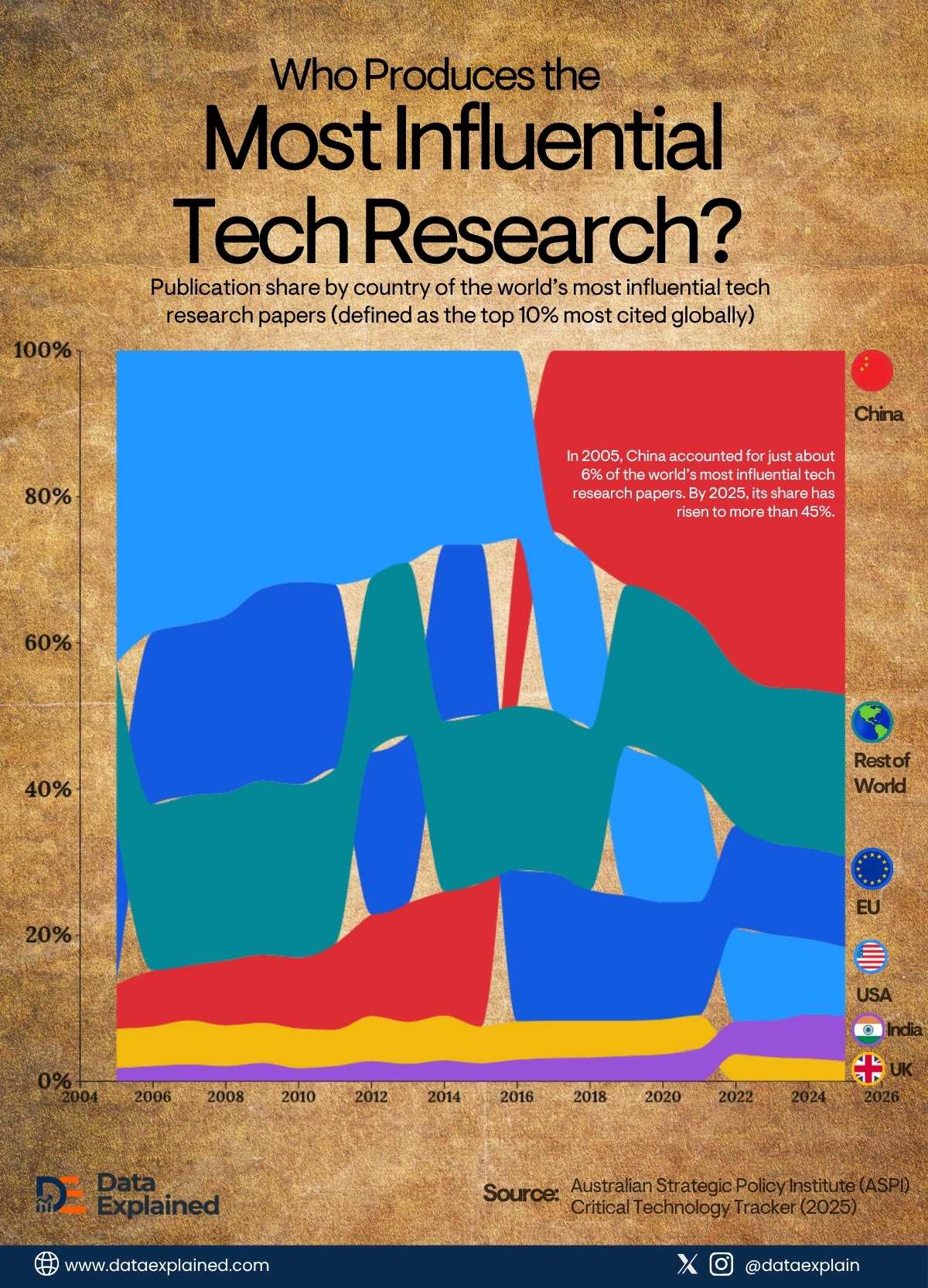
- The visualization above is based on data from the Australian Strategic Policy Institute (ASPI).
- It shows that China now produces nearly half of the world’s most influential tech research papers (defined as the top 10% most cited globally).
| wdt_ID | wdt_created_by | wdt_created_at | wdt_last_edited_by | wdt_last_edited_at | Year | China (%) | United States (%) | European Union (%) | United Kingdom (%) | India (%) | Rest of World (%) |
|---|---|---|---|---|---|---|---|---|---|---|---|
| 1 | emmanuel-ashemiriogwa | 04/05/2026 03:54 PM | emmanuel-ashemiriogwa | 04/05/2026 03:54 PM | 2005 | 6.20 | 43.40 | 21.70 | 5.50 | 1.80 | 23.00 |
| 2 | emmanuel-ashemiriogwa | 04/05/2026 03:54 PM | emmanuel-ashemiriogwa | 04/05/2026 03:54 PM | 2006 | 7.80 | 39.10 | 23.90 | 5.50 | 2.10 | 23.10 |
| 3 | emmanuel-ashemiriogwa | 04/05/2026 03:54 PM | emmanuel-ashemiriogwa | 04/05/2026 03:54 PM | 2007 | 7.50 | 37.40 | 23.40 | 6.00 | 2.30 | 23.20 |
| 4 | emmanuel-ashemiriogwa | 04/05/2026 03:54 PM | emmanuel-ashemiriogwa | 04/05/2026 03:54 PM | 2008 | 9.10 | 37.10 | 24.80 | 5.70 | 2.10 | 23.50 |
| 5 | emmanuel-ashemiriogwa | 04/05/2026 03:54 PM | emmanuel-ashemiriogwa | 04/05/2026 03:54 PM | 2009 | 9.30 | 32.50 | 26.20 | 5.50 | 2.50 | 23.80 |
| 6 | emmanuel-ashemiriogwa | 04/05/2026 03:54 PM | emmanuel-ashemiriogwa | 04/05/2026 03:54 PM | 2010 | 9.90 | 32.10 | 28.10 | 5.50 | 1.80 | 24.00 |
| 7 | emmanuel-ashemiriogwa | 04/05/2026 03:54 PM | emmanuel-ashemiriogwa | 04/05/2026 03:54 PM | 2011 | 11.90 | 32.30 | 25.40 | 5.00 | 2.10 | 24.20 |
| 8 | emmanuel-ashemiriogwa | 04/05/2026 03:54 PM | emmanuel-ashemiriogwa | 04/05/2026 03:54 PM | 2012 | 14.10 | 31.40 | 22.50 | 6.20 | 2.80 | 24.10 |
| 9 | emmanuel-ashemiriogwa | 04/05/2026 03:54 PM | emmanuel-ashemiriogwa | 04/05/2026 03:54 PM | 2013 | 16.50 | 29.40 | 23.20 | 5.80 | 2.40 | 23.90 |
| 10 | emmanuel-ashemiriogwa | 04/05/2026 03:54 PM | emmanuel-ashemiriogwa | 04/05/2026 03:54 PM | 2014 | 17.20 | 26.90 | 24.40 | 6.20 | 2.90 | 23.60 |
The Upward Trend
In 2005, China accounted for just about 6% of those publications. By 2025, its share has risen to more than 45%.
Over the same period, the United States has moved in the opposite direction.
Its share of top-tier research has fallen from around 40% in 2005 to roughly 10% in 2025, according to the ASPI data.
The crossover point (where China overtook the U.S.) occurred around 2017, marking a decisive turning point in global research leadership.
Other regions show more gradual shifts.
The European Union’s share declined steadily from about 25% to near 12%, while the United Kingdom remained relatively flat at low single digits.
India recorded modest growth, rising from roughly 2% to about 6%, but still trails far behind China’s output.
Why Does this Matter?
Unlike broader publication counts, the ASPI dataset focuses on the most-cited research.
That means work that tends to shape future innovation in areas such as:
- Artificial intelligence
- Semiconductors
- Advanced computing.
That makes the findings less about academic volume and more about influence.
China’s share alone now rivals, and in some cases exceeds, the combined contribution of traditional research leaders.
This backdrop helps explain the significance of the reversal of the Manus deal.
For years, global technology investment has operated on the assumption that capital and talent can move relatively freely across borders.
China’s decision to intervene at such a late stage challenges that assumption.
Research dominance can translate into economic advantage, military capability, and geopolitical leverage.
As a result, governments may be more willing to restrict foreign acquisitions that could transfer knowledge or capabilities abroad.
Still, the Data Doesn’t Tell the Full Story
While China leads in publication share, the United States continues to play a central role in commercializing new technologies, particularly through its deep venture capital ecosystem and global technology firms.
Many leading AI models, software platforms, and semiconductor innovations are still developed or scaled by U.S.-based companies.
In addition, research quality is difficult to measure solely through citation counts.
Some experts argue that breakthrough innovation (especially in emerging fields) may not always be captured by publication metrics alone.
China’s rise, however, is hard to ignore.
The scale and speed of its growth in high-impact research suggest a long-term shift rather than a temporary surge.
ELI5
China stopped Meta from buying a tech company even after the deal was almost done.
In a related event, China now leads the world in the most important tech research. That means it wants to keep its technological advantages rather than letting foreign companies take them. In simple terms, the country making the most powerful ideas is also trying to keep control of them.
Source: