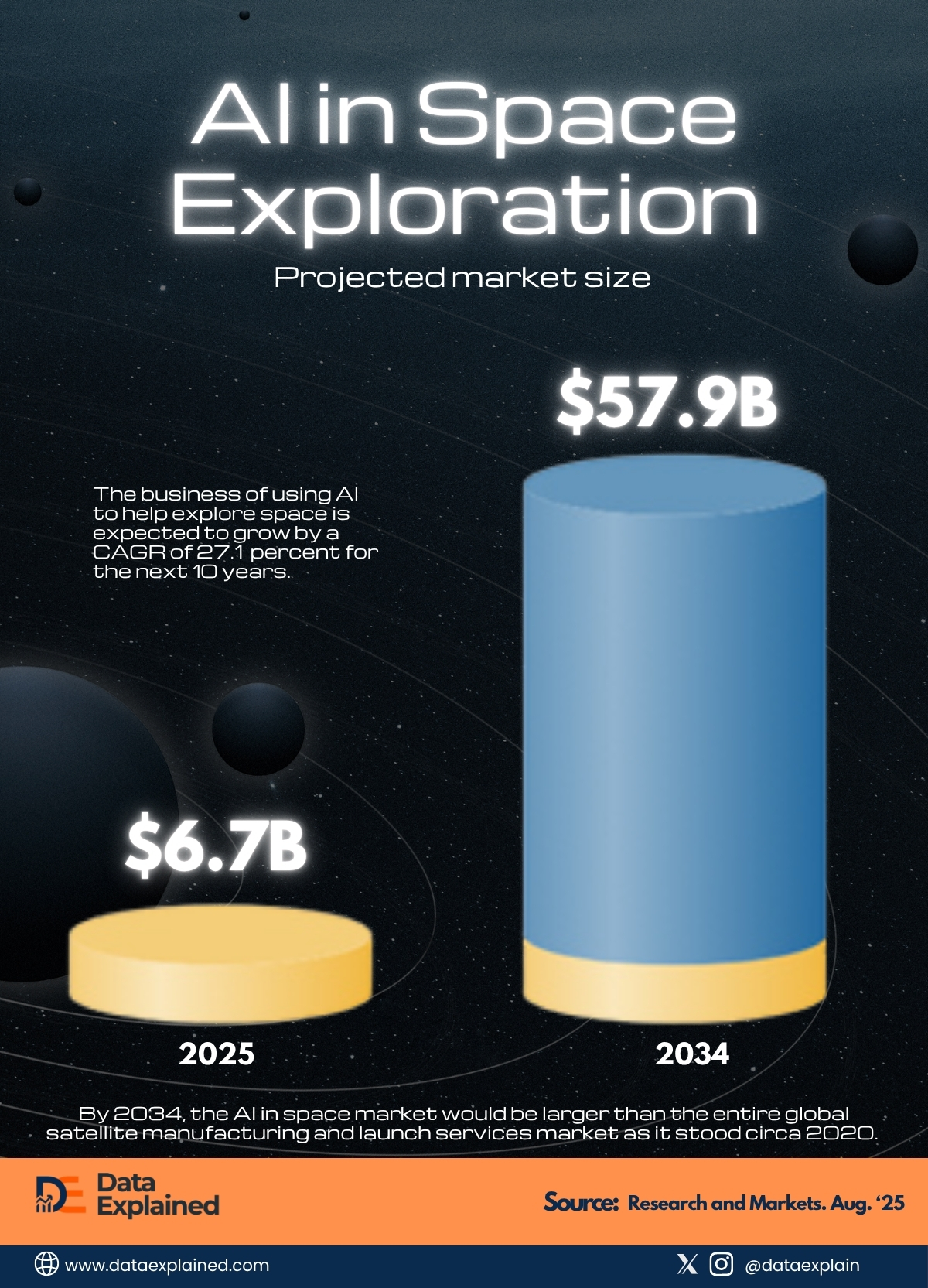
The market for artificial intelligence in space exploration is projected to grow from $6.7 billion in 2025 to $57.9 billion in 2034, an 8.6-fold increase over nine years at a compound annual growth rate of 27.1%.
The data comes from Research and Markets.
That growth rate means the market roughly doubles every 2.9 years.
Last week, SpaceX moved to position itself at the center of that curve.
TL;DR
- The AI in space market’s 27.1% CAGR is being driven by a field of competitors that SpaceX is entering later than some, which is precisely why the Cursor option exists.
| wdt_ID | wdt_created_by | wdt_created_at | wdt_last_edited_by | wdt_last_edited_at | Year | Ai in Space Exploration Market ($bn) |
|---|---|---|---|---|---|---|
| 1 | emmanuel-ashemiriogwa | 26/04/2026 11:26 AM | emmanuel-ashemiriogwa | 26/04/2026 11:26 AM | 2025 | 6.70 |
| 2 | emmanuel-ashemiriogwa | 26/04/2026 11:26 AM | emmanuel-ashemiriogwa | 26/04/2026 11:26 AM | 2034 | 57.90 |
The Deal
Elon Musk’s rocket company secured an option to acquire Cursor, an AI coding startup, for $600 million, or enter a deep strategic partnership for $100 million if it decides against full acquisition.
The agreement gives SpaceX a direct foothold in AI coding infrastructure, a segment where the company has lagged competitors, including GitHub Copilot.
It’s backed by Microsoft and OpenAI’s Codex.
The six times price spread between the partnership and acquisition options is structurally unusual.
It reflects genuine strategic uncertainty on SpaceX’s part.
The company has secured the right to decide without yet committing to a direction.
The announcement itself, regardless of which option SpaceX ultimately exercises, signals to the market that AI coding capability has become a strategic asset in the space sector rather than a productivity tool.
Cursor is an AI-assisted code editor.
SpaceX’s interest in it is less about space exploration AI directly and more about engineering speed.
That is, writing, testing, and deploying the software that runs rockets, satellites, and spacecraft faster than human engineers working without AI assistance can manage.
What the $57.9 Billion Market Covers
The AI in space exploration category includes:
- Autonomous spacecraft navigation (the systems that allow satellites and probes to make decisions without waiting for instructions from Earth)
- Satellite image analysis
- Mission planning optimization
- Space debris avoidance
- Ground station automation.
They are deployed and generating revenue today, producing the $6.7 billion 2025 baseline from which the projection departs.
NASA’s Artemis II mission, which recently completed its 10-day mission around the moon in April 2026, relies on AI systems for mission planning and communication management.
China’s expanding space program is a significant additional driver of AI in space investment that Western market research reports often incompletely capture due to limited visibility into Chinese government procurement.
The $57.9 billion projection is likely conservative on the Chinese contribution.
The Competitive Industry
SpaceX is not the only company moving into AI in space.
- Planet Labs uses AI to process the satellite imagery captured daily by its constellation.
- Maxar Technologies applies machine learning to geospatial intelligence.
- Amazon Web Services and Microsoft Azure both offer cloud platforms specifically designed for space data processing.
The AI in space market’s 27.1% CAGR is being driven by a field of competitors that SpaceX is entering later than some, which is precisely why the Cursor option exists.
By 2034, the AI in space market would be larger than the entire global satellite manufacturing and launch services market as it stood circa 2020.
ELI5
The business of using AI to help explore space is worth $6.7 billion today and is expected to grow to nearly $58 billion by 2034. SpaceX, the company that builds rockets and operates thousands of satellites, just exercised an option to buy an AI software company for up to $600 million to help its engineers work faster. The space race is becoming an AI race.
Source: