Reid Wiseman, Victor Glover, Christina Koch, and Jeremy Hansen are currently in lunar orbit; the first humans to travel that far from Earth since December 1972.
NASA’s Artemis II mission launched on April 1, 2026, and the crew is now conducting a close flyby of the Moon, passing within 4,067 miles of the surface, losing radio contact as they transit the lunar far side, and viewing parts of it no human eye has seen directly before.
The mission is historic.
However, the financial architecture behind it is documented in a single row of data:
The United States spent $79.68 billion on government space programs in 2024.
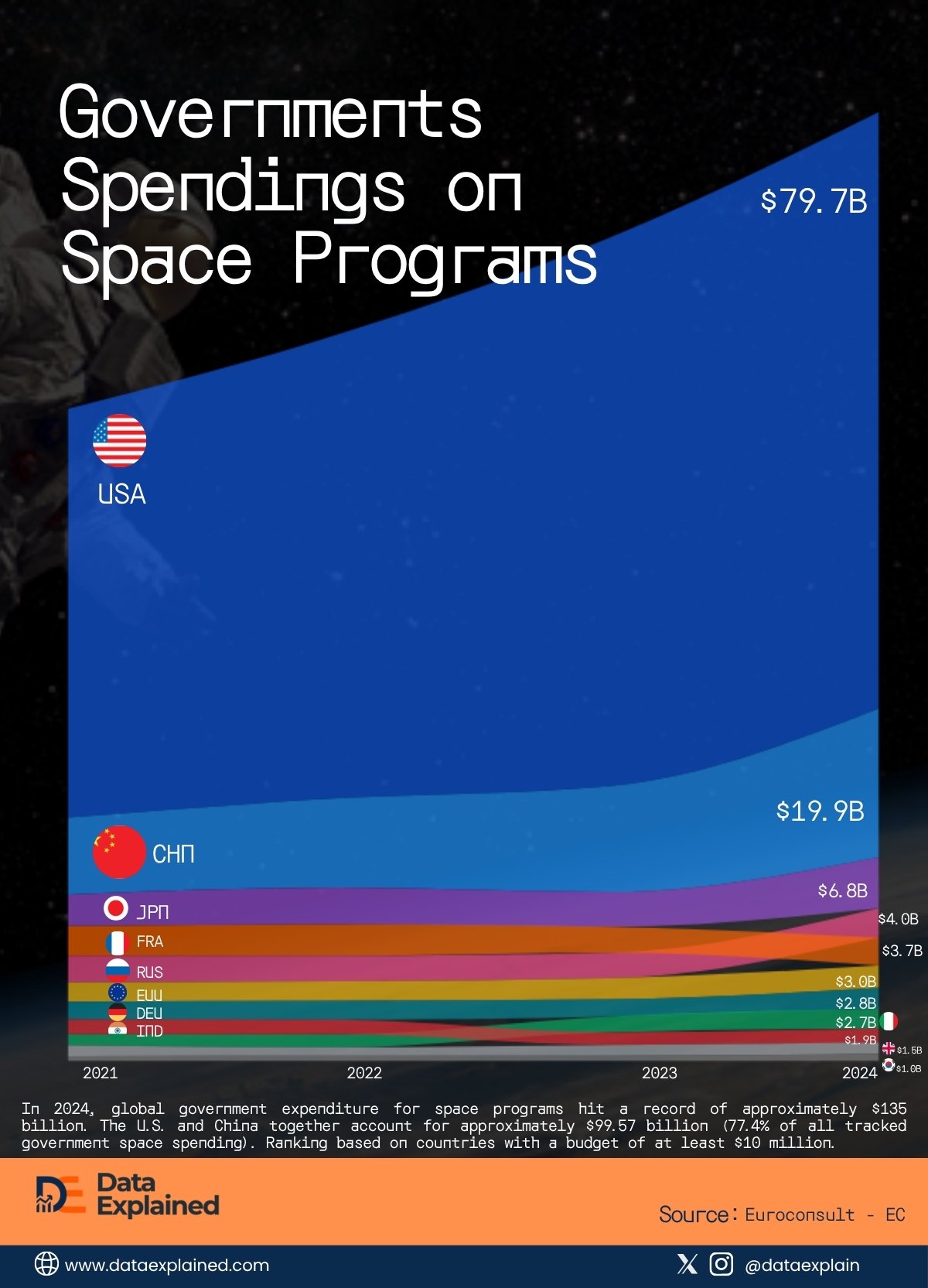
Today’s visualization shows government expenditure on space programs. It comes from the Euroconsult-EC (now Novaspace).
The dataset tracks government space program expenditure in billion USD across 11 countries from 2021 through 2024. It covers only countries with a budget of at least $10 million.
TL;DR
- In 2024, global government expenditure for space programs hit a record of approximately $135 billion.
- The U.S. and China together account for approximately $99.57 billion (77.4% of all tracked government space spending). The remaining nine entries share the other 22.6%.
| wdt_ID | wdt_created_by | wdt_created_at | wdt_last_edited_by | wdt_last_edited_at | Countries | 2021 ($bn) | 2022 ($bn) | 2023 ($bn) | 2024 ($bn) |
|---|---|---|---|---|---|---|---|---|---|
| 1 | emmanuel-ashemiriogwa | 07/04/2026 09:40 AM | emmanuel-ashemiriogwa | 07/04/2026 09:40 AM | United States | 54.59 | 61.97 | 73.20 | 79.68 |
| 2 | emmanuel-ashemiriogwa | 07/04/2026 09:40 AM | emmanuel-ashemiriogwa | 07/04/2026 09:40 AM | China | 10.29 | 11.94 | 14.15 | 19.89 |
| 3 | emmanuel-ashemiriogwa | 07/04/2026 09:40 AM | emmanuel-ashemiriogwa | 07/04/2026 09:40 AM | Japan | 4.21 | 4.90 | 4.65 | 6.80 |
| 4 | emmanuel-ashemiriogwa | 07/04/2026 09:40 AM | emmanuel-ashemiriogwa | 07/04/2026 09:40 AM | Russia | 3.57 | 3.42 | 3.41 | 3.96 |
| 5 | emmanuel-ashemiriogwa | 07/04/2026 09:40 AM | emmanuel-ashemiriogwa | 07/04/2026 09:40 AM | France* | 3.95 | 4.20 | 3.47 | 3.71 |
| 6 | emmanuel-ashemiriogwa | 07/04/2026 09:40 AM | emmanuel-ashemiriogwa | 07/04/2026 09:40 AM | European Union* | 2.57 | 2.60 | 2.81 | 2.98 |
| 7 | emmanuel-ashemiriogwa | 07/04/2026 09:40 AM | emmanuel-ashemiriogwa | 07/04/2026 09:40 AM | Germany* | 2.38 | 2.53 | 2.29 | 2.78 |
| 8 | emmanuel-ashemiriogwa | 07/04/2026 09:40 AM | emmanuel-ashemiriogwa | 07/04/2026 09:40 AM | Italy* | 1.48 | 1.74 | 2.11 | 2.65 |
| 9 | emmanuel-ashemiriogwa | 07/04/2026 09:40 AM | emmanuel-ashemiriogwa | 07/04/2026 09:40 AM | India | 1.96 | 1.93 | 1.69 | 1.89 |
| 10 | emmanuel-ashemiriogwa | 07/04/2026 09:40 AM | emmanuel-ashemiriogwa | 07/04/2026 09:40 AM | United Kingdom | 1.46 | 1.15 | 1.45 | 1.46 |
CONTEXT MATTERS HERE:
Today, there are six government space agencies with full launch and extraterrestrial landing capabilities:
- National Aeronautics and Space Administration (NASA)
- China National Space Administration (CNSA)
- Roscosmos State Corporation for Space Activities (Russia) (ROSCOSMOS)
- European Space Agency (ESA)
- Indian Space Research Organization (ISRO)
- Japan Aerospace Exploration Agency (JAXA)
NASA is undoubtedly the most renowned of them all. The requested FY 2024 budget for all sectors is $27.2 billion.
One Country, One Mission, One Number
According to Euroconsult-EC data, the ten other major space-spending nations combined (China, Japan, Russia, France, the European Union, Germany, Italy, India, the United Kingdom, and South Korea) spent approximately $48.9 billion on space in 2024.
The United States spent $79.68 billion.
America outspent the entire rest of the tracked world by nearly $31 billion in a single year.
The gap between what the U.S. spends and what its nearest rival spends is itself larger than the sum of what everyone else spends.
China, the second-largest space spender globally at $19.89 billion in 2024, is separated from the United States by $59.79 billion (a dollar difference bigger than the combined space budgets of the other nine countries on the list).
Artemis II is what that financial asymmetry produces at the frontier.
The Race Behind the Mission
China’s space budget has grown faster than any other major space power in the dataset.
From $10.29 billion in 2021 to $19.89 billion in 2024, Beijing nearly doubled its space spending in three years (a 93.3% increase).
The United States grew its own budget by approximately 46% over the same period, from $54.59 billion to $79.68 billion.
The absolute gap remains vast.
But China has announced crewed lunar landing ambitions for the late 2020s, and the budget trajectory is the clearest signal of how seriously those ambitions should be taken.
Japan ranks third globally at $6.8 billion in 2024, up 61.5% from $4.21 billion in 2021 (the largest absolute dollar increase among all tracked nations outside the U.S. and China).
Japan’s H3 rocket program, its SLIM lunar lander mission, and its deepening partnership with NASA through the Artemis Accords are the programmatic outputs of that growth.
Japan is quietly becoming the most capable space power in the world outside the top two.
The Country That Started the Race
Russia spent $3.96 billion on space projects in 2024.
Its budget has been essentially flat since 2021, edging between $3.41 billion and $3.96 billion over four years, while every other major program has grown.
Russia launched Sputnik. It sent the first human into space. For decades, it operated the most capable space program on Earth.
It now spends less than Japan and less than France, and its annual space budget has been compressed by war expenditure, economic sanctions, and fiscal contraction to a figure that Italy (at $2.65 billion) is approaching from below.
Roscosmos is no longer running the space race. The data makes that plain.
What about Canada?
One of the four astronauts currently orbiting the Moon, Jeremy Hansen, represents Canada, a country not present in this dataset.
Canada’s individual space budget falls below the $10 million minimum threshold for separate listing in the Euroconsult-EC data.
Canada’s contribution to Artemis is not financial at the headline scale. It is technological.
The Canadarm3 robotic system, a contribution of engineering capability rather than budget mass.
Bigger Picture
Total tracked government space spending across all 11 countries grew from approximately $96 billion in 2021 to approximately $128.6 billion in 2024, a 33.9% increase in three years.
The world is spending more on space every year at an accelerating pace.
Source:
Euroconsult (now Novaspace)