
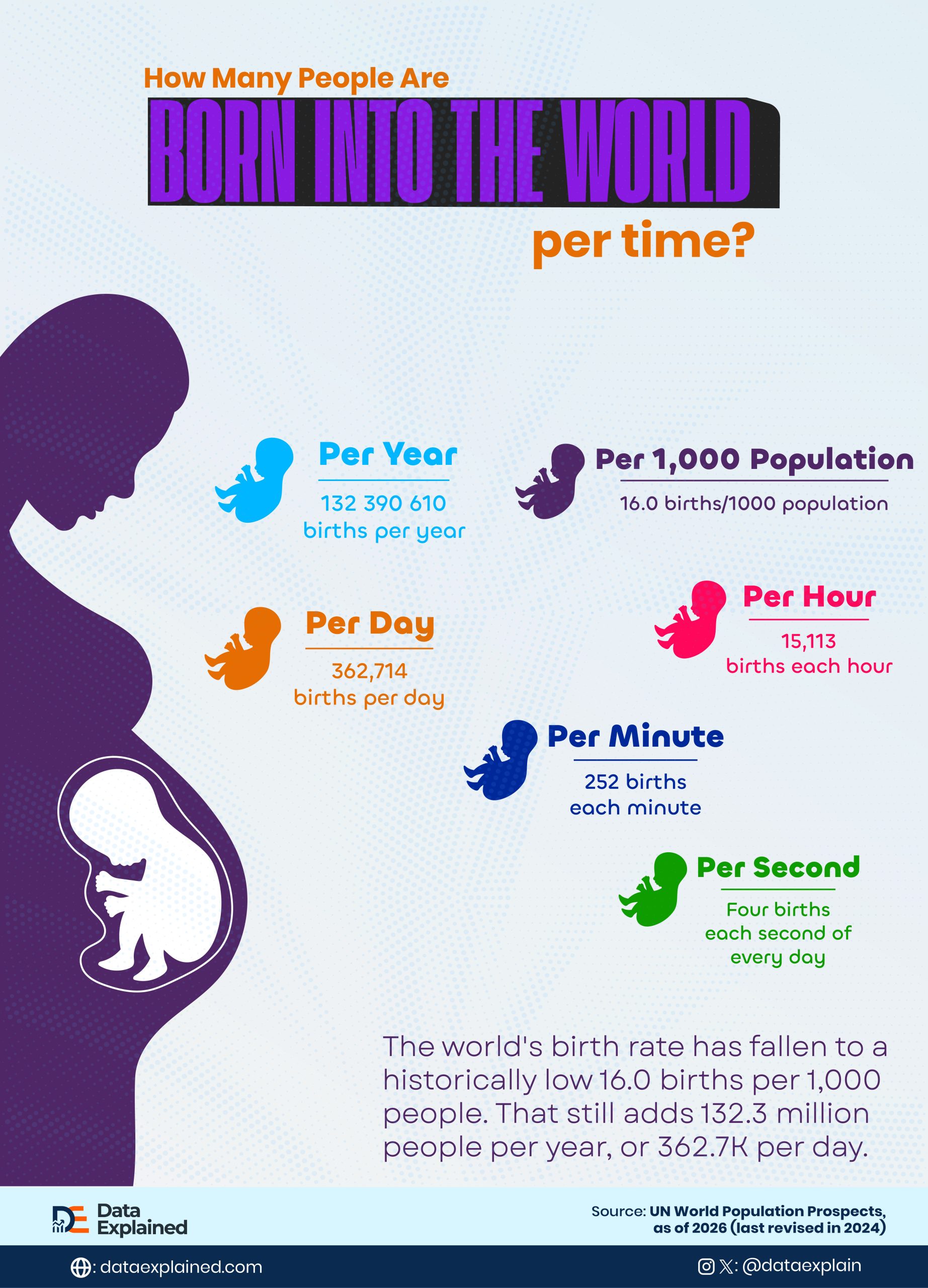
A falling global birth rate still adds 362,714 people to the world every single day.
The global rate is 16.0 births per 1,000 people, a historically low number, which translates to a daily total larger than the population of most mid-sized American cities.
The visualization above presents key data on the number of people born each day, based on information from the United Nations World Population Prospects, as of 2026 (last revised in 2024).
TL;DR
- The world’s birth rate has fallen to a historically low 16.0 births per 1,000 people
- That still adds 132,390,610 people a year, or 362,714 a day.
- A falling rate and a genuinely massive raw number can both be true at the same time
| wdt_ID | wdt_created_by | wdt_created_at | wdt_last_edited_by | wdt_last_edited_at | Timeframe | Birth Rate Value |
|---|---|---|---|---|---|---|
| 1 | Monica Ebunoluwa | 25/08/2026 04:27 PM | Monica Ebunoluwa | 25/08/2026 04:27 PM | Per Year | 132,390,610 births per year |
| 2 | Monica Ebunoluwa | 25/08/2026 04:27 PM | Monica Ebunoluwa | 25/08/2026 04:27 PM | Per 1,000 Population | 16.0 births per 1000 population |
| 3 | Monica Ebunoluwa | 25/08/2026 04:27 PM | Monica Ebunoluwa | 25/08/2026 04:27 PM | Per Day | 362,714 births per day |
| 4 | Monica Ebunoluwa | 25/08/2026 04:27 PM | Monica Ebunoluwa | 25/08/2026 04:27 PM | Per Hour | 15,113 births each hour |
| 5 | Monica Ebunoluwa | 25/08/2026 04:27 PM | Monica Ebunoluwa | 25/08/2026 04:27 PM | Per Minute | 252 births each minute |
| 6 | Monica Ebunoluwa | 25/08/2026 04:27 PM | Monica Ebunoluwa | 25/08/2026 04:27 PM | Per Second | Four births each second of every day |
Note: Figures represent a live, continuously updating calculation, not a fixed historical count.
Broken down further, the annual figure of 132,390,610 births works out to 15,113 per hour, 252 per minute, and roughly 4 per second.
Each of those numbers is simply the same annual total divided down into a smaller unit of time- one fact, expressed at five different scales.
Why a Low Rate Still Adds Up Fast
A rate of 16.0 per 1,000 sounds small on its own, and historically, it is.
Global birth rates sat well above 30 per 1,000 as recently as the 1970s. But that rate is multiplied by a global population of roughly 8.2 billion, and even a modest rate applied to a population that size still produces enormous raw numbers.
Multiply it out and the daily total, 362,714, comes out larger than the population of most mid-sized American cities, added to the world in a single day.
Zoomed out to the yearly figure, 132.4 million people are born globally each year, close to the entire population of Japan, one of the world’s most populous countries, born again from scratch every twelve months.
What a Single Global Number Can’t Show
A global average of 16.0 births per 1,000 does not reflect any single country’s actual experience.
Some countries post rates well above 30 per 1,000; others sit near or below the point where a population simply replaces itself over time.
The global number is real, but it’s an average smoothing over enormous variation underneath it.
It’s also only half the picture needed to understand population growth.
Births alone don’t tell you whether the world’s population is rising, falling, or holding steady. That requires weighing this figure against the global death rate too.
A birth-rate table on its own describes how many people are arriving, not the net change in the population.
There’s a simpler way to think about scale here, too. At a rate of 16.0 per 1,000, roughly 1 in every 60 people alive today was born within just the past year.
ELI5
The world’s birth rate is at a historic low, but it still adds about 362,000 people every day because the global population is so large that even a lower rate produces a huge number.
Roughly four babies are born every second somewhere in the world, and about 132 million are born every year, close to the population of Japan.
Source: